Last Updated on September 1, 2021 at 12:25 pm
Do you know what your investing growth rate is? No, I am not asking about your investment growth rate or CAGR. I am referring to your investing CAGR – the rate at which your investments have increased over a period of time.
When I made my first retirement calculator about 6/7 years ago, the first thing I realized was the importance of adding the rate at which investments increase as an input. There is a ‘good side’ to this and a ‘bad side’ to this. Which is what I would like to discuss in this post.
The wealth we create is primarily determined by how much we invest.
Here is a comparison of a constant SIP of Rs. 5000 in ICICI Prudential Discovery Fund versus a step-up SIP of Rs. 5000 increasing each year by 10%.
🔥Secure your future with our Robo-advisory tool trusted by over 3,500 investors and advisors. From effortless retirement planning to funding your children’s biggest dreams, turn your financial goals into reality. 🔥
Subscribe for money management solutions via email! (Link takes you to our email sign-up form) Join 32,000+ readers in our community.
👉 New Tool Alert! NaviPlan: A Privacy-Focused Multi-asset Tracker and Goal Planner 👈
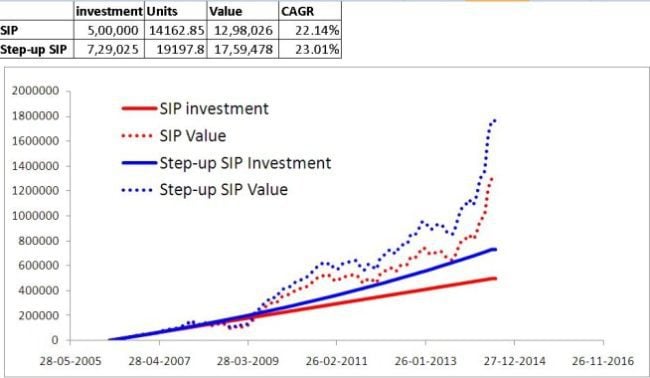
A systematic investment is a simple way to generate a corpus. A systematic increase in the systematic investment helps build a much bigger corpus.
Download the Step-up SIP Calculator
Download the Step-up SIP Backtesting Simulator
Now here is something even more amazing (at least for a start).
A 30 year requiring 30,000 a month in todays money 25 years later, needs to invest about 50,000 a month to create a retirement corpus
Assumptions: inflation – 8%, equity return =12%, debt return – 8%, post-retirement portfolio return =8%, 25 years in retirement. Chosen just for illustration. You are enter more reasonable inputs here: The low-stress retirement calculator (hopefully!)
Not many people can invest more than they spend and that too just for retirement! So an attractive alteranative is to assume that we can invest more gradually.
For the above inputs, if I assume a 5% increase in investment, the initial monthly investment drops to ~33,500. For a 10% increase, it becomes ~20,500! Hang on a minute! What is the catch?
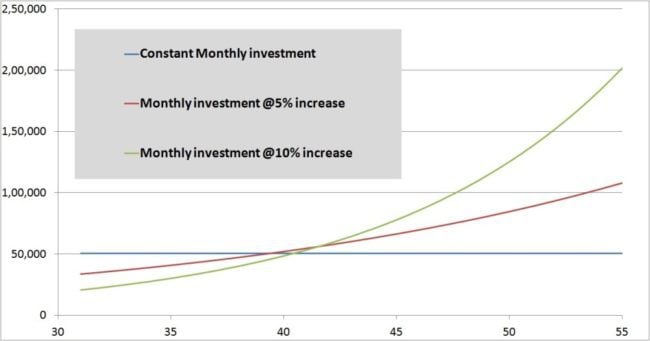
For the first 10 years or so, this approach looks better than the constant investment method. After that …! Every ten years or so, the investment amount must be doubled!
So this will work only if income increases at a decent pace and new recurring expenses (lifestyle creep) are manageable.
I have been adopting this approach since 2010-11 – about 10% increase in investment for all financial goals each year. So far I am fortuitous enough to have an investing CAGR better than this 10%, but it has been tough and will continue to remain so.
Someone said that the ‘best vice is advice’, but I will stick my neck out and a jot a few thoughts for young earners to ponder:
- invest as much as possible when you don’t have expenses related to health (typically that of parents)
- increase the investment amount as often as possible.
- If can keep this up for the first 5/6 years of your career,
- you could with retire early or
- not be affected if investment decrease due to reasons beyond your control down the line
In other words, make hay while the sun shines.
You can calculate your investing CAGR in the following way
Suppose you invested 15,000 a month, 5 years ago and you are now investing 24,000 a month,
investing CAGR=(24000/15000)^(1/5)-1 ~ 10%
Do give this a try and check if that rate of growth is sufficient for your financial goals.