Last Updated on September 4, 2018 at 9:58 am
Worried about turbulent markets? Thinking about stopping your stopping your SIP instruments? If you believe that our economy is bound to grow and that we should profit from it, I would strongly suggest that you do not stop your SIPs or equity investments now. Instead use the time to accumulate more units.
Let us track the XIRR of a SIP in Franklin India Blue Chip Fund from 3rd June. 1996 to 3rd Feb 2016. A total of 228 installments spread over nearly 20 years! This post was first published on May 2nd 2015 and has now been updated. I thank fee-only financial planner Melvin Joseph for suggesting I write about SIP volatility and why investors should not stop their SIPs now.
The XIRR of the investment is computed at each SIP date. That is, each month. XIRR as you may know, is representative of the average rate at which the instruments compounds each year.
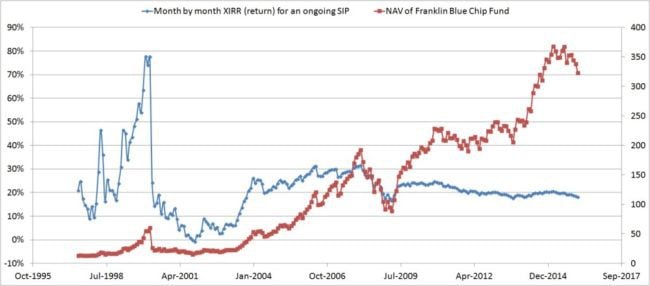
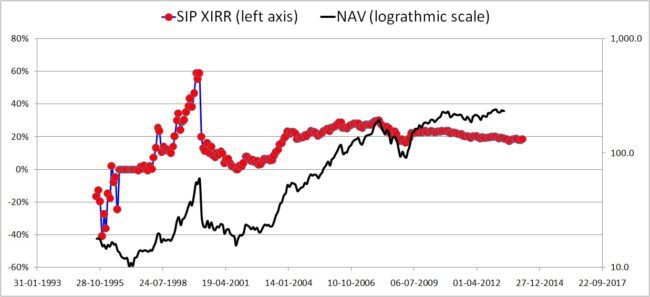
Notice how closely the XIRR mimics NAV movement. Notice the volatility in XIRR. You need nerves of steel to handle equity, and we are talking about a blue chip fund!! God bless those with ‘aggressive risk appetites’!
🔥Secure your future with our Robo-advisory tool trusted by over 3,500 investors and advisors. From effortless retirement planning to funding your children’s biggest dreams, turn your financial goals into reality. 🔥
Subscribe for money management solutions via email! (Link takes you to our email sign-up form) Join 32,000+ readers in our community.
👉 New Tool Alert! NaviPlan: A Privacy-Focused Multi-asset Tracker and Goal Planner 👈
I think the sharp drop around 2000 is related to the dot com crash (correct me if I am wrong). That is a bigger crash for FIBCF than 2008.
The XIRR reacts sharply in both instances but is higher in 2000 – much higher. It is tempting to think that this is because the SIP is much older in 2008(see below), but I think the stocks that the fund held during both times is also important to consider.
In Oct 2001, after 6+ years and 74 SIP installments, FIBCF had an XIRR of ….. 0%
SIPS will not help you during a sideways market! All well to say, ‘if you have held on for so many years, you will be rewarded’. Can you really blame an investor if he/she runs away from equity after 6 years of patience!
It is only during the start of the last bull run that FIBCF started to deliver. Since Nov. 2003 to April 2014, the average XIRR was 22.27%. Not bad at all.
Even the fall during the 2008 crash, though significant, was not alarming.
Question is, if I continue my SIP though one market cycle (bull run followed by bear run or bear run followed by bull run ), will the volatility in XIRR reduce?
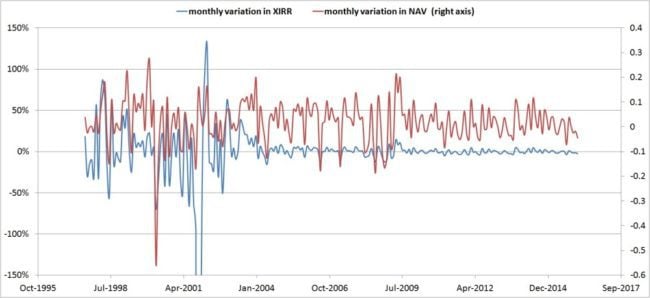
This data certainly suggest so. The monthly change in NAV is pretty much constant for the entire duration. The monthly change in XIRR is violent to start with drops to a low number after about 9 years.
Does this mean, older the SIP, less the volatility? The volatility around the 2008 crash is not visible! For an investor who had braved the sideways market after the Harshad Mehta scam and the dot-com crisis, the 2008 crash would like chicken feed.
Is because of fund management or because of the SIP? Hard to tell. Even if it has nothing to do with a SIP, it is still encouraging stuff.
I strongly believe that If I let my dull and boring SIPs continue, things should hopefully get better. Continue in the above example is about 10Y after which the next 9 years were pretty good.
So rain or shine, don’t worry about short-term market movements. keep Calm and MDBSC on!
Here is an illustration by Melvin. Consider two mutual funds. One whose NAV movement is linear and another which is volatile.
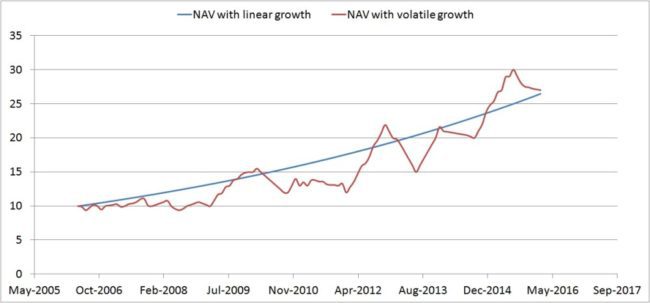
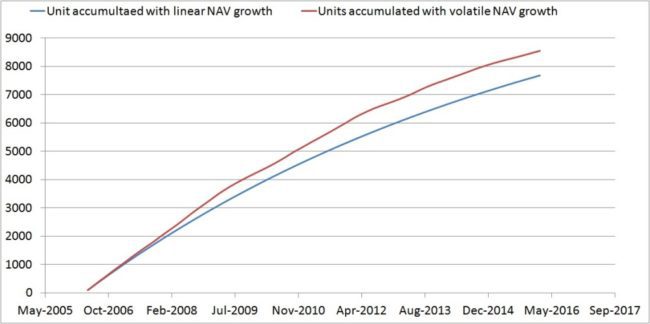
As long the volatile mutual funds, moves north, the investor will get a higher corpus because more units are purchased when the NAV dips. This is of course, a simplistic illustration. The point is that it pays to stay invested during turbulent times. If you think our economy will grow and our GDP will grow, that will sooner or later get reflected in the market movement.