A reader asks, “Sir, What return should I use while planning for retirement? I wish to retire by age 55. I am currently 35 years of age”.
Many people make two mistakes while planning their finances. The first common mistake is presuming that equity mutual funds provide a 12% (or more!) return and utilizing that figure to calculate the necessary investment amount. Regrettably, this approach entirely disregards asset allocation and the reality that investing 100% in equity is not feasible.
Even those considering asset allocation assume that the same weightage of equity and fixed income will persist until the need arises. We must appreciate that the asset allocation will not remain fixed in time. For example, the 30Y old can start investing 60% in equity and 40% in fixed income.
This ratio should not remain the same until he hits 55. That would be like leaving the fate of his hard-earned money in the hands of luck. In order to combat unknown market returns (aka sequence of returns risk), the equity allocation must be continuously tapered throughout the investment journey.
Also, return expectations vary with inflation. In the early 2000s, assuming a 15% equity return for “long term goals” seemed reasonable. Today 12% seems high! See: Ten-year Nifty SIP returns have reduced by almost 50%.
🔥Secure your future with our Robo-advisory tool trusted by over 3,500 investors and advisors. From effortless retirement planning to funding your children’s biggest dreams, turn your financial goals into reality. 🔥
Subscribe for money management solutions via email! (Link takes you to our email sign-up form) Join 32,000+ readers in our community.
👉 New Tool Alert! NaviPlan: A Privacy-Focused Multi-asset Tracker and Goal Planner 👈
Considering taxation and lower inflation estimates in the long term, we suggest estimating 9-10% post-tax returns for equity investments. This recommendation often surprises individuals, leading them to question the rationale behind investing in equity if the returns are only 9-10%.
The answer is that fixed-income returns are also proportionately decreasing and will continue to fall over the long term, even though some spikes are due to inflation (and elections!).
So we recommend using not more than 7% from fixed income (even if tax-free!) and 5-6% if the product is taxed. The change in the debt fund tax rule from 1st April 2023 is a further blow, and we have proportionately lowered our expectations.
So for a 60% equity and 40% fixed income mix, the expected portfolio return (approximately) is (60% x 10%) + (40% x 6%) ~ 8.5% (approx). This is only the initial asset allocation and return expectation.
The freefincal robo advisory tool auto-generates the recommended asset allocation values at different stages of the investment journey. The user can change all assumptions (returns, inflation etc.). This is a freefincal robo advisory tool screenshot showing the suggested asset allocation (left image) and change in assumed portfolio return for a 35Y old wishing to retire at 55.
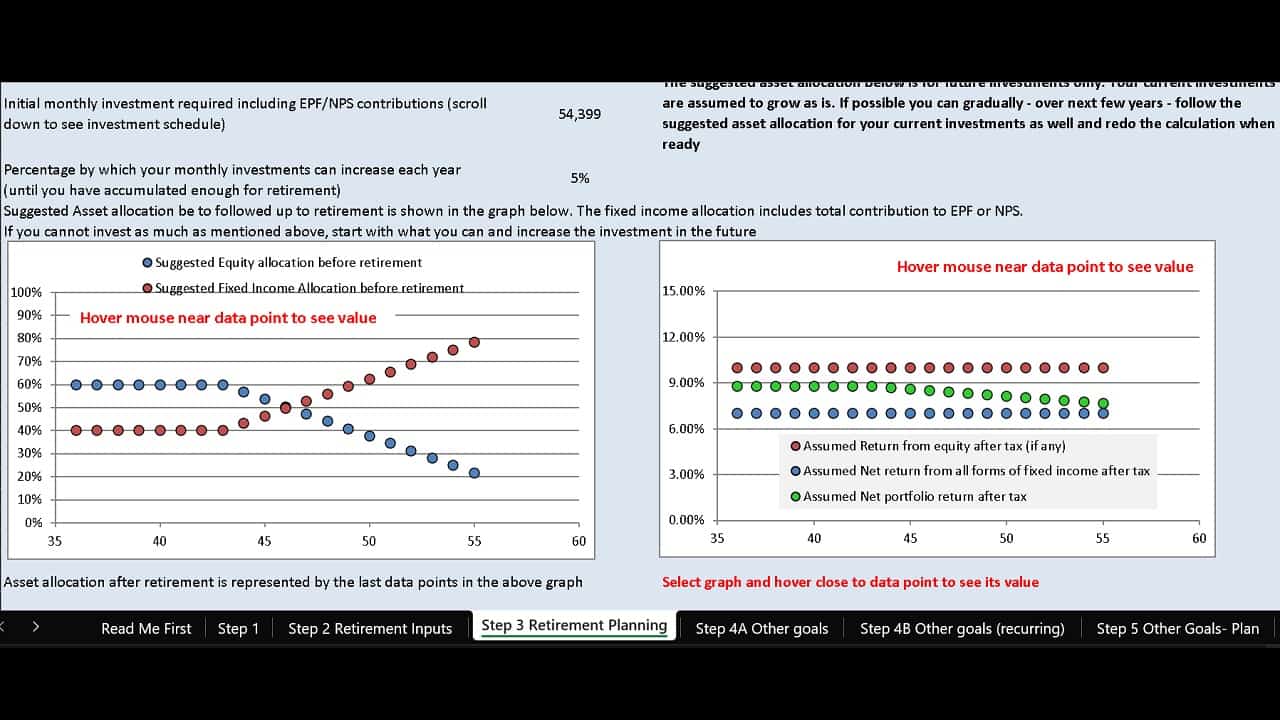
The equity allocation starts at 60% but starts decreasing gradually to 22% from the early 40s. This ensures the corpus is unaffected by a prolonged stretch of poor returns. This model has been extensively backtested to handle a wide variety of market fluctuations. See, for example: Why Understanding Sequence Risk is Crucial for Investing Success! And this video.
This also means that the returns from the entire portfolio change. This must be factored into the investment amount needed from day one (which the robo tool does).
A full retirement planning illustration with post-retirement inflation-protected income generation via a five-bucket strategy is available here: I am 30 and wish to retire by 50; how should I plan my investments?
In conclusion, an investor should never rely on a single return value for any asset class or the entire portfolio throughout the investment period. The asset allocation and its fluctuations will influence the variation in returns. Maintaining modest return expectations from equity and fixed-income investments is advisable. And these expectations must be revised from time to time as per changes in tax rules and economic conditions.