What’s your retirement SWP strategy going to be? A 2005 vs. 2008 Case Study

Published: May 19, 2026 at 6:00 am

Most retirement planning focuses on the “Magic Number”—the total corpus. But the day you stop working, the game changes. You stop getting credited on the 1st of the month, which helps you meet all your expenses. Instead, you need to plan to get that money into your account from the corpus you have accumulated. To meet monthly cashflow requirements, retirees can rely on:

  • Interest
  • Dividends
  • Rental income
  • SWP

Unless the corpus is very high, such that only interest, dividends, or rental income can meet your requirements, an SWP will be required at some stage. Also, interest income often remains static, whereas expenses grow due to inflation, making capital redemptions a necessity.

About the author: Jay Sheth, SEBI Registered Investment Adviser and a member of Fee-only India, a group of fixed-fee-only advisors. He can be contacted via his website shwealth.in.

For retirement planning, most of the strategy centres around the allocation between monthly inflows coming from fixed income or redemptions (SWP) and the allocation between debt and equity. Too high an allocation to debt, and your corpus may not grow enough or fall short; a very high allocation to equity may necessitate early withdrawals, thereby increasing the risk of capital erosion in the event of a sequence of bad returns.

In this blog, we will see historically how an SWP would have played out if a person retired between 2005 and 2008 with a corpus of INR 50 lakh, an initial withdrawal rate of 4%, and expenses growing at 6% p.a.

🔥Secure your future with our Robo-advisory tool trusted by over 3,000 investors and advisors. From effortless retirement planning to funding your children’s biggest dreams,  turn your financial goals into reality.🔥

Subscribe for money management solutions via email! (Link takes you to our email sign-up form) Join 32,000+ readers in our community.

The following chart shows the corpus if the entire amount were allocated to a single asset class (Gold, Nifty 100, Nifty Midcap 150, Nifty Smallcap 250, S&P 500, or G-Sec 10-Year). A hypothetical balanced portfolio (B Folio in the chart) is also created, assuming a 10% allocation to gold, 30% to Nifty 100, 10% to the Midcap index, 5% to the smallcap index, 10% to the S&P 500, and 30% to G-Sec.
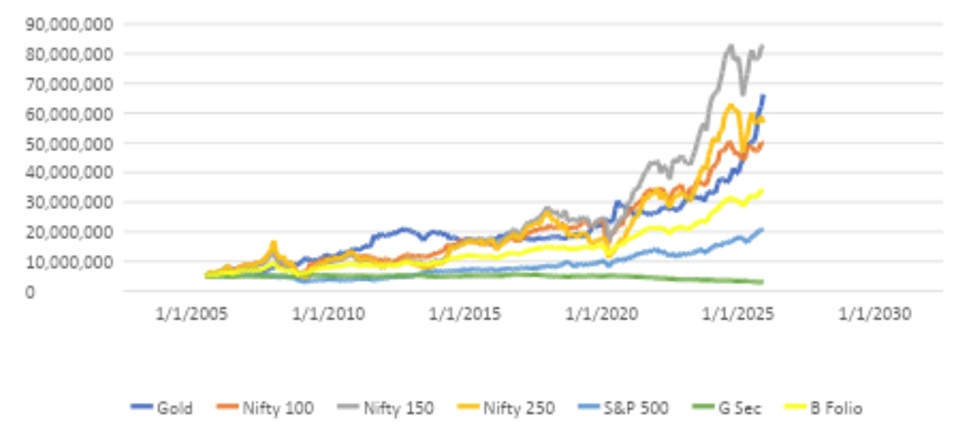
Evolution of various assets for retirement from 2005 - scenario one
Evolution of various assets for retirement from 2005 – scenario one

What we can see here is that if the corpus were invested 100% in any asset class, it would have grown substantially in value despite the monthly withdrawals. The required withdrawal rate as of 2025 would drop to 0.8%–1.9% across all asset classes except G-Sec. This would suggest that putting everything into equity could be a good idea; however, let us now look at how the corpus changes over the years if we keep the same assumptions, but assume the retirement instead started in January 2008.
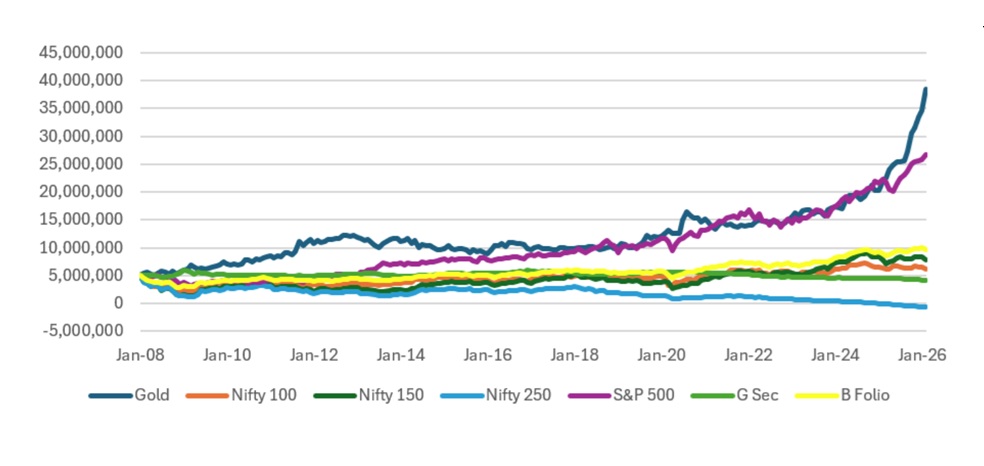
Evolution of various assets for retirement from 2008 - scenario two
Evolution of various assets for retirement from 2008 – scenario two

The scenario would have changed completely had the SWP begun in 2008. If everything were put into the Smallcap 250 index, the corpus would have been exhausted by the end of 2024. The midcap corpus, which was shining if the retirement SWP started in 2005, now struggles significantly. We now see the merit of having a balanced portfolio, which would have outperformed all Indian equities for most of the 17-year period. The balanced portfolio would have barely doubled over 17 years, and the required withdrawal rate would rise to 6.8%. This emphasises the need to rebalance rather than to follow a fixed withdrawal strategy for each asset class.

Now, let us see what happens if we had a bucket strategy and gave equity time to grow rather than withdrawing immediately. Let us assume retirement in 2005, with 50% of the corpus going to debt (G-Sec) and 50% to equity (Nifty 100). For the first 3 years, withdrawals are made only from debt. Since 2008 (when the sequence of bad returns began), all withdrawals have been shifted to equity. Ideally, 4–5 years of expenses should be kept in debt before tapping equity; however, a 3-year timeframe is taken here so that withdrawals begin exactly in 2008 when the bad sequence of returns starts. Also, for simplicity, only Nifty 100 and G-Sec are considered; in reality, there could be additional buckets of FDs, hybrid mutual funds, etc.

In this scenario, the equity base would have increased from INR 25 lakh in 2005 to INR 78 lakh in 2008, providing a much higher base to sustain the bad sequence of returns. If withdrawals from equity had continued, the corpus by the end of 2025 would have been INR 2.4 crore (debt plus equity), with a withdrawal rate of only 2.8% required after 20 years—indicating enough cushion for the corpus to last a lifetime.

Looking at both the charts, it may seem like gold is the real winner among all the asset classes. However, it is more a case of timing. If we were to assume retirement and SWP from 2013, all Indian equities and the S&P 500 would have comfortably outperformed Gold, assuming the same SWP annually.  

Conclusion

Retirement planning requires careful consideration of asset-class allocations, an appropriate withdrawal strategy, and tactical rebalancing. Predicting highs and lows of asset classes is futile; it is better to be well diversified and have a bucketing strategy.

Note: Tax and transaction costs have not been considered during redemptions. All returns are historical pre-tax.

Disclaimer: Nothing in this article is my solicitation, recommendation, endorsement or offer. Past performance of an index, individual asset class, or combination of asset classes is no guarantee of future returns or risks. We do not take any responsibility for investment decisions based on this article. Please consult your advisor before taking any investment decisions. Registration granted by SEBI, BASL membership, and NISM certification do not guarantee the intermediary’s performance or provide any assurance of returns to investors. Investment in the securities market is subject to market risks. Read all the related documents carefully before investing.

Do share this article with your friends using the buttons below.
Use this button to add freefincal.com as a preferred source of personal finance on Google News
google preferred source button
Click to add freefincal as a Google preferred source
Use our Robo-advisory Tool to create a complete financial plan! More than 3,000 investors and advisors use this!  Use the discount code: robo25 for a 20% discount. Plan your retirement (early, normal, before, and after), as well as non-recurring financial goals (such as child education) and recurring financial goals (like holidays and appliance purchases). The tool would help anyone aged 18 to 80 plan for their retirement, as well as six other non-recurring financial goals and four recurring financial goals, with a detailed cash flow summary.
🔥You can also avail massive discounts on our courses and the freefincal investor circle! 🔥& join our community of 8000+ users!
Track your mutual funds and stock investments with this Google Sheet!
We also publish monthly equity mutual funds, debt and hybrid mutual funds, index funds, and ETF screeners, as well as momentum and low-volatility stock screeners.

You can follow our articles on Google News

Follow Freefincal on Google News

We have over 1,000 videos on YouTube!

Subscribe to the freefincal Youtube Channel. Subscribe button courtesy: Vecteezy.
Subscribe to the freefincal YouTube Channel.

Join our WhatsApp Channel

Follow freefincal on WhatsApp Channel
Follow freefincal on WhatsApp
Podcast: Let's Get RICH With PATTU! Every single Indian CAN grow their wealth! 
Listen to the Lets Get Rich with Pattu Podcast
Listen to the Let's Get Rich with Pattu Podcast
You can watch podcast episodes on the OfSpin Media Friends YouTube Channel.
Lets Get RICH With PATTU podcast on YouTube
Let's Get RICH With PATTU podcast on YouTube.
🔥Now Watch Let's Get Rich With Pattu தமிழில் (in Tamil)! 🔥
  • Do you have a comment about the above article? Reach out to us on Twitter: @freefincal or @pattufreefincal
  • Have a question? Subscribe to our newsletter using the form below.
  • Hit 'reply' to any email from us! We do not offer personalised investment advice. We can write a detailed article without mentioning your name if you have a generic question.

Join 32,000+ readers and get free money management solutions delivered to your inbox! Subscribe to get posts via email! (Link takes you to our email sign-up form)


About The Author

Pattabiraman editor freefincalDr M. Pattabiraman (PhD) is the founder, managing editor and primary author of freefincal. He is an associate professor at the Indian Institute of Technology, Madras. He has over 13 years of experience publishing news analysis, research and financial product development. Connect with him via Twitter(X), LinkedIn, or YouTube. Pattabiraman has co-authored three print books: (1) You can be rich too with goal-based investing (CNBC TV18) for DIY investors. (2) Gamechanger for young earners. (3) Chinchu Gets a Superpower! for kids. He has also written seven other free e-books on various money management topics. He is a patron and co-founder of “Fee-only India,” an organisation promoting unbiased, commission-free, AUM-independent investment advice.
Our flagship course! Learn to manage your portfolio like a pro to achieve your goals regardless of market conditions! More than 3,500 investors and advisors are part of our exclusive community! Get clarity on how to plan for your goals and achieve the necessary corpus no matter the market condition!! Watch the first lecture for free!  One-time payment! No recurring fees! Life-long access to videos! Reduce fear, uncertainty and doubt while investing! Learn how to plan for your goals before and after retirement with confidence.
Increase your income by getting people to pay for your skills! More than 800 salaried employees, entrepreneurs and financial advisors are part of our exclusive community! Learn how to get people to pay for your skills! Whether you are a professional or small business owner seeking more clients through online visibility, or a salaried individual looking for a side income or passive income, we will show you how to achieve this by showcasing your skills and building a community that trusts and pays you. (watch 1st lecture for free). One-time payment! No recurring fees! Life-long access to videos!   
Our book for kids: “Chinchu Gets a Superpower!” is now available!
Both boy and girl version covers of Chinchu gets a superpower
Both the boy and girl-version covers of "Chinchu Gets a superpower".
Most investor problems can be traced to a lack of informed decision-making. We made bad decisions and money mistakes when we started earning and spent years undoing these mistakes. Why should our children go through the same pain? What is this book about? As parents, what would it be if we had to groom one ability in our children that is key not only to money management and investing but to any aspect of life? My answer: Sound Decision Making. So, in this book, we meet Chinchu, who is about to turn 10. The narrative revolves around what he wants for his birthday and how his parents plan for it, as well as teaching him several key ideas of decision-making and money management. What readers say!
Feedback from a young reader after reading Chinchu gets a Superpower (small version)
Feedback from a young reader after reading Chinchu gets a Superpower!
Must-read book even for adults! This is something that every parent should teach their kids right from their young age. The importance of money management and decision making based on their wants and needs. Very nicely written in simple terms. - Arun.
Buy the book: Chinchu gets a superpower for your child!
How to profit from content writing: Our new ebook is for those interested in getting a side income via content writing. It is available at a 50% discount for Rs. 500 only!
Do you want to check if the market is overvalued or undervalued? Use our market valuation tool (it will work with any index!), or get the Tactical Buy/Sell timing tool!
We publish monthly mutual fund screeners and momentum, low-volatility stock screeners.
About freefincal & its content policy. Freefincal is a News Media organisation dedicated to providing original analysis, reports, reviews and insights on mutual funds, stocks, investing, retirement and personal finance developments. We do so without conflict of interest and bias. Follow us on Google News. Freefincal serves more than three million readers a year (5 million page views) with articles based only on factual information and detailed analysis by its authors. All statements made will be verified with credible and knowledgeable sources before publication. Freefincal does not publish paid articles, promotions, PR, satire or opinions without data. All opinions will be inferences backed by verifiable, reproducible evidence/data. Contact Information: To get in touch, please use our contact form. (Sponsored posts or paid collaborations will not be entertained.)
Connect with us on social media
Our publications

You Can Be Rich Too with Goal-Based Investing

You can be rich too with goal based investingPublished by CNBC TV18, this book is designed to help you ask the right questions and find the correct answers. Additionally, it comes with nine online calculators, allowing you to create custom solutions tailored to your lifestyle. Get it now.
Gamechanger: Forget Startups, Join Corporate & Still Live the Rich Life You Want Gamechanger: Forget Start-ups, Join Corporate and Still Live the Rich Life you wantThis book is designed for young earners to get their basics right from the start! It will also help you travel to exotic places at a low cost! Get it or gift it to a young earner.

Your Ultimate Guide to Travel

Travel-Training-Kit-Cover-new This is an in-depth exploration of vacation planning, including finding affordable flights, budget accommodations, and practical travel tips. It also examines the benefits of travelling slowly, both financially and psychologically, with links to relevant web pages and guidance at every step. Get the PDF for Rs 300 (instant download)