Last Updated on June 3, 2016 at 8:40 pm
If we ‘hold’ equity for the ‘long term’ are we assured of beating inflation with a real return? Will equity beat all other asset classes if we wait long enough? Will long-term equity investing always be successful?
Equity as an asset class is sold to investors with an ‘yes’ to such questions. Sold either directly or indirectly via all types of media. Yesterday, the nifty valuation charts showed us that the average values of PE,PB and dividend yield are changing as each day goes by. I would like to dwell on this theme of change for the next couple of days.
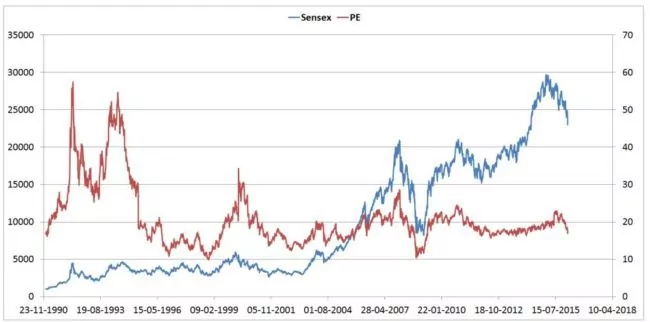
Notice the evolution of the Sensex PE.
🔥Secure your future with our Robo-advisory tool trusted by over 3,500 investors and advisors. From effortless retirement planning to funding your children’s biggest dreams, turn your financial goals into reality. 🔥
Subscribe for money management solutions via email! (Link takes you to our email sign-up form) Join 32,000+ readers in our community.
👉 New Tool Alert! NaviPlan: A Privacy-Focused Multi-asset Tracker and Goal Planner 👈
The max PE observed prior to each crash seems to be decreasing with the passage of time.Thanks to Balaji Swaminathan for pointing this out. I do not wish to read too much into this, except to say that the definition of a ‘high PE’ changes each day which could well impact PE based market timing models – the anchor is moving.
Now a look at a couple of slides I use in the investor workshops. The first is a salesman’s dream and can be effectively used to convince a new equity investor.

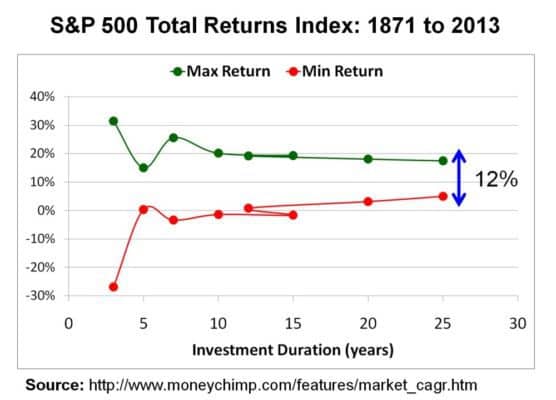
The average maximum and minimum return for every 3,5,7,10,15,20 and 25 year period between 1979 and 2013 have been plotted. Notice how, with increasing investment duration, the volatility (here measured as the difference between max. and min. return) decreases. Does this mean, we can expect the same trend over the next 25, 30 years? Does this mean we can expect a 15-16% return if held for long enough time?
Many of us conveniently forget that our markets are simply too young. There is not enough data points to establish any ‘concrete’ trends.
Take the case of a much older market – the S&P 500. Here one can get 125+ 25 year data points in a rolling return analysis!
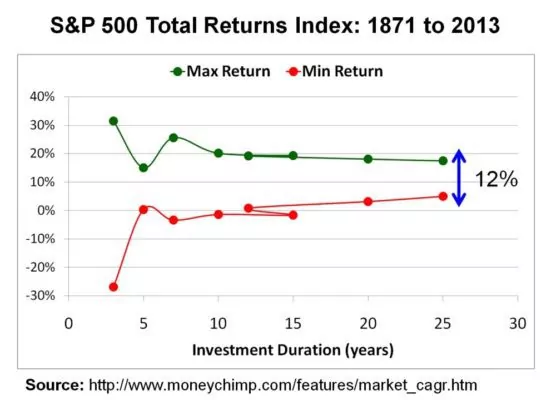
1) do not expect volatility to come down (too much) with time.
2) Do not assume that holding for the long term will make everything go away. It may or it may not.
3) Remember our market is too young and is still evolving. There no absolute rules or thumb rules.
Question is, how to handle this? I can think of two ways:
- Time the market for lowering portfolio volatility- this may or may not result in higher returns (see link below)
- Do not time, invest systematically, but rebalance from to time to time, with a focus on the financial goal. This includes shifting to safer asset classes depending on market movements in the last 10 years or so before the money is required.
- A mix of the two
In both methods (1,2), you do not trust the market to deliver over the long-term, but trust it to take away the gains it has offered sooner than later!
I dont care which is superior, but I do know which is suitable for me – 2 (which is anyway mandatory for everyone).
When it come to equity investing, hope is NOT a strategy.
More about change in stock market trends and timings models: Is it possible to time the market?