Last Updated on December 18, 2021 at 10:40 pm
On Feb 2nd the day after the budget, the Sensex fell by about 2%. If you this is a “big fall” or if you are worried, you only have two choices: get used to it and be ready for more or leave and head to fixed income. The following charts were published on Mar 11, 2015, after a similar 2% fall on Mar 9th, 2015. Nothing has changed!
Looking at investor reactions, I am now confident that if there is a sustained fall, most of them will not add more to equity. Good. Only the fittest survive.
=-=-=-=-=-=
On Monday last, most Indian stock indices ‘crashed’ by about 2%. Immediately the media wrote columns as to why this occurred. The next day there were hand-holding articles as to why one should not be scared of such market movements. A case of, ‘pinch the baby and rock the cradle’.
Here is a series of Nifty graphs in this regard.
🔥Secure your future with our Robo-advisory tool trusted by over 3,500 investors and advisors. From effortless retirement planning to funding your children’s biggest dreams, turn your financial goals into reality. 🔥
Subscribe for money management solutions via email! (Link takes you to our email sign-up form) Join 32,000+ readers in our community.
👉 New Tool Alert! NaviPlan: A Privacy-Focused Multi-asset Tracker and Goal Planner 👈
A single-day fall of 7% or more
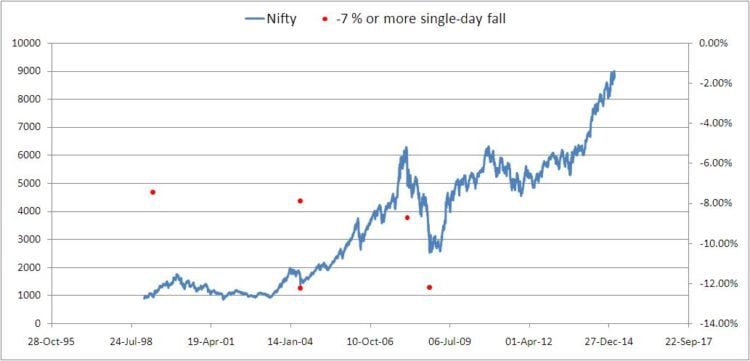
We have had a 12% fall and ~ 8% fall in the middle of a bull run (Jan 2004) and another ~8% fall in late 1998.
So, the next time there is such a single day fall, can we assume the market has crashed and that we are heading towards a bear market?
A single-day fall of 5% or more
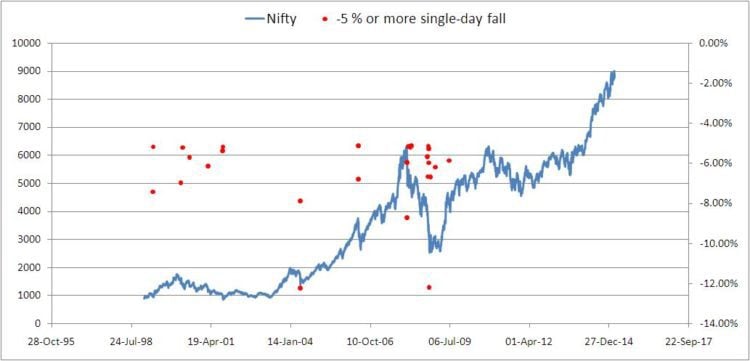
Should be cut our losses and exit when there is a 5% or higher fall?
A single-day fall of 2% or more
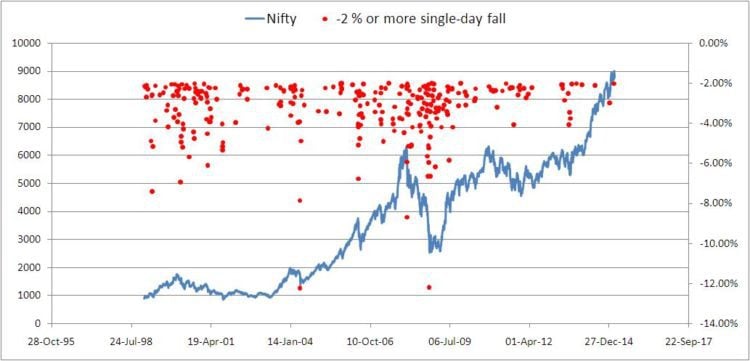
A single-day fall of 2-3%
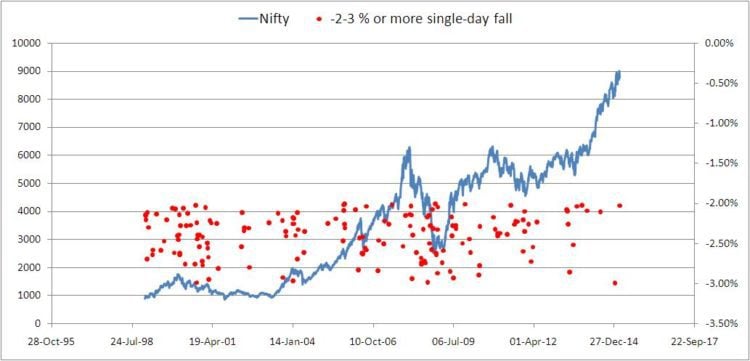
Does this put Mondays ‘crash’ (rightmost red dot) in perspective?
If it does, keep calm and MDBSC* on
If it does not, if you feel compelled to fret over the reasons for the fall, if you need hand-holding and reassurances that ‘we are still in a bull market’ and that ‘all will be will’, get out of equity today and stick to fixed-income products.
‘Wealth creation’ is not for the faint hearted.