Last Updated on May 12, 2025 at 10:19 am
Here is a comparison of SIP and lump sum returns of active and passive large-cap equity funds over the last 1,2,3,4,5,6,7,8,9 years. I shall follow this up with other categories – mid-cap, small-cap etc. and repeat this study from time to time.
Before we begin, would like to point out that our new book, You Can Be Rich Too With Goal-Based Investing is now available with a (total)discount of ~ 30% (Rs. 280) at Infibeam if you use the discount code BS10.
For this study, a passive mutual fund is just an index (either cap-based or strategic). The expenses associated with investing in such a passive fund are ignored so that it is that much harder for active funds to beat them. Therefore, no ETFs or index funds are included in this study.
An active fund is defined as usual – one in which portfolio management is done by a set of human beings.
🔥Secure your future with our Robo-advisory tool trusted by over 3,500 investors and advisors. From effortless retirement planning to funding your children’s biggest dreams, turn your financial goals into reality. 🔥
Subscribe for money management solutions via email! (Link takes you to our email sign-up form) Join 32,000+ readers in our community.
👉 New Tool Alert! NaviPlan: A Privacy-Focused Multi-asset Tracker and Goal Planner 👈
The number of active funds considered varied from 29 for the 9-year SIP/lump sum calculation and 46 for the 1-year SIP/lump sum calculation.
The passive “funds” considered are:
BSE Large Cap Total Returns Index (TRI)
Nifty 50 TRI
Nifty 50 Value 20: the 20 most liquid value blue chip stocks selected from the Nifty 50 index. Read more: Nifty50 Value 20 Index (NV20) as a mutual fund benchmark
Nifty Quality 30: 30 stocks that show signs of a “durable business model”. A quality score is assigned after considering ROE, Debt/Equity and Profit After Tax for the last three financial years. Read more: Nifty Strategy Indices as Mutual Fund Benchmarks
Nifty Low Volatility: A portfolio of 50 stocks that has the least volatility among all the stocks listed on the NSE. This is referred to as a smart beta strategy. Read more: Nifty Low Volatility 50: A Benchmark Index to watch out for
One can debate if the last two indices are truly “large cap”, but both of them are less volatile than the Nifty 50. So I believe the comparison is justified.
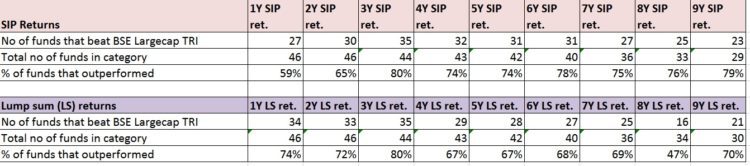
Active Large Cap funds vs BSE Large Cap TRI
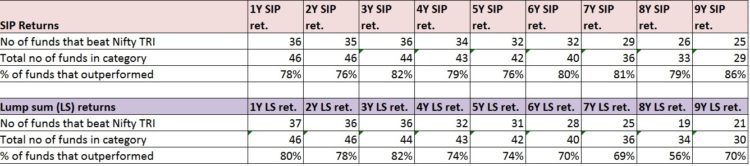
Active Large Cap funds vs Nifty 50 TRI
Active Large Cap funds vs Nifty Low Volatility

Active Large Cap funds vs Nifty Quality 30

Active Large Cap funds vs Nifty 50 Value 20

I think it is fairly clear that active large cap funds have done quite well and there is no compelling reason to abandon these for passive large-cap funds. A simple annual review and course correction is enough to ensure we stay invested in reasonable outperformers.
That said, Nifty Low Volatility appears quite promising to me. My understanding is that this is not available as an index fund and only as an ETF – I would stay away from all such ETFs.
The Nifty Next 50 is the most promising index fund that I have seen, but that is strictly not a large cap index. It can be compared to multi-cap funds as done before. The index funds based on this have pretty low AUM, though.
One can argue that this is based on past data and future outperformance will be lower. Fair enough. I would prefer to enjoy that alpha for as long as I can get it. It is not going to disappear for an “active investor” who rebalances systematically.
That said, the question to ask is: Should I pay X% (extra expenses) to get Y% as extra returns or should I settle for index returns?
Since it is not rocket science to get that Y% return, I will take my chances with active funds.
The data use in this study can be found here: Active vs Passive Large Cap Data (Dec 2nd, 2016)
Chennai DIY Investor Workshop Jan 29th, 2017
The fifth Chennai DIY investor workshop will be held on Jan 29th, 2017. Ashal Jauhari and I shall be the speakers. Read more and register for the event.
What Readers Say about You Can be Rich Too
You Can be Rich Too With Goal-Based Investing is my new book with Subra(money.com) published by CNBC TV 18.
Highly recommended
For anyone who wishes to take control of his/her finance this book is a must read. Very simply put, even an amateur in finance will be able to understand and implement. The author genuinely attempts to inculcate the habit of investing among the people who have the ability to invest but refrain from doing it, either due to lack of time , interest or understanding!. The message from the book is ” Investment done without setting a goal/ objective is like leaving for a trip without knowing the destination, not everytime the end result will be promising. Hence, it’s important to invest in a planned & disciplined manner.” A read is highly recommended
Check out the other reviews and buy now via Amazon.in for Rs. 399 or Bookadda for Rs. 339/-. Or via Infibeam for just Rs. 280.
The book is also available on Kindle at Amazon.in (Rs. 244.30) or at Amazon.com ($3.36 or Rs. 244.30).
Also at, Google Play Store (Rs. 244.30)
If you have read the book, please consider writing a review this weekend.