Last Updated on December 18, 2021 at 10:45 pm
Are you worried the high expense ratios of active mutual funds? Are you looking for an index fund that has performed reasonably well with low expenses? Then you can consider a Nifty Next 50 index fund instead of active funds in the multi-cap category.
Why? As pointed out in a series of posts on the Nifty Strategy Indices as Mutual Fund Benchmarks, the Nifty Next 50 or formerly the Nifty Junior which consists of stocks with top 50-100 market capitalization has a good record in the multi-cap category.
Nifty Next 50 Index fund: 5-year Returns
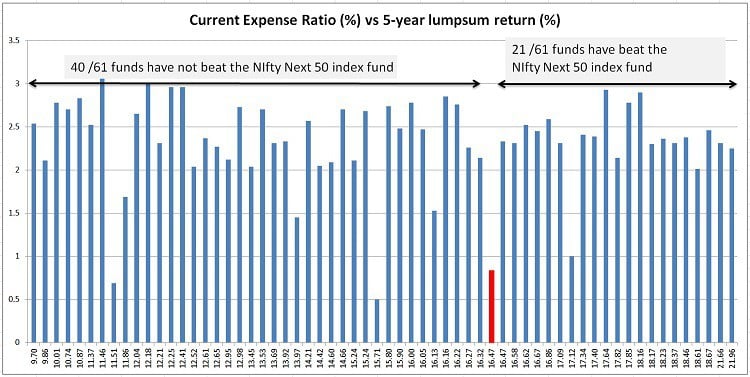
Consider the return-rank of ICICI Pru Nifty Next 50 fund:
21st out of 64 funds over 5 years. This considers the regular and direct plans as independent funds. (In a sense this is double-counting)
🔥Secure your future with our Robo-advisory tool trusted by over 3,500 investors and advisors. From effortless retirement planning to funding your children’s biggest dreams, turn your financial goals into reality. 🔥
Subscribe for money management solutions via email! (Link takes you to our email sign-up form) Join 32,000+ readers in our community.
👉 New Tool Alert! NaviPlan: A Privacy-Focused Multi-asset Tracker and Goal Planner 👈
47/138 over 3 years and 1 year.
This performance at a fraction of the expense ratio of most funds in the category. The y-axis in the above graph represents the current expense ratio plotted against the 5-year returns. Notice where the red bar is.
I can spot only two index funds based on Nifty Next 50 – one from ICICI, one from IDBI and an ETF from SBI.
As mentioned in the above post, this is an impressive performance.
Wait a minute!
The last 5 years has not witnessed a robust bull run like in the 2000s. What if we extend the analysis further back?
I used my mutual fund return listings tool to check returns for the last 9 years. Here only regular plans are considered.
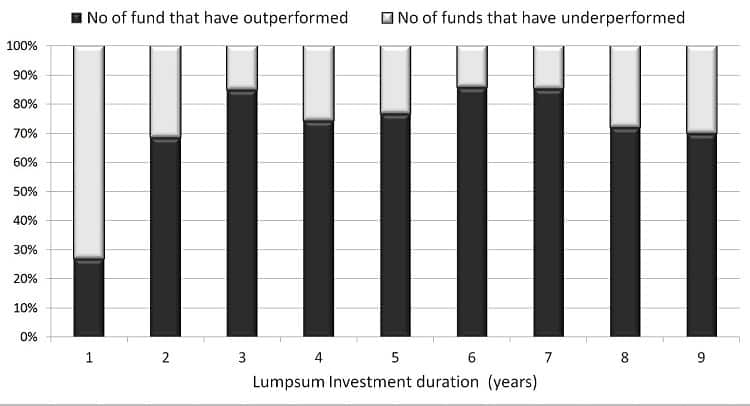
I think it is reasonable to conclude that about 70% of active funds have beat the Nifty Next 50. However, the number of multi-cap funds have doubled in the last 9 years. So this 70% margin is likely to fall in future.
Update: Please see my response to Shan’s comment below about GS Junior Bees has performed.
Choosing an index fund boils down to how much we expect the outperformance to fall in the long-term.
Pros of Index Investing
In the large-cap category, most active funds beat Sensex or Nifty index funds (how is a matter of debate!!). Over the last 10 years, only 3 active large cap funds have underperformed wrt index funds and these are duds no one would touch. Over the last 5 years, the corresponding number is just 5.
In the primarily large-cap plus mid-cap category (multi-cap), the NIfty Next 50 Index funds have provided good returns considering the extremely low expenses.
No need to worry about fund management changes.
Pretty much a turnkey mutual fund solutions to beat inflation (with portfolio management)
The Next 50 index has a nice large cap tilt with 15-20% exposure to mid-caps. This makes it a minimalist portfolio without the dangers of small and micro caps.
Cons of Index Investing
Active management is not about just for beating the index. It is also for lowering risk*. An index fund has a risk equal to that of its underlying index. In the case of a sustained sideways market, an index fund can not only be stressful to hold, but also may be detrimental for our goal.
* I shall give an interesting example of this point tomorrow.
Index investing requires tremendous maturity. One will have to recognise that selecting the right equity mutual fund scheme is not possible and not worry about the funds that have (or will) beat the Nifty Next 50 index funds.
Trivia
Over the last 5 years,
the ICICI Pru Nifty Next 50 Index Fund has beat (not by much) Quantum Equity Fund of Funds. This is a professionally managed basket of direct plan active funds.
beat HDFC Equity by almost 3%!
The ICICI Pru Nifty Next 50 Index Fund direct plan has an expense ratio of only 0.29% as against 0.84% for the regular plan! The regular fund has a 3-year return rank of 47/138 and the direct plan 39/138!
To be fair, the multi-cap category as defined by Value Research is quite varied. It has a CNX 500 index fund, a fund of fund, at least two funds that invest in international equity (PPFAS,Templeton India Equity Income). They may simply not consider the Nifty Next 50 as a target to beat.
Still, from an investor’s view point, the Nifty Next 50 is a very good alternative in terms of pure return per unit expense ratio. That said, return is a point to point perspective. The risk or the stress associated with index investing is often not considered. I would like to think active management which offers better risk-adjusted returns for higher fees is still something to consider.
Note: I am not suggesting that we abandon active multi-cap funds in favour of NIfty Next 50. Just saying that such an index fund could be a good choice of investors who are repulsed by high expenses and believe that the outperformance margin will come down in future.
Do check out:
The freefincal Excel Stock Screener
Automated Stock Analysis with Screener.in data