Last Updated on December 29, 2021 at 11:55 am
One of the most common investor mistakes is to assume that higher the equity in the portfolio, higher the reward. Studying balanced mutual funds or aggressive hybrid mutual fund will tell you that this is wrong. In this article, I compare the risk vs return of Aggressive Hybrid Mutual Funds vs diversified mutual funds & show how aggressive hybrid (Balanced) funds are better.
What are aggressive hybrid mutual funds?
A hybrid mutual fund is one that invests in two pre-dominant asset classes. Almost always stocks and bonds. An aggressive hybrid fund is one that is treated as an equity fund for taxation. That is, it holds at least 65% of direct Indian equity (stocks) and this allocation can go up to 80%.
The “aggressive” represents the absence or minimal presence of arbitrage exposure within the overall equity exposure. This is the key difference between an aggressive hybrid fund and a balanced advantage fund (will be covered in another post).
Typically most hybrid funds rebalance their portfolios once a month. So any excessive equity exposure is moved to debt and vice versa. Such frequent rebalancing is one of the key reasons for their success.
🔥Secure your future with our Robo-advisory tool trusted by over 3,500 investors and advisors. From effortless retirement planning to funding your children’s biggest dreams, turn your financial goals into reality. 🔥
Subscribe for money management solutions via email! (Link takes you to our email sign-up form) Join 32,000+ readers in our community.
👉 New Tool Alert! NaviPlan: A Privacy-Focused Multi-asset Tracker and Goal Planner 👈
What are diversified equity mutual funds?
A strict definition would be a mutual fund that can invest in stocks across sectors and across the market cap. So large and midcap funds and multi-cap funds are good examples. A less rigid definition only considered sector diversification. So all equity funds excluding sectoral funds can be considered as diversified mutual funds.
The biggest drawback in using diversified mutual fund is the fear of non-performance with respect to a benchmark index. Readers may be aware that over the past couple of years, I have shown this to the case wrt several indices. You can explore the full archive here: Index investing
So the problem is that the investor tends to feel that they are paying too much fees. Aggressive hybrid funds although with a similar fee structure offer pretty much guaranteed lower risk (see below) with rebalancing benefits. Since at least for now, there is no aggressive hybrid index fund, balanced fund investors can feel justified about the fee paid.
This is the reason why I have been using balanced funds as the core of retirement and sons’ future goals for quite a while now.
Aggressive Hybrid (balanced) Mutual Funds vs diversified mutual funds
To make this comparison, I have considered direct mutual funds and returns over the last 5 years and plotted them against the volatility for this period. Volatility is measured using the standard deviation in monthly returns. That is, it tells us how much individual monthly returns can deviate from the average monthly return. Thus this is a reward (return) vs risk plot.
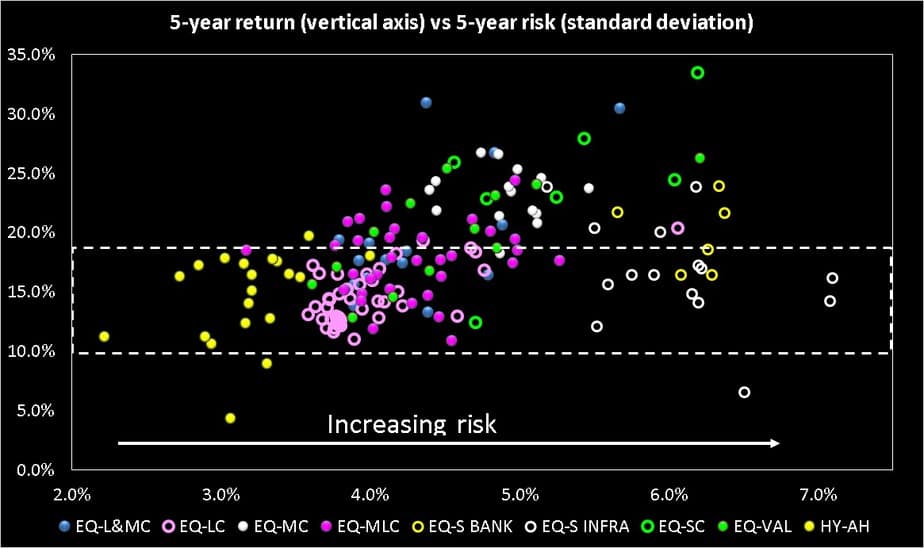
Here:
- Eq-L&MC refers to large and midcap
- Eq-LC <==> Large cap
- EQ-MCL <==> multi-cap
- EQS-Bank <==> banking funds (not a diverisifed fund!)
- EQS-Infra <==> infrastructure funds (not a diversified fund!)
- EQ-SC <==> small-cap
- EQ-Val <==> Value oriented
- HY-AH <==> aggressive hybrid.
Take a moment to become familiar with where each category falls and then take a look at the dotted rectangle. Notice that the aggressive hybrid funds exhibit about 25% lower risk for similar reward compared to many large-cap, multi-cap and large and midcap funds. This is what I mean by: “Why Aggressive Hybrid Mutual Funds score over diversified funds”
This is not a one-off observation. You can use the monthly fund screener to get this data for 3Y and 4Y as well. Also, this post is an update to Balanced Equity Funds: the low risk, high reward option
The returns are not guaranteed, but the lower risk is, in the case of most aggressive hybrid funds. For investors who are not happy with paying large fees to active diversified funds and for investors who are risk-averse, aggressive hybrid funds are a fantastic solution for long-term goals only.
Recognise that the volatility is only about 25% lower. So don’t expect your balanced fund to not fall at all when the market falls. Just that it will fall less.
What about small-cap funds? Should I sell all my other funds and buy only small-cap funds? Well, by buying small-cap funds you are guaranteed of risk. That much is for sure.