Last Updated on December 29, 2021 at 6:01 pm
The AUM (asset under management) of Parag Parikh Flexi Cap Fund (previously known as Parag Parikh Long Term Equity Fund) grew by 147% in 2020. This article evaluates the AUM growth of this fund and discusses if this is a cause for concern.
This article stems from a question posed by a reader: “I have been observing for the last six months, the AUM of PPFAS flexi cap fund is increasing very quickly. Unfortunately, I don’t have exact data on monthly basis. The same had happened with Kotak Multicap in the past. Can we have a quantitative analysis of how the fund performance is affected when there is a sudden influx of large cash? ( Normally it happens with Actively managed popular funds)”
A sudden influx of cash can, in general, impact performance, in particular, the ability of the fund manager to freely churn stocks. It is quite possible that the sudden increase in AUM of HDFC Top 100 and HDFC Equity after the 2009 market recovery is the reason for subsequent underperformance of these funds. However, it is hard to quantitatively connect AUM with performance (at least for Indian funds): Does the size of a mutual fund affect its performance? and Mutual Fund Size vs. Performance: A Case Stud
It is, intuitively known that investors are known to close the barn door after the horse has bolted. That is, they will wait to see the performance, wait for the fund to get a five-star rating, rush to buy it, the AUM swells, the law of averages kicks in, the star rating drops, investors, move on to buy the next star rated fund adding clutter to the portfolio. Rinse and repeat. Reminds you of what Agent Smith said in the Matix:
🔥Secure your future with our Robo-advisory tool trusted by over 3,500 investors and advisors. From effortless retirement planning to funding your children’s biggest dreams, turn your financial goals into reality. 🔥
Subscribe for money management solutions via email! (Link takes you to our email sign-up form) Join 32,000+ readers in our community.
👉 New Tool Alert! NaviPlan: A Privacy-Focused Multi-asset Tracker and Goal Planner 👈
Every mammal on this planet instinctively develops a natural equilibrium with the surrounding environment but you humans do not. You move to an area and you multiply and multiply until every natural resource is consumed and the only way you can survive is to spread to another area. There is another organism on this planet that follows the same pattern. Do you know what it is? A virus.
Very few funds have been able to manage the inflow of funds without a drop in performance and without restricting inflows. Example ICICI Blue Chip and HDFC Midcap (at least until a couple of years ago).
So while it is obvious that Parag Parikh Flexi Cap Fund has caught investor attention, it is impossible to predict future performance linked to AUM inflow. All we can say for sure is, if the market does not move up as rapidly as it has in the last few months, the inflow will reduce.
Even without looking at the data, one could say this much: there is no point worrying about what we cannot control. At present, an AUM of 6000-7000 crores is unlikely to be an issue for a flexi-cap fund. When it becomes an issue is hard to say. Funds that swell up in AUM tend do increase the number of stocks in the portfolio; increase their allocation to large caps; reduce the churn rate – Prashant Jain’s funds are a good example.
Even if one notices such changes, it would be hard to directly attribute it to AUM – quantitatively that is. For example, a drop in the star rating of the fund (an eventuality) could simply mean the availability of better performing funds, not necessarily the aum growth of Parag Parikh Flexi Cap Fund.
The underperformance of Parag Parikh Flexi Cap Fund wrt its benchmark (also an eventuality) could arise from a portfolio different from that of the index (the same reason for outperformance!), not AUM increase.
The situation is quite similar to high PE and market corrections.. The market does not wake up one morning and decide to fall down because the PE is high. With that said, let look at the data.
AUM trend of Parag Parikh Flexi Cap Fund
The 147% growth in AUM of Parag Parikh Flexi Cap Fund is 36th highest increase out of 399 equity funds. A percentage increase in AUM alone does not say much because (1) the base AUM matters and (2) the increase in the market value (capital gains) of the portfolio also has to be factored in.
From Rs. 2585 crores in Dec 2019 the aum has increased to Rs. 6393 Crore in Dec 2020 (all numbers approximate). About 71.6% of the funds Average Assets under Management (AAUM) for the quarter of October – December 2019 was in the direct plan (old PMS investors likely to be the biggest chunk + about 5% AMC skin in the game)
The direct share dropped a bit to 69.5% of the Average Assets under Management (AAUM) for the quarter of October – December 2020 (source AMFI). So distributors have started to push the fund in 2020 (everyone likes a winner!). The regular AAUm grew by 147% while the direct AAUM by 123%.
Since PPFAS does not have a bank (at the time time of writing!) investors need not fear a steep increase in (regular) AUM, but as long as the fund continues to do well and a bit beyond, a robust increase in AUM should be expected.
As mentioned above, the increase in AUM is because of two reasons: more funds(inflow) and capital gains. We can estimate the inflow in a crude manner. Let us consider a dramatic example: Quant Small Cap Fund.
In Dec 2019, the fund had only 1.9 Crores of AUM. In Dec 2020 it became 94.1 Crores. A 4783% increase! During this period the fund gave a return of 75.1% (abs change in NAV).
If that 1.9 Croes AUM was intact, then the capital gain of 75.1% would move this AUM to only 3.4 Crores. So the remaining 91.4 – 3.4 = 90.7 Crores (all nos approximate) is likely to be the inflow. The estimated increase in AUM due to inflow is 90.7/1.9 or about 4708%.
Of course, this is a crude estimate as investors would continuously invest and redeem in open-ended funds, but that is all that can be done. While the % increase in AUM for Parag Parikh Flexi Cap Fund is 147% (Dec 2019 to Dec 2020), the estimated increase in AUM due to inflow is about 115% – still significant.
The estimated increase in AUM due to inflow for Parag Parikh Tax Saver Fund is 282%. So this is getting noticed more. While the direct AAUM of this ELSS fund grew by 250% (same period as above), the regular AAUM shot up 376% (lock-in = more commissions). Of course, the Tax Saver fund has just hit 100 Crores AUM (meaning it will take a few more years for these investors to worry about AUM).
The normalized evolution of AUM and NAV of the Flexicap fund is shown below (I have deliberately avoided the use of log scale!)

Since March 31st 2020, the NAV has increased by 68% while the AUm by 161%. The estimated increase in AUM due to inflow is about 93% – almost a doubling of the AUM due to inflow.
The six-month change in AUM and NAV rolled over each month is shown below. Initially, there is a small change in the AUM and NAV movement from early 2018 the AUM lines pulls away from the NAV. The bare data is sourced from ACE MF.
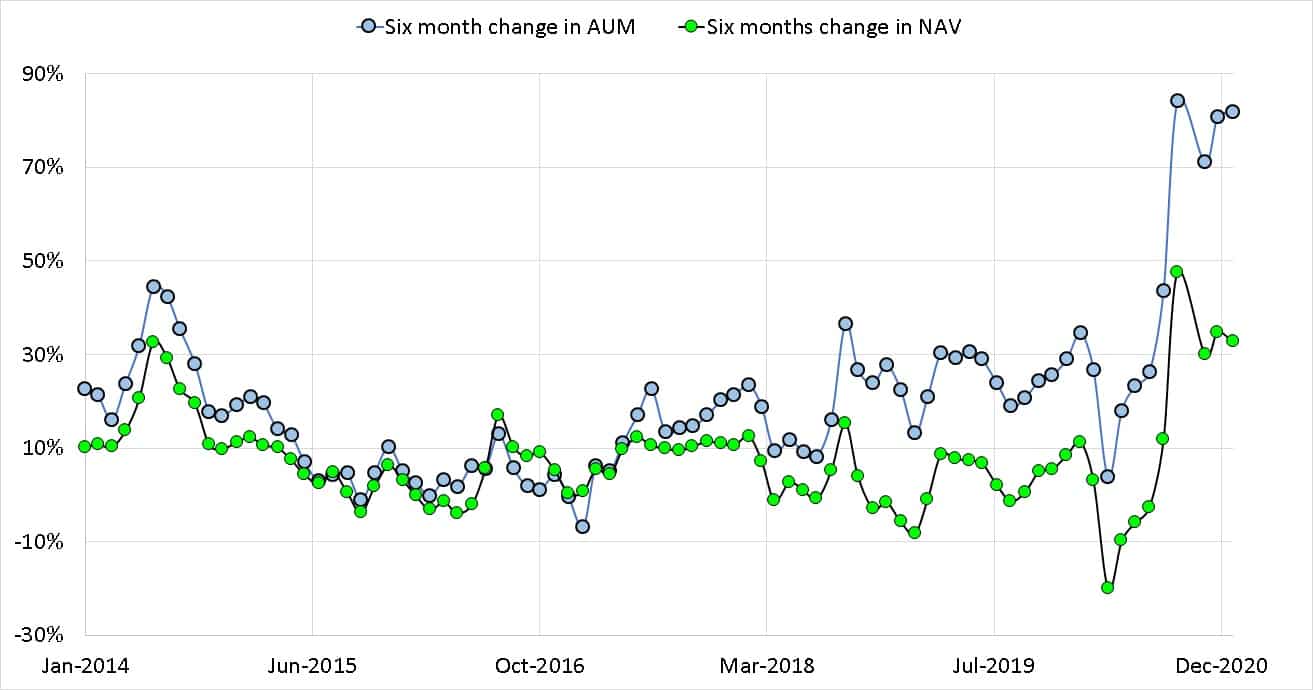
If we try to separate the inflow and capital gains as mentioned above we get a smoother increase in flow in 2020.

These numbers are more for the AMC to pat itself on the back and dole out bonuses (maybe employees can stake their claim with this article!). For investors, it is just standalone information. As mentioned above it is hard to correlate performance with AUM movements if we try to go beyond lazy speculation.
Bulging AUM is the price one has to pay for outperformance in addition to the expense ratio. I would recommend index funds for those worried about AUM hike, but for any given choice, investors find something to worry about and get confused.