Last Updated on December 29, 2021 at 5:04 pm
Axis Nifty 100 Index Fund is an open-ended index that aims to achieve a return close to Nifty 100 subject to tracking error. The NFO opens today (Sept 27th to Oct 11th) and then will be available for continuous purchase. This is the first Nifty 100 (N100) index fund – we have N100 ETFs from ICICI and Reliance. The introduction of this index fund has some significance considering that, as of Dec 2018, Only Five Large Cap funds have comfortably beat Nifty 100! Hence the question, can Axis Nifty 100 Index Fund be a replacement for active large cap funds and even Nifty 50 and Next 50 combinations such as these: Combine Nifty and Nifty Next 50 funds to create large, mid cap index portfolios
This is not some recent phenomena where active fund managers, especially those handling large cap funds, are struggling against the index. This was well known even in April 2010. See: This will change the way you invest: S&P Index Versus Active Funds report. This is the scheme information document of the fund at the SEBI site.
Questions to ask before investing in Axis Nifty 100 Index Fund
- Why should I choose an N100 index fund instead of a Nifty index fund? After all, because of free-float market cap weighting, both indices will have the same dominant stocks. The fifty additional shares from Nifty Next 50 will not have much weight in NIfty 100.
- Can a fund manager handle 100 stocks with a tracking error close to Nifty index funds?
- What is the expense ratio of Axis Nifty 100 Index Fund direct plan? Is it low enough? Will the AMC keep it that way?
We will know about the expense ratio only after it is available for continuous purchase. We will know about the tracking error only a few months later. Whether the AMC will keep the expense ratio low or make frequent changes will take longer to evaluate.
So even if the answer to question one is convincing yes, we still need to wait a while. There is no flaming hurry to invest during the NFO period. Let Axis bank customers do that in the regular plan.
🔥Secure your future with our Robo-advisory tool trusted by over 3,500 investors and advisors. From effortless retirement planning to funding your children’s biggest dreams, turn your financial goals into reality. 🔥
Subscribe for money management solutions via email! (Link takes you to our email sign-up form) Join 32,000+ readers in our community.
👉 New Tool Alert! NaviPlan: A Privacy-Focused Multi-asset Tracker and Goal Planner 👈
Should I replace my active fund with index funds?
Only 14 out of 28 large cap funds fell less than N100 over every possible five year period tested from April 2006 with 70% or more consistency. This is the only USP of an active large cap fund, and that is badly missing. Even over the last year, only 8/21 managed a similar downside protection score. So indexing is the way to go in this space for sure. Data source: Sep 2019 Equity Mutual Fund Performance Screener
If you are wondering about the outperformance, then only 50% of the large cap funds were able to beat the Nifty 100 at least 70% of the five-year durations tested. So beating the Nifty or Nifty 100 has become (has been for a while) a coin-toss.
Therefore, there is effectively only one question to answer:
Should I use Nifty + Nifty Next 50 (if necessary) or should I use Nifty 100?
Why is the AMC launching an N100 index fund instead of focussing efforts on Axis Bluechip Fund (Review: Can this be used to beat Nifty?). My doubt (and it is only a doubt) is that AMCs are now targetting direct plan AUM from prominent robo advisors like Paytym, ETMoney etc
Nifty 100 vs Nifty 50
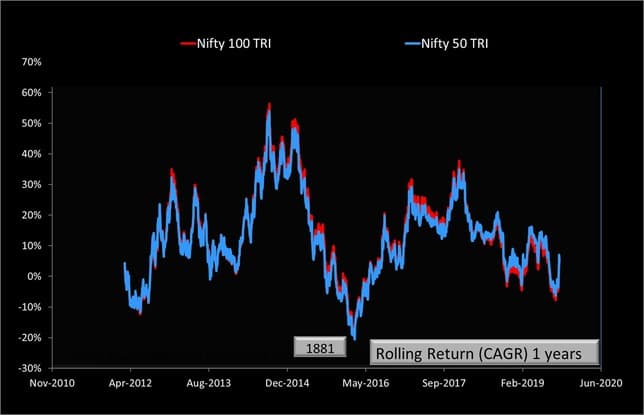
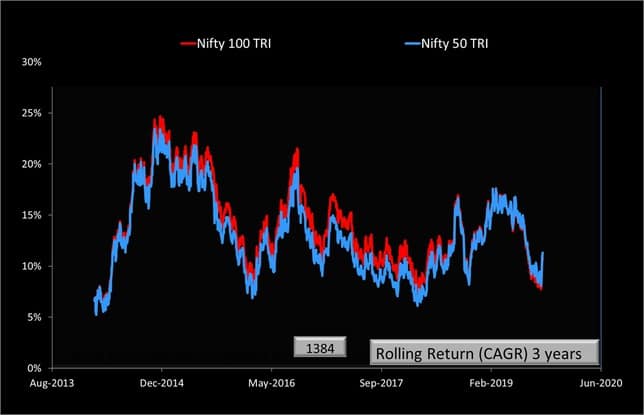
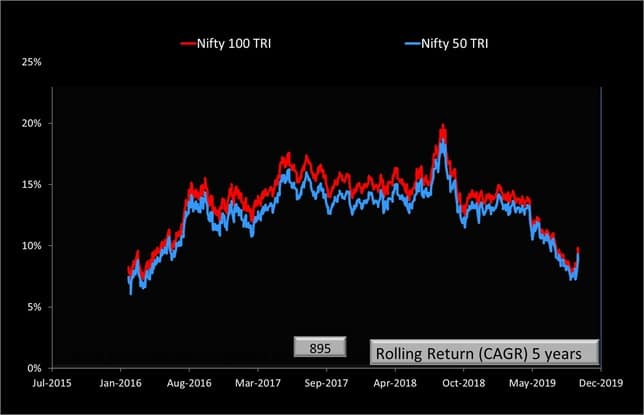
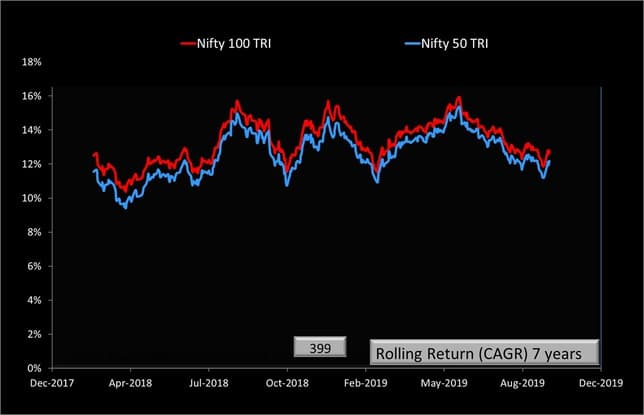
Let us now look at the rolling returns of Nifty 100 and NIfty 50 total return indices. This means that we shall compare every possible 3,5,7 and 10-year return durations.
First that over a year, you cannot tell the two indices apart. This changes.
Three years
Five years
Seven years
Should you invest in Axis Nifty 100 Index Fund?
Before you get carried away by the “extra return” that Nifty 100 offers, please look at the horizontal axis window as the duration increases. The time window becomes shorter and shorter. This is because we have little data to work with. We cannot be sure if this will repeat in future.
That being said, it is worth considering Nifty 100 as a replacement for Nifty 50 or (80-90%) Nifty 50 and (20-10%) Nifty Next 50 combination. See: Combine Nifty & Nifty Next 50 funds to create large, mid cap index portfolios, provided Axis Nifty 100 Index Fund
- has an acceptably low expense ratio
- has an acceptably high AUM (the bank RMs should take care of that?)
- has an acceptably low tracking error
Nifty 100 is undoubtedly a suitable replacement for active large cap funds. However, it will take at least six months for these to get established. So I would strongly advise you to wait until that time. Naturally, a Nifty 100 index fund does not suffer from maintenance issues (rebalancing) and associated tax and exit loads, however, it should first deliver as an index fund.
Tracking 50 more stocks (compared to a Nifty index fund) will be at least 2X more challenging as the impact costs dramatically increase for Nifty Next 50 stocks: Warning! Even large cap stocks are not liquid enough! Can you handle this? Also, it would be worth pointing out that the largest equity active fund – Kotak Standard Multicap Fund (Review: Too much AUM, too soon?) – has only 52 stocks.
Now while we imagine the plight of Motilal Oswal Nifty 500 Fund( Review: Avoid & stick to Nifty 50 Index funds), let us give Axis Nifty 100 Index Fund some time to perform. Investors using Nifty 50 and Nifty Next 50 combinations can happily and peacefully continue investing. You are not missing out anything.
Endnote: Many investors assume lower expenses alone is enough to choose an index fund or ETF. Expense is only one of the several factors influence index fund/ETF tracking error. The more reliable way to judge is to compare returns of the index and the fund/ETF over different durations. I am working a monthly report of index funds. See ETFs vs Index Funds: Stop assuming lower expenses equals higher returns!
Check out these resources published in the last few days
- How I achieved financial freedom and became an Investment Advisor!
- Factors that helped me achieve financial freedom
- This free ebook on Health Insurance will help you choose a policy with ease!
- Axis Midcap Fund Review: Invest or give it some time to perform?