Last Updated on April 14, 2026 at 11:48 am
Axis Triple Advantage Fund is an open-ended multi-asset fund that invests in stocks, bonds and gold (min 10% allocation to each). In this review, we study its history and recent performance and discuss when this is fund can be considered for investment.
Multi-asset funds have a mandate to invest in three asset classes – stocks, bonds and gold with minimum 10% allocation in each at all times. Since they rebalance their portfolio on a monthly basis at no tax outgo to the unitholder, they tend to exhibit lower volatility.
A new investor looking for long-term mutual fund solutions can consider multi-asset funds but must consider how it would manage its asset-allocation. The SEBI mutual fund recategorization rules have created some confusion in this space.
🔥Secure your future with our Robo-advisory tool trusted by over 3,500 investors and advisors. From effortless retirement planning to funding your children’s biggest dreams, turn your financial goals into reality. 🔥
Subscribe for money management solutions via email! (Link takes you to our email sign-up form) Join 32,000+ readers in our community.
👉 New Tool Alert! NaviPlan: A Privacy-Focused Multi-asset Tracker and Goal Planner 👈
Prior to these rules, the Axis Triple Advantage fund had a mandate to approximately invest equal portions in gold (20-30%), bonds (30-40%) and stocks (30-40%) – a close approximation to an all-weather portfolio like The Permanent Portfolio: A Fascinating Low-Volatility Option For The Long Term Indian Investor.
This maximised the benefit of tracking gold price and periodic rebalancing as one could see from the backtests in the old product presentation. The problem with the SEBI rules is the minimum allocation to each of the three asset classes is only 10%. There are no restrictions on how the AMC can manage the rest of the portfolio.
Take, for example, ICICI Multi-Asset Fund (link to fund review). This is one of the core holdings of my portfolio – My 2019 personal financial audit. I also recommend it for first-time investors.
This was earlier called ICIC Dynamic Equtiy Fund and used an PB-based “in house” tactical asset allocation model to determine direct stock exposure. The same model is still being used for ICICI Multi-asset. This makes it a two-in-one kind of fund. A multi-asset fund and a dynamic asset allocation fund.
It is in this aspect Axis Triple Advantage Fund varies from ICIC Multi-asset. In its old avatar the rebalancing was systematic and not strategic. There is no indication in either the scheme document or its presentation leaflet that this has changed.
Axis Triple Advantage Fund Revised Asset Allocation
Equity and Equity related instruments: 65% to 80%
Bonds: 10% to 30%
Gold ETFs: 10% to 30%
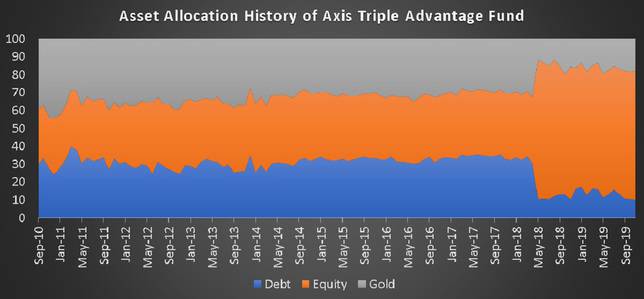
This is a big change from its earlier allocation, making it an equity-oriented fund in terms of taxation. The asset allocation history is shown below. The change in strategy is clearly evident.
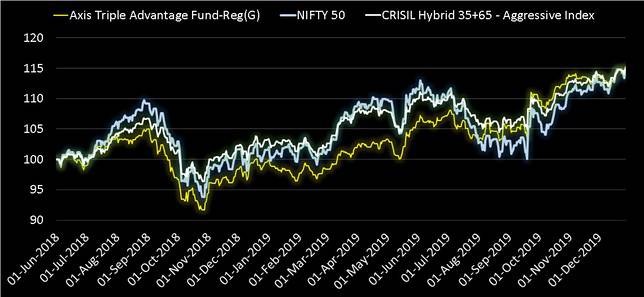
ICICI Multi-asset fund in comparison has a significantly lower volatility.

Outlook
Axis Triple Advantage is fundamentally different from ICIC Multi-asset in mandate and practice (so far). This can be on the watchlist of investors looking for an aggressive hybrid fund. Its true colours will be known only during a stock market downturn and how much it increases gold allocation.
The difference pointed out here is yet another instance of SEBI making things worse with its categorization rules.