Last Updated on December 18, 2021 at 10:51 pm
Choosing an appropriate benchmark for balanced mutual funds has always been a problem for the retail investor. In this post, I propose a new and more importantly accessible benchmark for equity-oriented balanced mutual funds – ones that do not use arbitrage opportunities or derivatives.
As always, I make no claim about the superiority of my choices. I am happy to change the index constituents if you can point out reasons for the same in the comments section.
Many, if not most balanced funds are benchmarked to the CRISIL composite indices. These are unbelievably expensive (few lakhs per year) are not available in the public domain (duh!). For example, the constituents of Crisil Balanced Fund Aggressive Index which can be used for equity-oriented funds (no arbitrage) are explained in this post: CRISIL Balanced Index: a benchmark for balanced mutual funds.
Valueresearch has its VR Balanced index. This I assume is some kind of weighted average of funds in the Hybrid: equity-oriented category. However, this category is a joke. It is a mix of conventional balanced funds, the new equity Savings funds and funds that dynamic change asset allocation. Excuse me for not taking the star ratings of such an inhomogeneous category seriously. The VR balanced index is not available in public domain and cannot be used at will. Morningstar also has two similar indices – moderate and aggressive.
🔥Secure your future with our Robo-advisory tool trusted by over 3,500 investors and advisors. From effortless retirement planning to funding your children’s biggest dreams, turn your financial goals into reality. 🔥
Subscribe for money management solutions via email! (Link takes you to our email sign-up form) Join 32,000+ readers in our community.
👉 New Tool Alert! NaviPlan: A Privacy-Focused Multi-asset Tracker and Goal Planner 👈
The S&P BSE Balanced Index(aggressive)
I would like to create a derived index with the above name from two of S&P BSE indices:
70% of S&P BSE AllCap Index (total returns index) and
30% of S&P BSE India Bond Index.
The BSE Allcap index has about 70% large cap allocation, 15% mid-cap and 15% small-cap. This I believe represents a typical portfolio alignment of most equity-oriented balanced funds. The 70% allocation to this equity index also reflects the typical asset allocation of such funds.
The BSE Indian Bond Index is a composite bond index that consists of both government and corporate bonds with a maturity duration that is neither too small or nor too long. I think this is a suitable candidate for the fixed income portfolio.
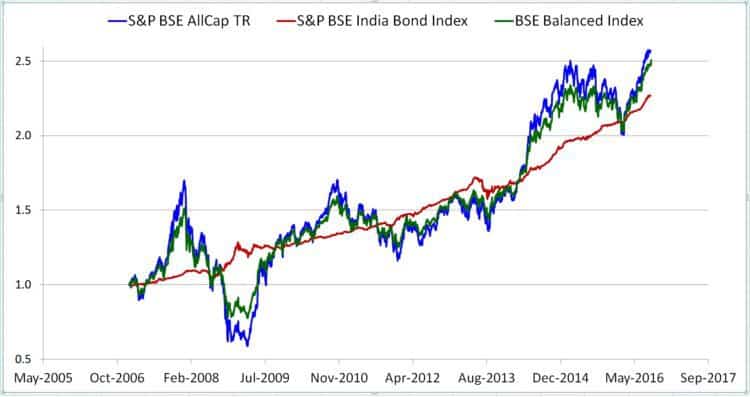
In my opinion, a benchmark should not be easy to beat! Using NIFTY TRI, BSE 100 TRI, BSE 200 TRI instead of the BSE Allcap TRI resulted in lower returns (based on past performance, much of which is backtested). The quantum of outperformance when compared with popular balanced funds was the lowest for the Allcap+bond index.
Here is how the balanced index fared against a few balanced funds. I shall include all balanced funds in this months return listings.
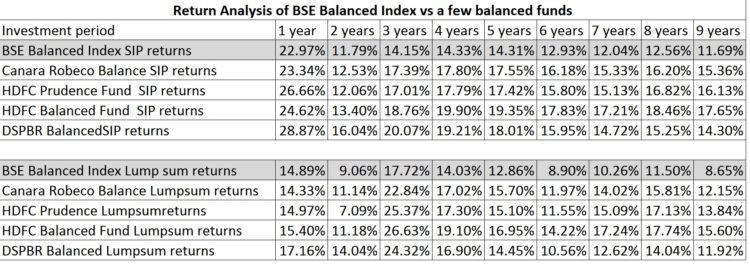
Note: I have taken the two indices mentioned above and created the balanced index by taking 70% of Allcap and 30% of India Bond index on each business day. That the rebalancing is done daily. This is way too often. Typically the rebalancing is done only once a month. But for this the the price movement of all the stocks and bonds is the index is needed.
S&P BSE Balanced Index is a name coined by me because it is derived from two of their indices. This has nothing to do with S&P or BSE. If in future they come up with their such index, I shall be happy to discard this.
Do let me know your thoughts and better ways of building an index for balanced funds.