Last Updated on August 30, 2021 at 9:08 am
Four friends who had invested in the same equity mutual fund via a monthly SIP decided to estimate the growth of their investments together.
The first friend beamed with joy, ‘my investment has beat (pre-tax) fixed deposits by almost 3%’!
The second friend was not so happy, ‘if I had invested this amount in a recurring deposit, I would have got the same return. I have got more returns only because of the difference in taxation rules’.
The third friend was sad and shocked. ‘What on Earth are you guys saying, I would have got more had I just kept the money in my SB account”!
🔥Secure your future with our Robo-advisory tool trusted by over 3,500 investors and advisors. From effortless retirement planning to funding your children’s biggest dreams, turn your financial goals into reality. 🔥
Subscribe for money management solutions via email! (Link takes you to our email sign-up form) Join 32,000+ readers in our community.
👉 New Tool Alert! NaviPlan: A Privacy-Focused Multi-asset Tracker and Goal Planner 👈
The fourth friend was in despair! ‘How on Earth did I alone lose money?!’
By now the relevance of the title should have become clear. The story of the blind men and the elephant is centuries old and is believed to have originated from India.

John Godfrey Saxe’s poem introduced the poem to the western world.
It was six men of Indostan
To learning much inclined,
Who went to see the Elephant
(Though all of them were blind),
That each by observation
Might satisfy his mind.…..
…..
And so these men of Indostan
Disputed loud and long,
Each in his own opinion
Exceeding stiff and strong,
Though each was partly in the right,
And all were in the wrong!
To many readers, it should also be clear why the four friends mentioned above were partly right but were also wrong.
Let us try and understand why each friend had an opinion about the investment (and therefore about the mutual fund) so different from the other.
The fund in question is, ICICI Focussed Blue Chip Equity. The four friends calculated returns (XIRR) as on 10th May 2016. Let us refer to them F1, F2, F3 and F4.
F1: SIP started in May 2013. (3Y ago), XIRR = 10.88%
F2: SIP started in Nov 2013. (6 months after F1), XIRR = 7.55%
F3: SIP started in May 2014. (6 months after F2, 1Y after F1), XIRR = 2.35%
F4: SIP started in Nov 2014. (6 months after F3), XIRR = -0.22%
The impressions of the four friends based on the XIRR of their investment was accurate. However, when they shared the numbers with each other they were surprised, to say the least!
Yes, the investments were started on different dates and hence were of different durations. Each instalment had a different age. This is the primary reason the values are different.
The point is, even if investors know about this beforehand, many would still be surprised at how much returns can swing in equity mutual funds (or stocks). How much it can differ for SIPs started 6 months apart.
Please do not conclude from this data that if one stays invested for ‘a long time’ returns would be ‘good’. That is nonsense. If you want proof, have a look at this Dollar Cost Averaging aka SIP analysis of S&P 500 and BSE Sensex or this, Rolling SIP Return Analysis: Franklin India Blue Chip Fund
Moral of the story 1: When we invest matters! The same fund can be an excellent fund or a poor fund depending on when we started investing. Or rather when we choose to review performance!
In the above case, the review point was the same, but durations were different. Have a look at what happens if the duration is the same (3Y sip), but the review points change by each business day (end of 3Y period). This is known as rolling returns. Each data point below represents the return of a 3Y SIP.
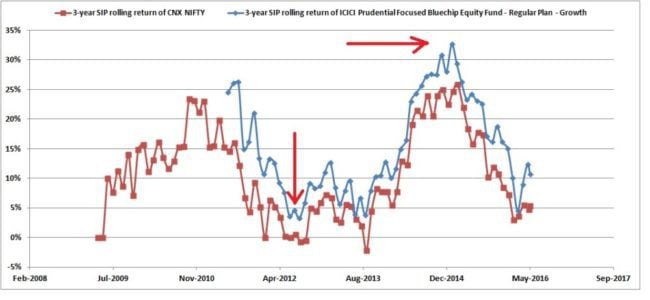
Notice that the returns swing from 6% to ~33% depending on when it was started!
Moral of the story 2: Different investors, analysts and star rating portals offer different views on the same fund because they are reviewing it over different durations. Therefore, it is important not to get swayed by such opinions.
Insipired by threads at FB group, Asan Ideas for Wealth.