It is well known that Mid cap and small cap funds are volatile. They can provide stellar returns or losses in quick time. Does it make sense for investors to book profits from mid cap and small cap mutual funds tactically? Let us find out.
As an analyst, the main aim of tactical asset allocation or market timing is to lower portfolio risk. A higher return is only a desirable side effect. As an investor, the main aim is to lower the volatility in portfolio growth as the deadline for the goal approaches. Also when we test a strategy in the past, return difference between a tactical strategy vs a “buy each month” strategy will depend on whether the market crashed in the period studied or not. The risk difference will be more or less independent of market ups and downs.
Profit booking from Mid cap, Small cap mutual funds
There are many things to consider before coming with a profit booking strategy. In what follows, I shall compare “buy each month and hold” mid cap or small cap fund (systematic investing for want of a better word) vs mid/small cap + large cap tactical strategy.
That is, we shall consider tactical allocation from a mid cap fund (or small cap fund) to a large cap and vice versa depending on market conditions. This will keep the equity: fixed income asset allocation of investors portfolio unchanged. Only the market cap of the equity portion will vary.
🔥Secure your future with our Robo-advisory tool trusted by over 3,500 investors and advisors. From effortless retirement planning to funding your children’s biggest dreams, turn your financial goals into reality. 🔥
I have not considered exit loads and taxes, as usually done in all previous tactical asset allocation studies. Two reasons (1) the systematic portfolio here has only equity unlike those (2) my aim is to check how tactical movements lower risk. If an investor is unwilling to book profits fearing taxes then they must suffer losses. One cannot eat a cake and have it too.
We have considered 43 10-year backtests from 1st April 2005 and use Nifty Midcap 150 TR Index, Nifty Small Cap 250 TR Index and Nifty 50 TR Index. Using active funds can lower the benefits of tactical profit booking but using them in a back-test will bring in biases. Again, an investor cannot eat a cake and have it too.
Using a ten-month moving average for tactical profit-booking
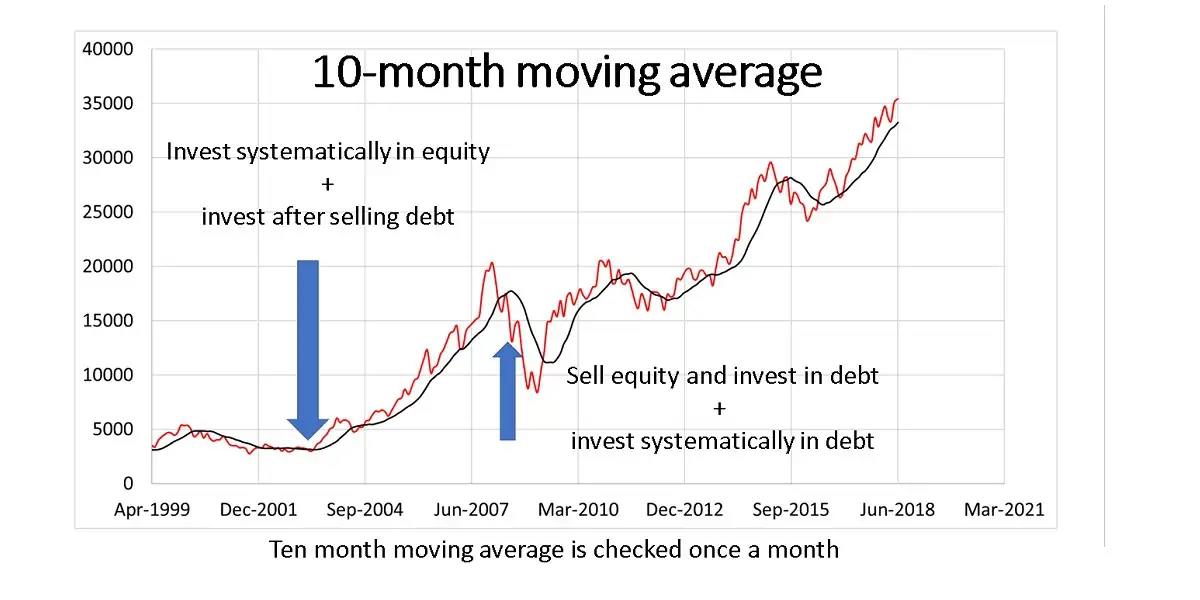
I shall only provide the gist of the method below. We shall consider two approaches: (1) Single 10 MMA and (2) Double 10 MMA.
Single 10 MMA
Look at the price of the Mid cap index at the start of the month. If it is above the last ten-month average price, buy mid caps only, sell existing NIfty 50 holdings and invest in mid caps. If on the other hand, the current price is < 10 MMA, then sell all mid cap holdings, invest in Nifty 50 and continue investing in Nifty 50. We shall compare this method with a SIP in the mid cap index. The same strategy will also be used for small cap indices.
Double 10 MMA
In this case, we take decisions of both Midcap and Nifty 10 MAAs.
When Midcap price > Mid cap 10 MMA OR Nifty price > Nifty 10 MMA, buy midcaps, sell existing Nifty holdings and buy mid caps with it.
When Midcap price < Mid cap 10 MMA OR Nifty price < Nifty 10 MMA, sell midcaps, buy Nifty holdings and keep investing in Nifty.
Profit booking from mid cap funds
Single MMA strategy (mid cap)
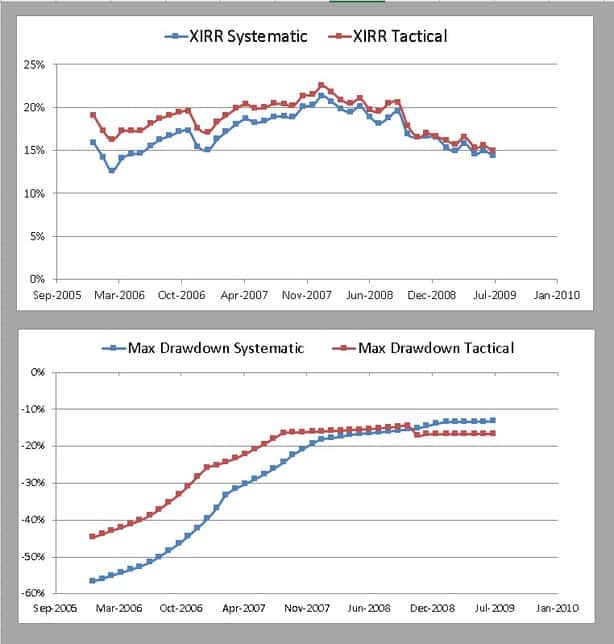
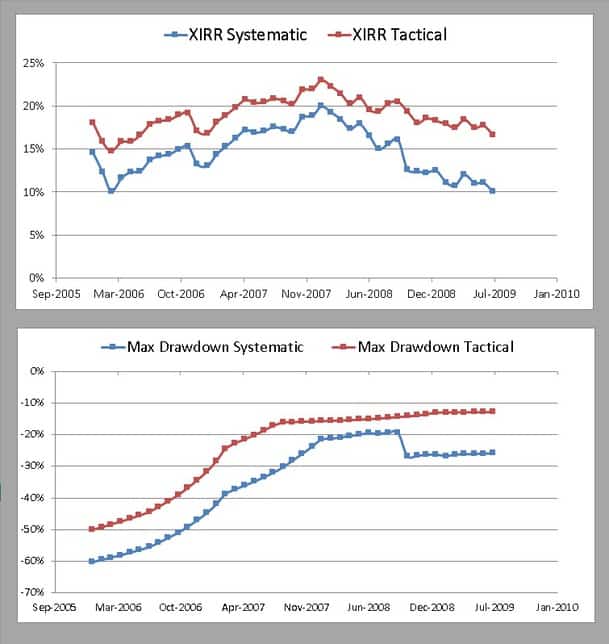
First, consider the 43 backtests. Top panel shows the annualized return XIRR comparison. Notice that the tactical strategy has done well all the time. The quantum of outperformance depends on whether the window saw a market crash or not. The bottom panel shows the portfolio drawdown. That is the max fall from a peak. Typically the tactical strategy has a lower fall from peak. Similar graphs for other methods will be presented below without further commentary.
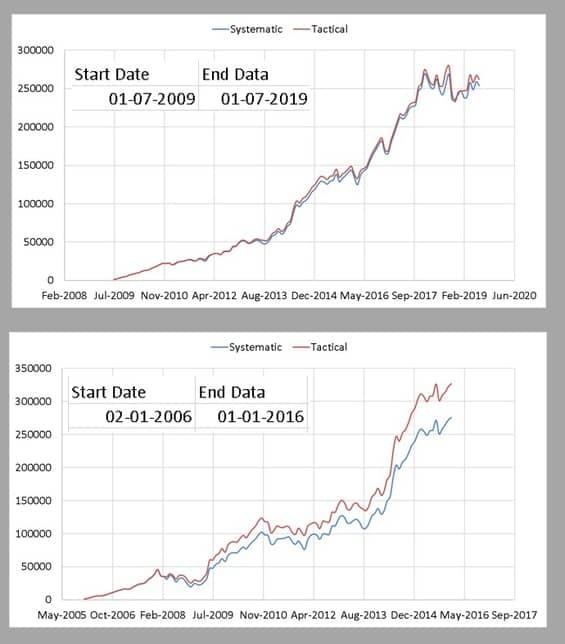
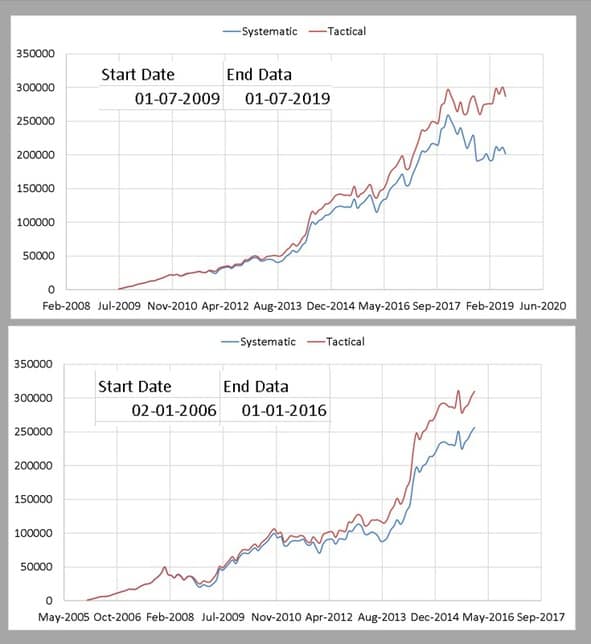
Next, we look at two portfolio growth charts. Please note that 43 such instances have been compiled above.
Double MMA strategy (mid cap)
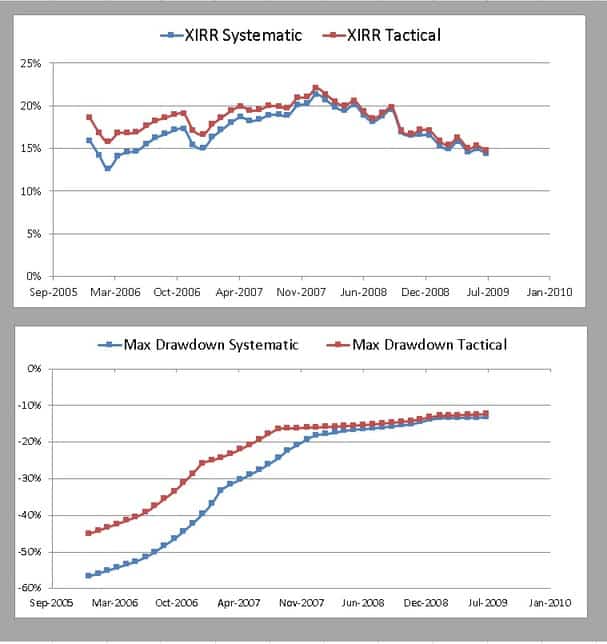
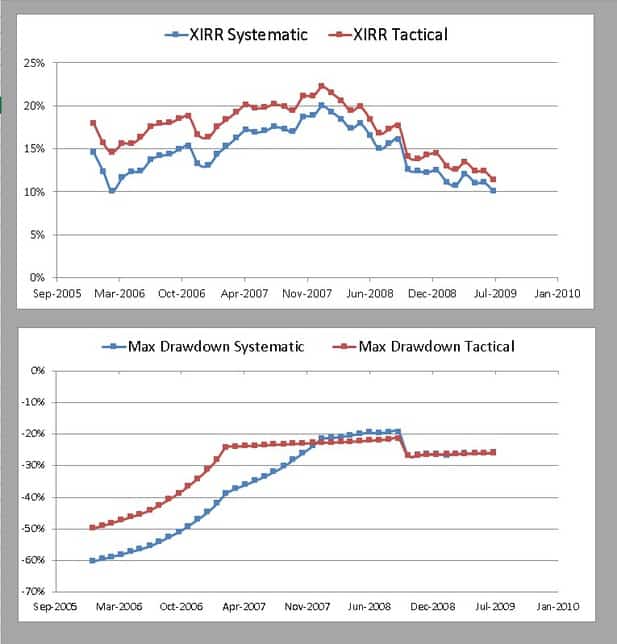
If we use two 10-MMAs (both Midcap 150 and Nifty 50), the return outperformance is marginally lower and risk outperformance (bottom panel) is marginally higher.Profit booking from small cap funds
Single 10 MMA (small caps)
Notice that the benefit of booking profits from small caps is higher than that with mid caps.
Here are two of 43 backtest examples.
Double 10 MMA (Small caps)
Finally, two sample backtests.
Should you book profits from mid cap and small cap mutual funds?
There is a clear benefit for mid cap mutual funds also, but here the investor must better appreciate the basics of portfolio management and asset allocation than the above. So I will not recommend it for everyone. However, this will benefit those with a clear target corpus.
Why not use large and mid cap funds or mid and small cap funds instead of such profit booking? Yes to the former. The risk is too much in the latter and some tactical play is necessary, in my opinion. What do you think? Will you try this out?
Do share this article with your friends using the buttons below.
Create a complete financial plan with our Robo-advisor!
Trusted by 3500+ investors and advisors! Use code robo25 for a 20% discount!