Last Updated on August 30, 2021 at 3:40 pm
Risk represents the probability of loss and volatility a measure of fluctuation. The loss here refers to a loss of capital and fluctuation the ups and downs in the movement of an asset. Now these are textbook definitions. When applied to real-life new dimensions get added on, as with everything else.
Let us start with the standard refrain of the mutual fund industry: risk is not volatility.
Everyday ups and downs of the stock market is volatility. They do not represent risk/real losses (or gains!) unless redeemed.
The biggest risk is to blindly believe that risk is not volatility!
🔥Secure your future with our Robo-advisory tool trusted by over 3,500 investors and advisors. From effortless retirement planning to funding your children’s biggest dreams, turn your financial goals into reality. 🔥
Subscribe for money management solutions via email! (Link takes you to our email sign-up form) Join 32,000+ readers in our community.
👉 New Tool Alert! NaviPlan: A Privacy-Focused Multi-asset Tracker and Goal Planner 👈
The volatility of the stock market can be measured in multiple ways. The simplest is perhaps the difference the maximum return and the minimum return.
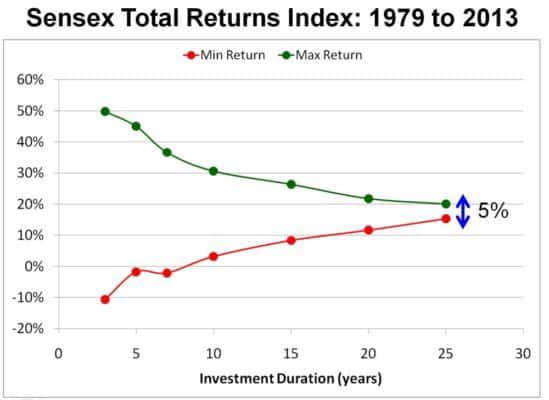
Will equity markets give ‘good returns’ over the next 5 years? One look at the above graph will tell you that the volatility over 5 years is pretty high. If I go ahead and take a chance, volatility represents risk.
It is only over very long durations, volatility is small enough to not represent risk. Read more: Equity investing: How to define ‘long-term’ and ‘short-term’
Even for a long-term goal after a few years, volatility represents risk. Suppose you have financial goal 25 years away. Today, volatility does not matter to you. However, 20 years later, volatility represents risk. Which is why it is crucial to exit equity when the goal nears.
Risk is not volatility only when you don’t have to redeem in the near future. However, as pointed out by Krishna Kumar at AIFW, this applies to only normals ups and downs of the stock market. If there is a 40% crash tomorrow, then recovery may take several years. If I don’t know how to assess the impact of such an even on my financial goals, knowledge of volatility metrics means little.
Volatility is mathematical. Risk maybe psychological and if so, often due to innumeracy.
Taking comfort in past performance, having blind faith that an SIP will work, or that equity will beat inflation over the long term are examples innumeracy risk. There is no mathematical evidence to back that.
Other examples: Taking comfort in fixed income, not understanding what a real return is; Assuming cost inflation index represents real inflation.
Use of volatility models without understanding inherent limitations also represents risk! Read more:Value at risk (VAR): Would you buy a car with a faulty airbag!
There are other types of investment risks which have little to do with the volatility of an asset class. A nice compilation can be found here