These are a set of slides on retirement planning that I have used at investor workshops and corporate meets. The aim is to quickly convey the importance of retirement planning to young earners.
1. Imagine how your monthly income will evolve in the future
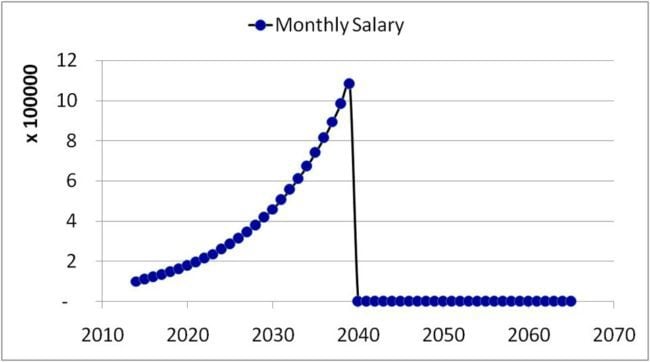
The abrupt stoppage in income represents retirement.
2. Now imagine how your monthly expenses will evolve in the future
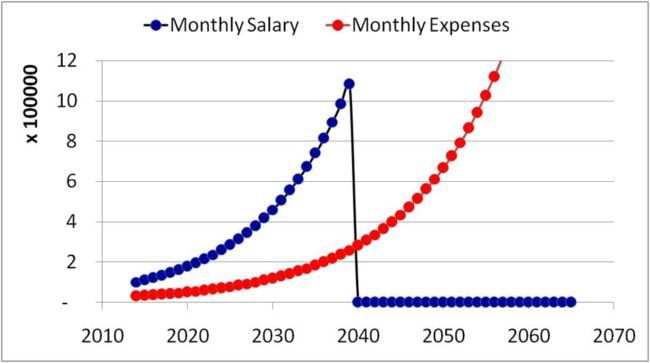
Obviously expenses do not stop when income stops. So those who do not have the means to account for expenses when income stops better hope they are dead on or before retirement!
🔥Secure your future with our Robo-advisory tool trusted by over 3,500 investors and advisors. From effortless retirement planning to funding your children’s biggest dreams, turn your financial goals into reality. 🔥
Subscribe for money management solutions via email! (Link takes you to our email sign-up form) Join 32,000+ readers in our community.
👉 New Tool Alert! NaviPlan: A Privacy-Focused Multi-asset Tracker and Goal Planner 👈
The expenses in the above graph seem to head for the roof. Let us rescale it over our expected lifetime.
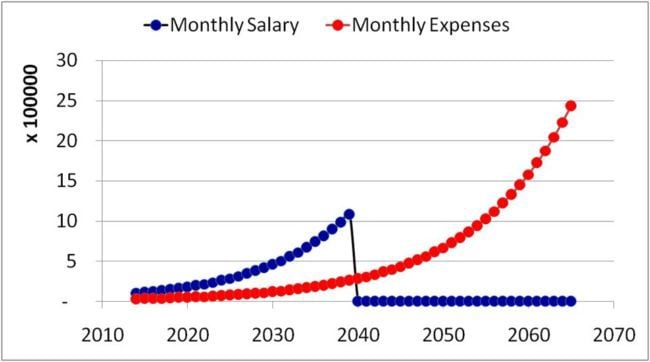
In about 15 years after retirement, the monthly expenses, thanks to inflation, is higher than the last drawn pay!
Meaning that if I had an (imaginary) monthly pension that equals my last drawn pay, I would only be financially independent for about 15 years after retirement. So we need to do a lot better!
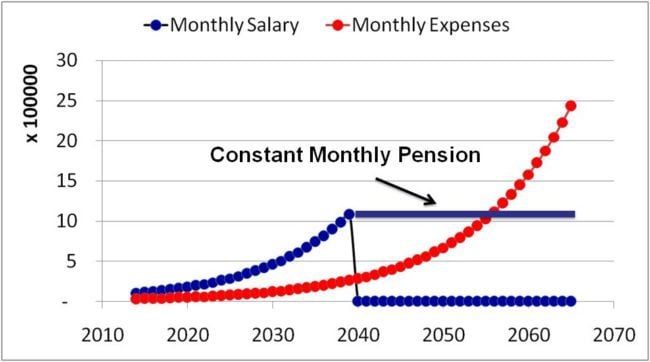
The sad truth is actual pensions (be it from a pension plan or employer-provided annuity) are much, much lower than the last drawn pay—something like this.
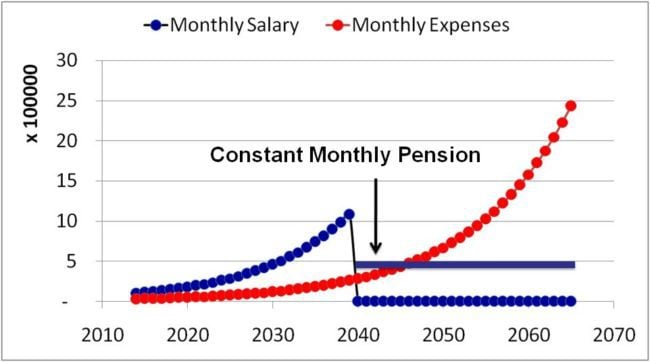
Therefore, for your own sake, tell yourself that a pension is not enough for financially independendent retirement.
Instead, think of inflation-protected income (blue dot within the red circles below)
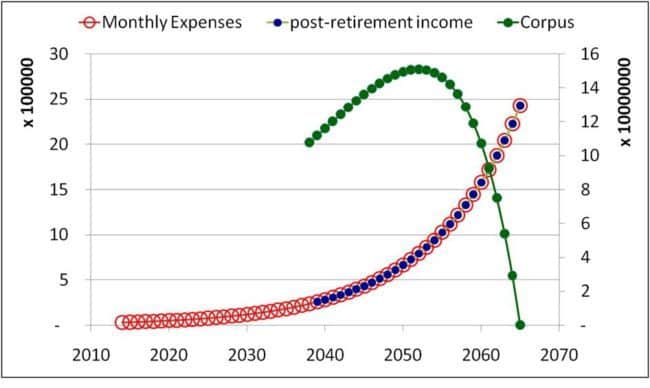
To generate this inflation-protected income, you need a corpus that is between ~ 25-35 times (depending on inputs) your annual expenses at the time of retirement (the earliest green dot). As you withdraw more and more from the corpus, it decreases and drops to zero, hopefully when you die, and only when you die. Ensuring this is the third stage in retirement planning.
The second stage is to ensure our investments grow and hit the first green dot when we retire.
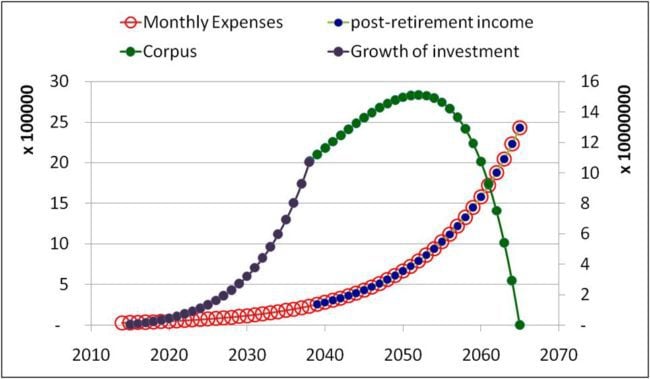
We need to do two things to grow the corpus. 1. Choose a productive but diversified portfolio; 2. Invest
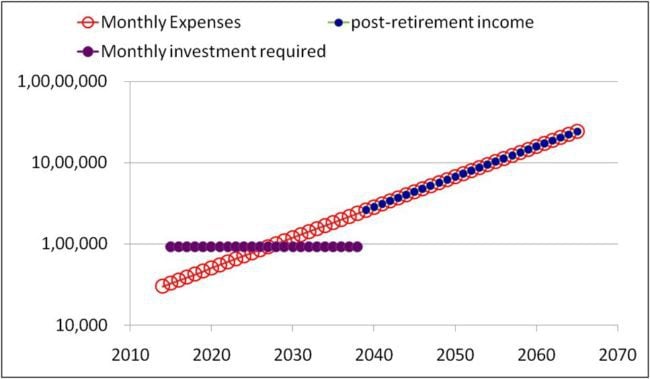
One cannot choose to invest a constant sum because the monthly investment to be made immediately will be much larger than monthly expenses. The above graph has a logarithmic y-axis, and hence the lines appear linear.
To ease our burden, we can instead choose to increase our investment each year from now until retirement.
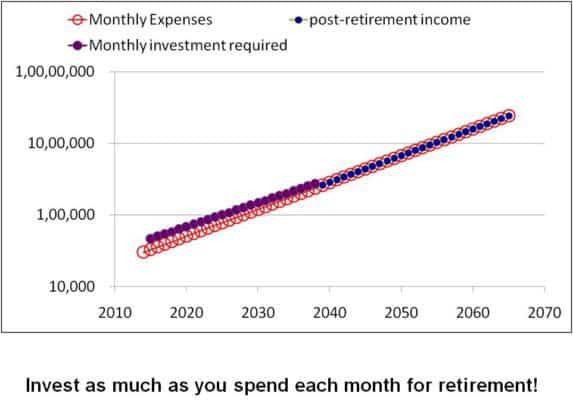
This would imply we must strive to invest as much as we spend.
This is easier said than done. Let us have a look at the second graph again.
In this picture, the gap between the monthly salary and monthly expenses increases as we approach retirement. If this is how our lives pan out, then we can manage to invest as much as we spend with a little effort and discipline.
Unfortunately, our expenses tend to grow in steps, as shown in green below.
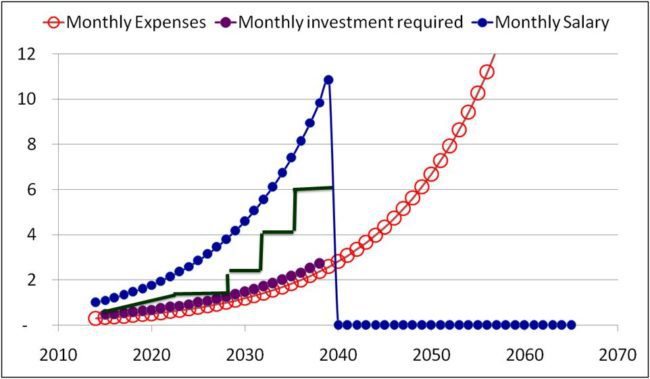
Call it lifestyle creep if you like. If we embrace every new technology that arrives, if we cannot distinguish between our needs and wants, if we succumb to peer pressure and buy what others buy, we will never be able to invest enough.
Meaning we are sowing the seeds for our future financial doom today.
Lifestyle creep, the desire to spend for today and enjoy when young, resides in all of us. What is needed is a definite boundary: We can spend the way we wish as long as we can manage to invest as much as we can.
Safeguarding that boundary is the first and foremost step of retirement planning.
If you want to get started with your retirement planning, our robo advisory tool will help you create a complete financial plan.