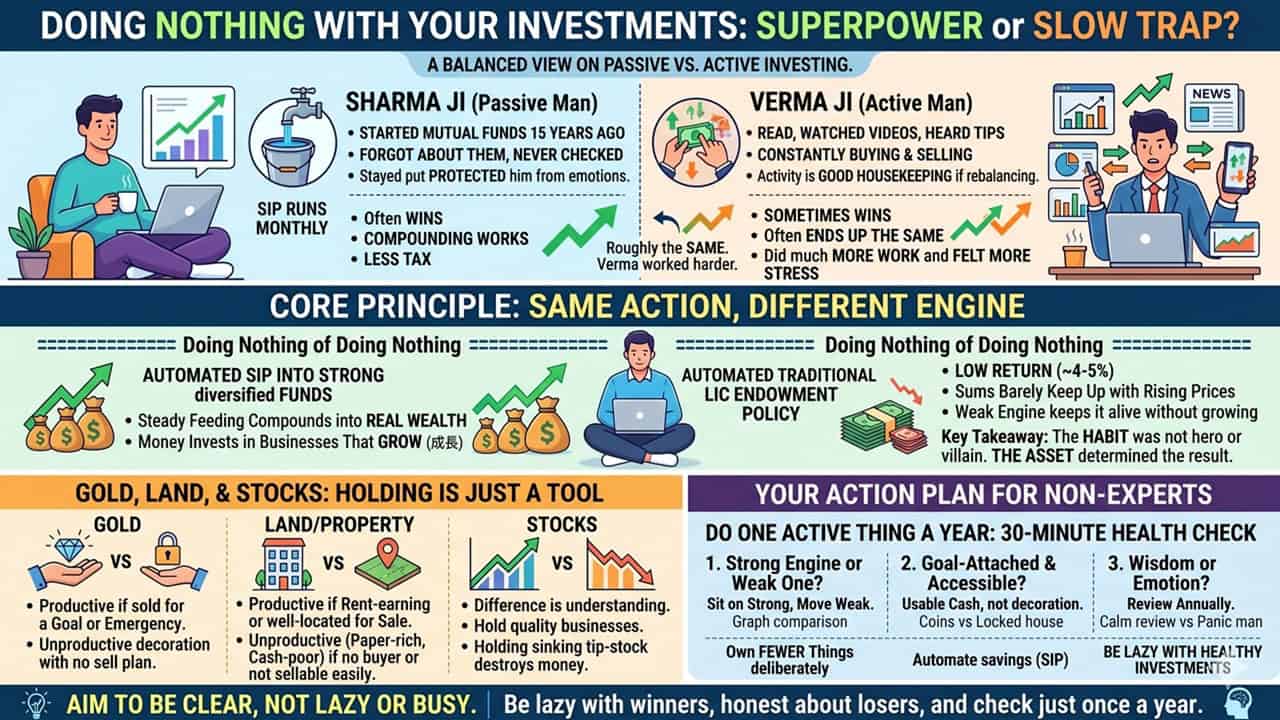
Let me tell you about two neighbours. Sharma ji started a few mutual funds 15 years ago, then got busy with life and basically forgot about them. Never checked, never sold. The SIP just ran every month like a quiet tap filling a bucket.
Verma ji was the active one. He read, he watched videos, he heard tips. Every few months, he sold something and bought something better. Always busy with his money.
Now, the usual story ends with the lazy man becoming a crorepati and the busy man ending up poor. Do nothing, win everything. But that is a fairy tale. Real life is more honest than that, and more interesting.
About the author: Ajay Pruthi is a fee-only SEBI-registered investment advisor. He can be contacted via his website plnr.in. Ajay is part of the freefincal list of fee-only advisors and fee-only India.
First, the truth about Sharma ji and Verma ji
🔥Secure your future with our Robo-advisory tool trusted by over 3,500 investors and advisors. From effortless retirement planning to funding your children’s biggest dreams, turn your financial goals into reality. 🔥
Subscribe for money management solutions via email! (Link takes you to our email sign-up form) Join 32,000+ readers in our community.
👉 New Tool Alert! NaviPlan: A Privacy-Focused Multi-asset Tracker and Goal Planner 👈
After 15 years, here is what actually tends to happen, and it is not one clean answer.
Often, Sharma ji wins. Not because he was clever, but because by sitting still he let compounding work, paid less tax, and avoided the classic mistake of selling the boring fund to chase the exciting one right before it cooled off. Staying put protected him from his own emotions.
But sometimes Verma ji wins too. If he genuinely moved out of a weak fund into a stronger one, or trimmed an overheated stock and rebalanced sensibly, his activity may have added a little. Not all action is foolish. Some of it is good housekeeping.
And very often, they end up roughly the same. This surprises people. Verma ji’s clever moves cancelled out, some good, some bad, minus taxes and costs, and he landed close to where Sharma ji landed by doing nothing. He just did a lot more work and felt a lot more stress to reach the same place.
So the first lesson is this. Activity is not the same as progress. Doing more does not guarantee more. But doing nothing does not guarantee more either. It depends on what you are doing and what you are sitting on.
Same action, different engine: two SIPs that end very differently
Here is the cleanest way to see it. Take two people who are both, in plain terms, doing nothing.
The first picks a few good, diversified mutual funds and starts an SIP. Every month, money is automatically debited from the account. He never checks, never switches, never fiddles. He is doing nothing.
The second buys a traditional LIC endowment policy. Every month, or every year, the premium leaves the account automatically. He too never checks, never changes anything. He is also doing nothing.
From the outside, their behaviour is identical. Same discipline, same auto-debit, same patience, same fifteen or twenty years of leaving it alone.
But the engine under the two is completely different. The mutual fund money is invested in businesses that grow, so the steady feeding compounds into real wealth. The endowment premium mostly goes into a low-return product, often giving around four to five percent a year, while a part quietly pays for a small insurance cover and costs. After twenty years, the first person may have built serious wealth. The second has a modest sum that grew in number but barely kept up with rising prices.
Notice what this tells us. Doing nothing was not the hero, and not the villain. The same faithful, do-nothing habit produced very different results, only because of what the money was sitting in. A steady SIP into a strong engine builds wealth. The same steady payment into a weak engine just keeps it alive without growing it.
Someone will say the LIC policy is simply the safe, debt part of their plan, and every plan needs safety. That is true, every plan does need a stable portion. But even within safe, debt-style options, there are usually better choices than a long-lock-in endowment policy like good debt funds, or fixed deposits, which tend to offer clearer returns and far less lock-in. So the lesson is not that safety is bad. It is that even your safe money deserves a decent engine, not just any product that happens to feel safe.
Gold, land, and stocks: the same idea everywhere
Gold tells the same story. Held quietly for years and then actually used, sold or loaned for a wedding, a medical emergency, or as the family backup in a bad year, it has served Indian families for generations. But gold locked away with the firm belief that we will never sell it, no matter what, only grows on paper. It becomes a proud number you tell relatives, not money that ever helps you. So gold depends on one thing: is it attached to a goal you will eventually use, or is it just sitting there forever and doing nothing?
Land or a plot or flat bought sensibly and later sold to fund a real goal has built serious wealth for many families, and a flat earning rent is doing nothing very productively, growing and paying you monthly. But a far-off plot that earns no rent, has no buyer when you need cash, and cannot be sold in one corner during an emergency leaves you paper-rich and cash-poor. The value is real, but it cannot show up in time when life knocks.
Stocks too. People who understood a business and held it patiently for years did wonderfully. People who bought on a hot tip with no understanding, then held a sinking company for a decade hoping it would come back, destroyed their money. The difference was never hold versus sell. It was understanding versus no understanding.
So here is the conclusion: it genuinely depends
Doing nothing is not a strategy by itself. It is a tool, and whether it helps or hurts depends on what you are holding. So instead of a slogan, here is a simple three-question check.
One, is this a strong engine or a weak one? A good fund, a quality company, a useful property is worth sitting on. A low-return policy or a dead tip-stock will not grow no matter how long you wait. Sit still on the strong ones. Move the weak ones.
Two, is it attached to a goal, and can I actually reach the money? Wealth that can never be used is not wealth; it is decoration. Gold you will never sell, land with no buyer, these fail this test. Ask whether you can turn it into cash when the day comes that you need it.
Three, am I changing it out of wisdom, or out of emotion? Selling a weak fund after a calm yearly review is wise. Selling a good fund in panic because the market dropped, or chasing a new hot one because a cousin bragged at a party, is emotion. Emotion is what makes Verma ji underperform.
The plan for someone who does not follow each and every trend
You do not need to become an expert. You need a system that protects you from both mistakes, doing too much, and doing nothing about the wrong things.
Own fewer things, deliberately. Two or three good funds, an index fund is perfectly fine, beat a zoo of forty. Less to track, less to get wrong.
Automate the saving. An SIP on salary day turns doing nothing into an automatic strength, money invests itself whether you feel like it or not.
Be lazy with your healthy investments. Once it is in good funds, leave it alone. Do not sell on fear. Do not switch on gossip. This is the patience that quietly builds wealth.
But once a year, do one active thing: a 30-minute health check. Run the three questions across everything you own. Most things you will leave untouched. The weak ones, a poor policy, a dead stock, land with no purpose, are where you act, calmly, once a year.
The final word
Sometimes doing nothing makes you rich. Sometimes doing nothing quietly makes you poor. Sometimes being active helps, and often it just tires you out and lands you in the same place.
There is no universal winner between doing nothing and doing something. The winner is the person who knows which one this particular situation needs, who is patient with good things and willing to act on bad ones.
So do not aim to be lazy. And do not aim to be busy. Aim to be clear. Be lazy with your winners, honest about your losers, and check, just once a year, which is which. That single habit beats both the man who does too much and the man who does nothing at all.