Last Updated on May 7, 2022 at 7:22 am
Several readers have asked us what their debt fund strategy should be in the wake of the interest rate hike by RBI. In this edition of FAQ, we discuss what debt mutual fund investors should do.
Our coverage of the rate hike also includes:
- Explained: Why did RBI increase the REPO rate? How will it impact debt mutual funds?
- Which debt funds fell the most due to the REPO rate hike?
Do check out previous editions of the FAQ:
- FAQ on index investing
- FAQ on Mutual Fund Systematic Withdrawal Plans (SWPs)
- FAQ: Target Maturity Debt Mutual Funds
- FAQ: How inflation affects our ability to manage money
- FAQ on gilt mutual funds: essentials investors should know
- FAQ Super Top-up Health Insurance
1. Noticed that even liquid funds and money market funds fell on May 5th. Why did this happen? I thought that these funds are the least impacted by interest rate changes?
🔥Secure your future with our Robo-advisory tool trusted by over 3,500 investors and advisors. From effortless retirement planning to funding your children’s biggest dreams, turn your financial goals into reality. 🔥
Subscribe for money management solutions via email! (Link takes you to our email sign-up form) Join 32,000+ readers in our community.
👉 New Tool Alert! NaviPlan: A Privacy-Focused Multi-asset Tracker and Goal Planner 👈
The short-term bond market immediately demanded fresh bonds with a higher coupon rate as the RBI move was unexpected. As one can see from the Indian bond yield curve here, the yield in the short-term segment (arrow) moved up (relative to a month ago) much more than the long-term segment.
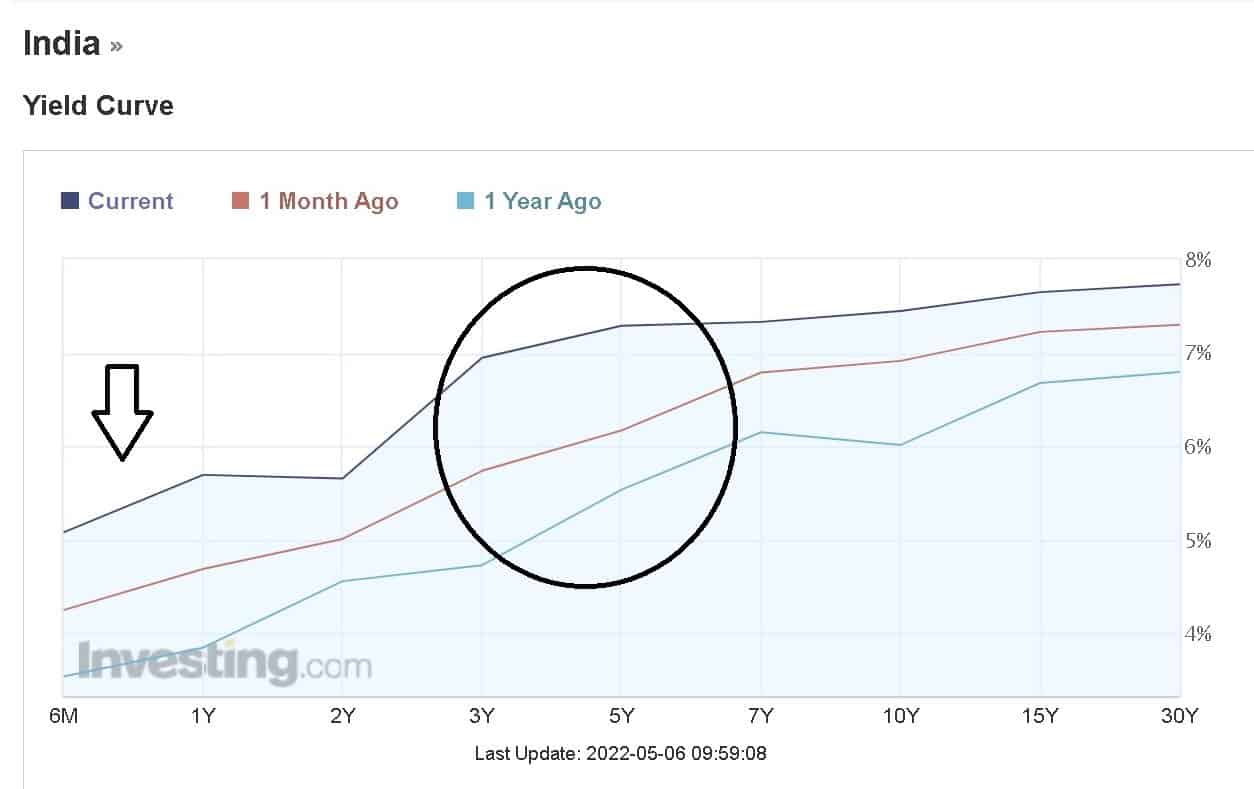
This is because everyone has been expecting a rate hike for months now in the long-term segment. Perhaps the extent of the hike and its timing caught the short-term segment by surprise and the demand for existing bonds dropped resulting in yield hardening and price decrease which resulted in the debt fund NAVs.
2. I noticed that many gilts funds did not fall as much as constant maturity funds or as much as I thought they would. Why is this so?
A 10-year constant maturity fund as the name suggests is inflexible in terms of where it can invest. So its NAV would take a hit. However, funds from other categories with 7-9 years average maturity fell more as the demand and supply forces are the same in every segment of the market. See the oval in the above picture and Which debt funds fell the most due to the REPO rate hike?
Also, gilt funds are essentially dynamic bond funds and had ample time to decrease the average maturity of the portfolio. See: How Dynamic Bond Funds are preparing for an interest rate hike.
3. Should I exit from my gilt funds? If you invested in these for long term goals fully aware of the risks, you can continue. If not it is better to exit. If there are further rate hikes, the NAV of these funds will fall further.
4. Is this a good time to start investing in gilt funds? This response is only for those who want to opportunistically invest in gilts. Those invested in gilt funds for long term goals can ignore this.
In our opinion, it is better not to buy gilt funds at the bottom of the rate cycle. “Buy the dip” can be terribly frustrating and it may take months and months or even a few years for gilts to recover. We had earlier published a momentum-based gilt-fund entry and exit strategy. We shall update the results soon. For those interested, the model has been saying “sell” since July 2021. Please note this is only for those who prefer tactical play.
I am invested in the ICICI Gilt fund – Why I partially switched from ICICI Multi-Asset Fund to ICICI Gilt Fund – and I shall continue investing in it as per my desired asset allocation.
5. Should I choose floating rate funds now? No. It is unnecessary and complicated. Those who wish to get better returns from their debt portfolio due to the rate hike can simply buy liquid funds or money market funds. See: Should we invest in floating-rate MFs to benefit from interest rate hikes? However, higher gains in these funds are subject to future rate hikes and their frequency. One should expect a magical transformation!
6. What kind of funds should I choose to get good returns in the near future? As answered in question 5. Again this is only for those who wish to benefit from this macroeconomic decision (rate hike to curb inflation).
7. Will there be future rate hikes? Highly likely but it may not happen every quarter!
8. Will the stock market crash because of rate hikes? No. However, sustained rate hikes could mean a sideways market until there is some sudden bad news for it to crash or until investors believe the future is reasonably bright for it to move up.
We recommend that investors do not engage in tactical play and invest in both gilt funds or liquid/money market funds as per their needs.