We profile debt mutual funds from time to time in our fund profile section. This time we consider SBI Magnum Ultra Short Duration Fund. Launched in May 1999, the fund currently has an AUM of Rs. 12,513 Crores.
What is an ultra-short duration fund? Ultra-short duration funds are defined as “investment in Debt & Money Market instruments such that the Macaulay duration of the portfolio is between 3 months -6 months.
Ultra short duration funds are NOT the same as Ultra short-term funds.
What is a Macaulay Duration?
The Macaulay duration is defined as the amount of time it takes to recoup our investment.
Let us under this via an example. If the following discussion is a bit hard for you to understand, you can read the basics in this article: Why you need to worry about “duration” if your mutual funds invest in bonds (the following example is also from this article). Do not invest in debt mutual funds without understanding the risks! Download our free e-book: A Beginner’s Guide To Investing in Debt Mutual Funds
Suppose an Rs. 1000 bond was issued at a coupon rate (interest rate) of 8%. So Rs. 1000 is the original price of the bond, and the interest payment each year is Rs. 80.
We wish to buy this bond, and there are two more years for maturity. The current yield is 8% (same as the original rate); therefore, the current price is also Rs. 1000.
🔥Secure your future with our Robo-advisory tool trusted by over 3,500 investors and advisors. From effortless retirement planning to funding your children’s biggest dreams, turn your financial goals into reality. 🔥
Subscribe for money management solutions via email! (Link takes you to our email sign-up form) Join 32,000+ readers in our community.
👉 New Tool Alert! NaviPlan: A Privacy-Focused Multi-asset Tracker and Goal Planner 👈
After 1Y, we will receive the interest of Rs. 80. After 2Y: Rs 80 + Rs. 1000 = Rs. 1080.
Now out of the Rs. 1000, we paid, say
Rs. X will become Rs. 80 after 1Y at the current yield of 8%. X = 80/(1+8%) = Rs. 74.07
Rs. y will become Rs. 1080 after 2Y at the current yield of 8%.
Y = 1080/(1+8%)^2 = Rs. 925.93
Rs. X + Rs. Y = Rs. 1000 = the amount we paid to buy the bond.
Let us look at this in another way.
X/1000 of the original investment will be locked in for 1Y, or
Rs. (X/1000) x 1 Year = Fractional lock-in period of Rs. X = 0.07 years (see table below)
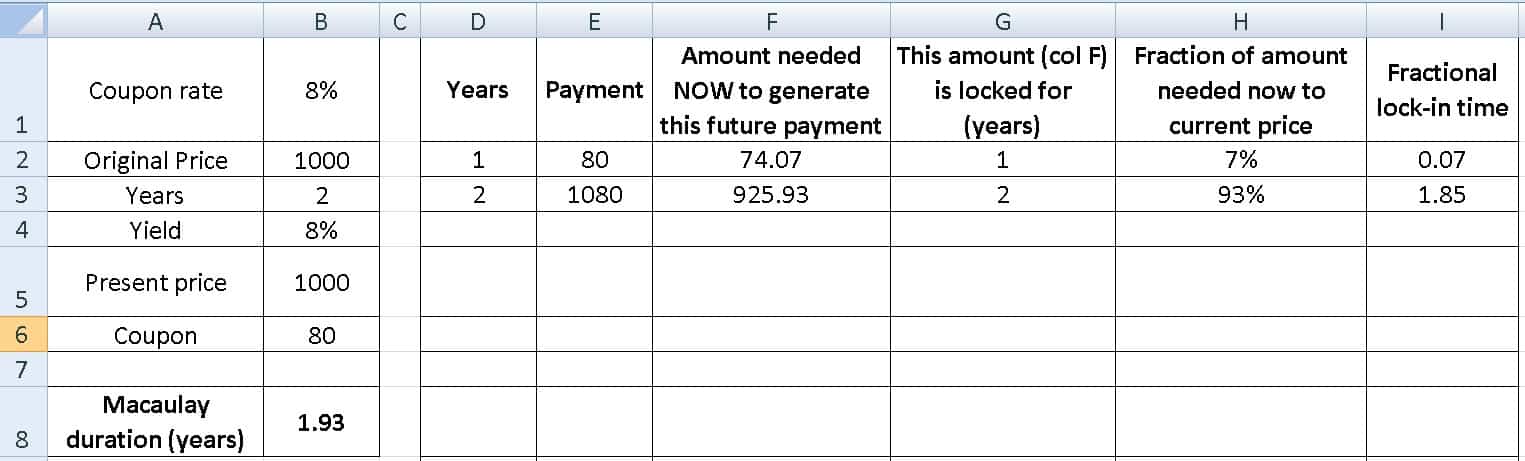
In other words, if Rs. 1000 is locked in for one year, how long should Rs. X be locked in for the same yield in investment:
This is (X/1000) x 1 Year = 0.07 years
Similarly, Y/1000 for the original investment will be locked in for 2Y, or
Rs. (Y/1000) x 2 years = Fraction lock-in period of Rs. Y. =1.85 years
Or, If Rs. 1000 is locked in for two years, how long should Rs. Y be locked for the same yield in investment:
This is (Y/1000) x 2 Years 1.85 years
Macaulay Duration = 0.07 + 1.85 = sum of fractional lock-in periods = 1.93 years.
That is, after 1.93 years, you would have effectively recouped your investment even though you will get your money back only after 2Y.
So SBI Magnum Ultra Short Duration Fund should invest in such a way that its Macaulay Duration is between 3 to 6 months. This does not mean it will invest in bonds maturing within six months!!
The change in the definition of this category is most unfortunate, as one can see from the portfolio Maturity profile of SBI Magnum Ultra Short Duration Fund.
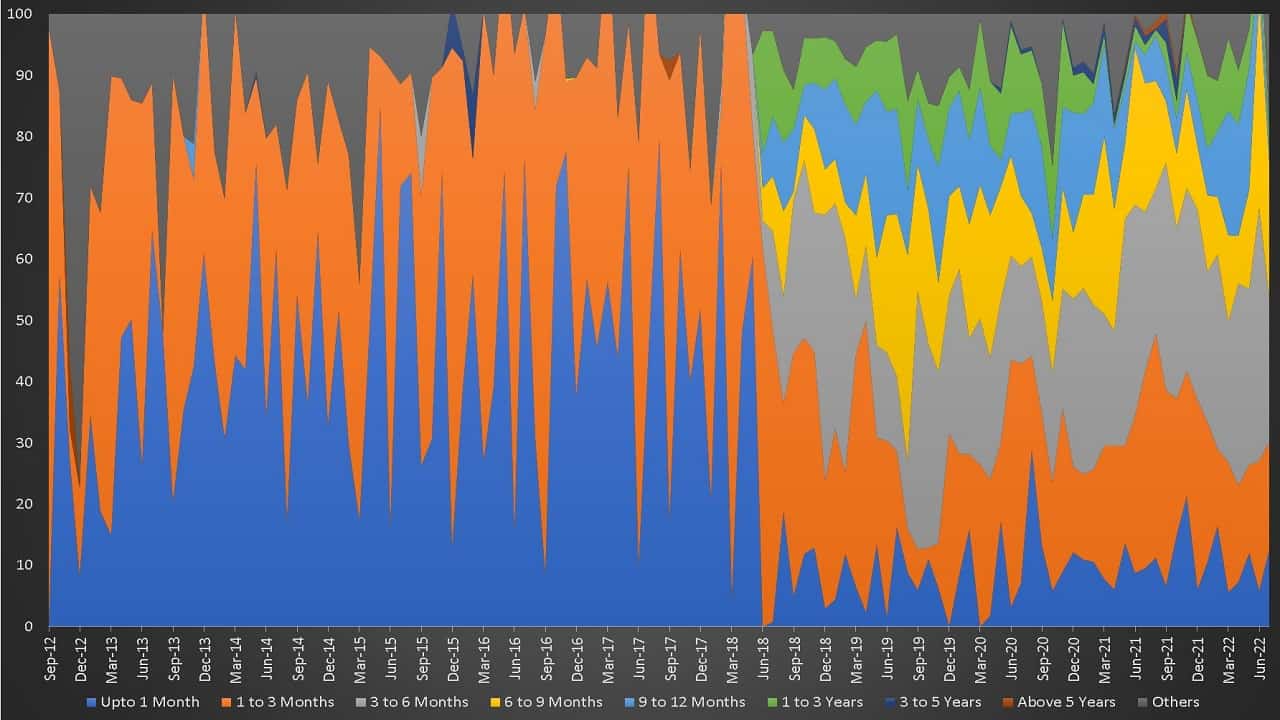
Before the new SEBI definition, the fund only invested in bonds with a maturity of up to three months and cash. Now it holds bonds with 1-3 years of maturity. This spread in maturities makes this category more complicated.
The average maturity profile of the fund is shown below in black. The modified duration – a measure of interest rate sensitivity – is also shown along with the yield to maturity (right axis).
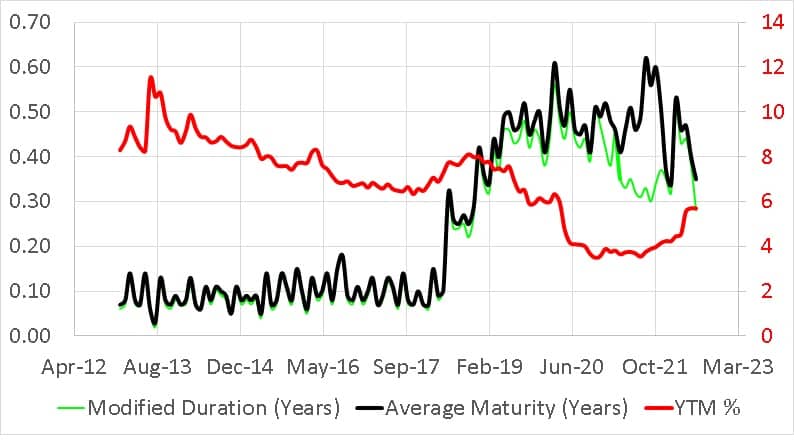
The increase in maturity and interest rate sensitivity after the SEBI mutual fund categorization rules came into force can be clearly seen. Also, once see the variable yield to maturity. This means the returns on these funds have come down considerably over the last few years but may increase due to the interest rate hikes.
The five-year rolling returns compared with the CRISIL 1=year treasury bill index are shown below.
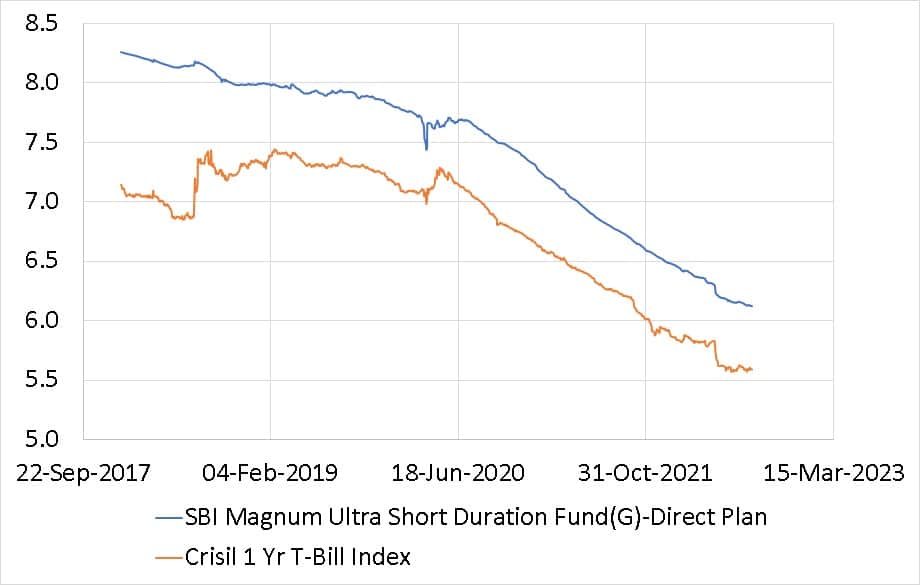
Notice a strong drop in returns over the last few years due to falling interest rates. Investors must appreciate that debt mutual funds are market-linked products, and one cannot fixate on a particular return from them.
The credit rating profile of the fund is shown below.
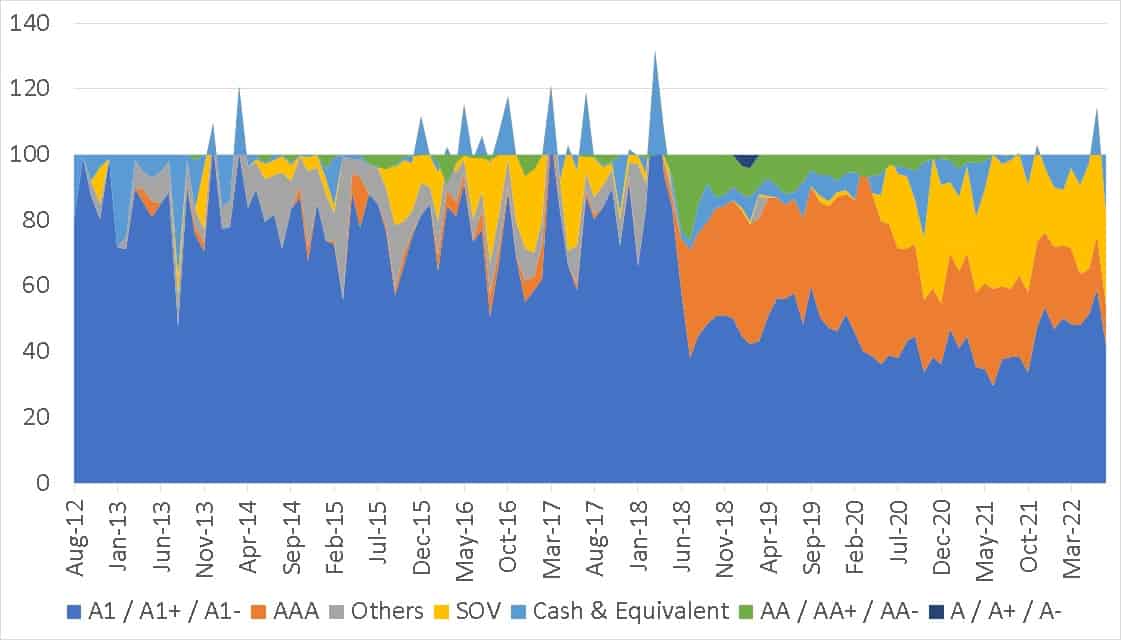
A1+ is the short-term (<1Y) bond rating equivalent of AAA, which is given for longer-term bonds. The change in the nature of the fund after the SEBI categorization is evident again. The fund also invests a small portion in AA-rated bonds as well from time to time The spikes above 100% represent bond derivates like interest rate swaps. There will be a corresponding negative entry in the portfolio, so the sum is 100%.
Can we invest in SBI Magnum Ultra Short Duration Fund? Yes, but only if you recognise the risks. It is meant for investors who can stomach guaranteed higher risk than liquid funds or money market funds for potential higher reward.
For what durations can we choose this fund? For durations higher than three years. To appreciate this reasoning, see: How to start investing in debt mutual funds – a primer.