Last Updated on December 29, 2021 at 12:02 pm
This is a performance review of HDFC Hybrid Equity Fund and its old avatar HDFC Balanced. As we did last week with ICICI Prudential Equity & Debt Fund (ICICI Balanced), we shall use Nifty 100 TRI as the benchmark. We shall also use both ICICI Equity & Debt and ICICI Balanced Advantage as additional benchmarks.
The idea is to scout for aggressive hybrid and balanced advantage funds that have either beat large-cap benchmarks or have produced comparable returns. This way, investors can get decent returns with guaranteed lower risk, justifying their choice of active funds instead of switching over to index funds.
HDFC Hybrid Equity Fund: History
In a baffling and messy response to the SEBI categorisation rules, HDFC decided to close both its balanced funds HDFC Balanced and HDFC Prudence and merge them with unknown funds! From June 1st 2018, HDFC Balanced and its AUM was moved to HDFC premium multi-cap and then renamed as HDFC Hybrid Equity Fund. HDFC Prudence also met a similar fate and became a balanced advantage fund.
As explained earlier: What now for HDFC Prudence and HDFC Balanced Investors?!, HDFC Hybrid Equity will remain a balanced fund (min 65% direct equity exposure) and there is only a marginal change in the asset allocation.
🔥Secure your future with our Robo-advisory tool trusted by over 3,500 investors and advisors. From effortless retirement planning to funding your children’s biggest dreams, turn your financial goals into reality. 🔥
Subscribe for money management solutions via email! (Link takes you to our email sign-up form) Join 32,000+ readers in our community.
👉 New Tool Alert! NaviPlan: A Privacy-Focused Multi-asset Tracker and Goal Planner 👈
However, investors will have to handle this merge carefully when calculating returns. If you download the NAV from AMFI fro HDFC Hybrid Equity, it will give you the NAV of HDFC Premier Multi-cap prior to Jun 4th 2018. I do not know how start rating portals have handled this change. If you are interested, this is how to calculate returns correctly across the merger: Mutual Fund Mergers: how to track investments, calculate returns and pay capital gains tax post-merger
If you use the freefincal mutual fund and financial goal tracker, you can easily calculate consolidated returns. This is the merged NAV of HDFC Hybrid Equity Fund
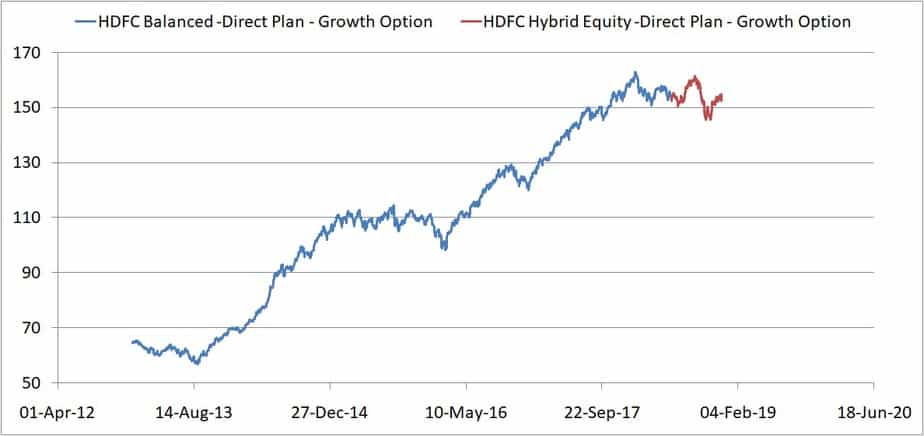
In what follows, we will use the above NAV history for analysis. If we look at historical annual returns Value Research has listed, it appears as if HDFC premier multi-cap performance! So I think the 4-star rating that you see there is probably not for HDFC balanced! Another wrong start rating?
Rolling Returns and Risk over three years
So let us now look at the rolling returns and risk of HDFC Hybrid Equity Fund compared with Nifty 100 TRI, NIfty 100 Equal Weight TRI, ICICI Balanced Advantage and ICICI Equity & Debt Fund.

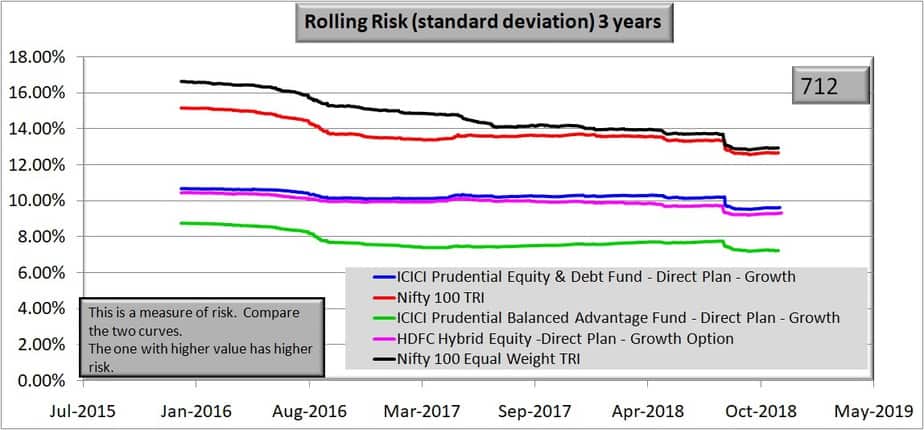
That is pretty awesome! There is practically no difference between HDFC Hybrid Equity and ICICI Equity & Debt Fund! Note that ICICI Balanced Advantage is a lower risk and lower return fund and that is good too. Let us now see the same graphs over 4 and five years. What was 700+ return and risk (standard deviation) data points for 3Y will decrease in number.
Rolling Returns and Risk over four years

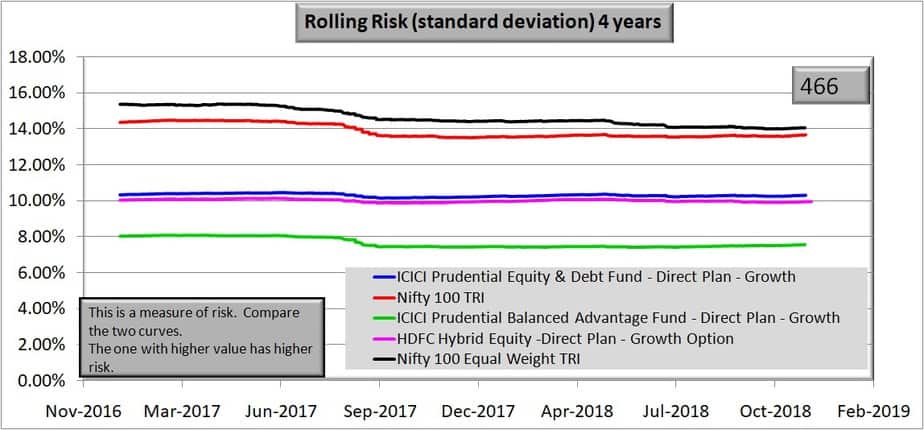
Rolling Returns and Risk over five years
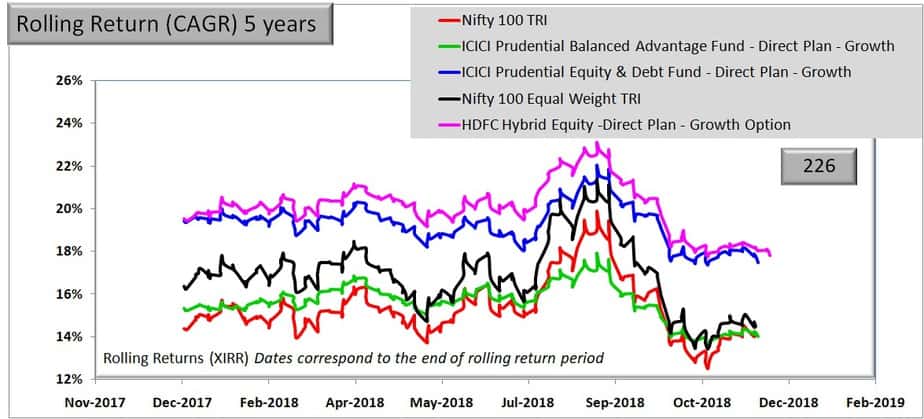
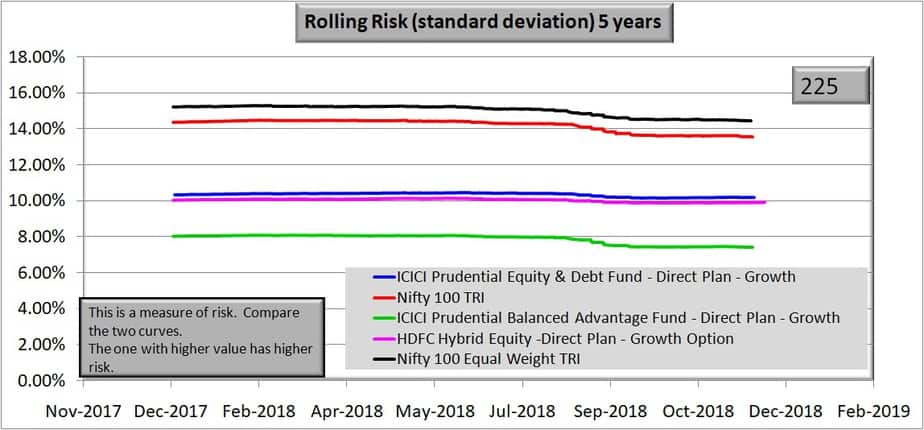
The 3Y performance has repeated over 4 and 5Y.
Video Version
Summary
Overall I think HDFC Hybrid Equity or HDFC Balanced (since we are studying its history) has an impressive track record and there is no reason for existing investors (including me) to leave it. I think the performance is good enough for new investors to consider it too.
However, choose this fund only if you do not have any other aggressive hybrid or balanced advantage fund in your portfolio. In fact, such funds can form the core of your portfolio as explained here: Why Aggressive Hybrid (balanced) Mutual Funds score over diversified funds
Watch the latest from freefincal @ youtube
Watch other mutual fund reviews