Last Updated on December 29, 2021 at 5:20 pm
A SIP in Hindustan Unilever (HUL) since Sep 2002 would have generated a growth equivalent to 31.22% annualized return! Out of which 1.6% is from dividends. An analysis.
Before we begin, you can now watch for free the first lecture of the goal-based portfolio management lecture series. The contents of the course and FAQ can also be found there.
Stock back-test analysis like this one has multiple limitations and biases. It is important to recognise these before proceeding. It is assumed in this study that HUL was continuously part of Sensex from Sep 2002 till date. There is no concrete freely accessible single source of evidence to support this.
🔥Secure your future with our Robo-advisory tool trusted by over 3,500 investors and advisors. From effortless retirement planning to funding your children’s biggest dreams, turn your financial goals into reality. 🔥
Subscribe for money management solutions via email! (Link takes you to our email sign-up form) Join 32,000+ readers in our community.
👉 New Tool Alert! NaviPlan: A Privacy-Focused Multi-asset Tracker and Goal Planner 👈
The govt on the 25th anniversary of the Sensex released a circular pointing out that HUL was part of the Sensex from inception (Jan 1986) to Jan 2010. Random checks on LIC Sensex Fund factsheets after that show that HUL was part of the Sensex.
Why HUL was chosen? The stock currently occupies 27% of the author’s stock portfolio and is the main reason for this “what if one had started an SIP in X year” study. A study of the oldest Sensex index fund factsheets to find out HULs past presence in the index revealed that in Sep 2002, the Sensex had about 15% exposure (the highest) to HUL (Hindustan Lever then).
This was chosen as a start date to represent an investor choosing the top stock in Sensex to invest in. The assumption here is, one stock a month was purchased as long as the stock was part of the index.
There is clearly a bias in the choice of HUL and a “convenient” start date: what if we systematically purchase a reasonably strong company as long as there is no severe bad news? This study does not factor in the emotions of an investor during periods when HUL landed in controversy
It should be observed the stock price (excluding dividends) went through a decade long “flat Period”. It is not easy to hold the stock, let alone keep buying more during such a time. However, such grit is necessary to make money off the market.
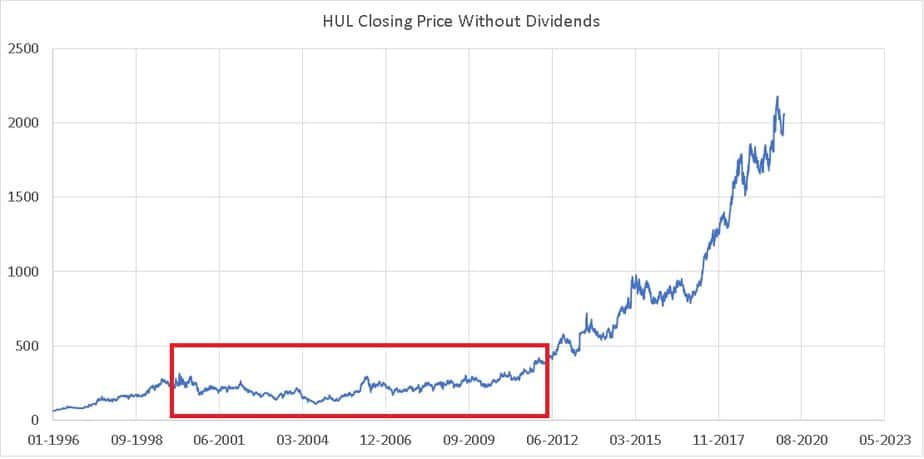
The same date in log scale to highlight the quantum of rise and fall. To understand the benefits of log graphs, see, Are you ready to climb the Sensex Staircase?!
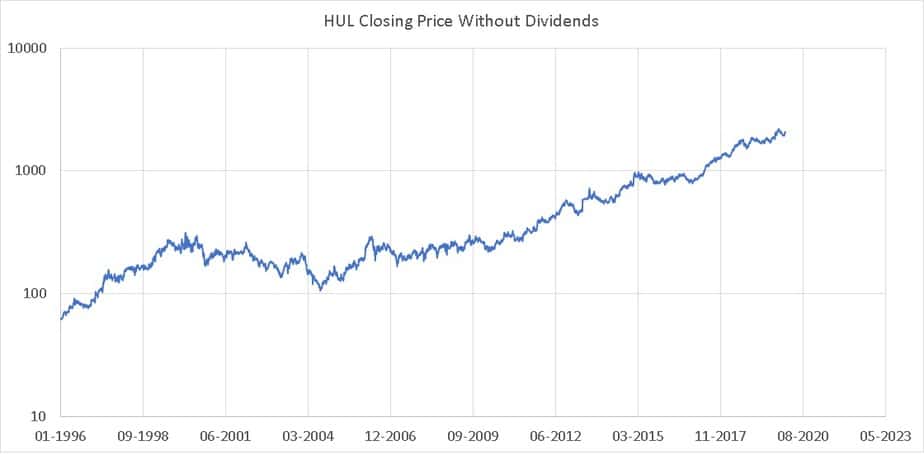
Systematic buying prior to 2002 would have been a lot more volatile.
In addition, one can always argue that HUL was chosen because it was always part of the Sensex. While this was not the case when the numbers were crunched, such an argument cannot be easily refuted. Another issue is HUL was not significantly affected in the 2008 crash
The main inference from this study is just this. (1) Continuous purchase of a strong low volatile company regardless of price levels has a reasonable chance of success. (2) Dividends over a period of time play a big role. (3) Curiosity gets the better of reason! (4) Simplywall.st from which these results are derived (particularly the snowflake shown in the inset in the featured image) provided interesting insights into a stock portfolio. The author is a paid subscriber but not affiliated with them in any other way.
This study is not a recommendation to buy HUL or any other such stock in the index or elsewhere. All other numbers shown below should not take as representative of an investment in the stock or index.
Total no of shares purchased since Sep 2002: 209
Total investment: Rs. 1,22,127
Current Value: Rs. 4,29,892
Divideds (incl above) Rs. 26,388.
Annualized Return (before dividends): 29.62%
Annualized Return (incl dividends): 31.22%
Stock Beta last five years: 0.16
This means the stock was 84% less volatile than the market!
HUL has been a remarkable outlier in the period studied and these numbers should be viewed with extreme scepticism with regard to reproducibility in future. The singular point this study wishes to convey is the benefit of systematically buying low volatile stocks of robust companies.