A reader says, ” How did you manage your emotions for all those years when you had negative or zero returns? I always had this question about your investing journey. How could you keep faith that it will all turn positive one day? I wouldn’t have done it for so many years. Did some sane advice from someone help you? I find that behavioural control is the most important thing”.
“How could you do it at that time when there was not much information probably on the Internet? If you could focus on your psychology or your internal mental turmoil of those years, then it will help many investors sail through the difficult times. People generally boast their success stories, but they hardly go through the difficult times, and what helped them”.
Context: The reader is referring to the gain or loss in my equity mutual fund retirement portfolio up to Dec 2019, shown below. I cannot update this graph as I have rebalanced the portfolio.
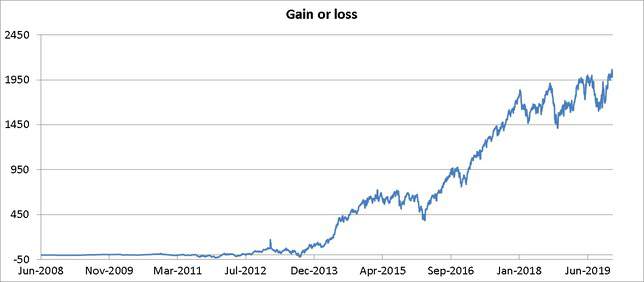
Notice for the first five years and three months, returns were zero. In hindsight, I am thankful I did not quit during those years; otherwise, I would never have achieved financial independence. You see the gains suddenly shoot up due to this graph.
🔥Secure your future with our Robo-advisory tool trusted by over 3,500 investors and advisors. From effortless retirement planning to funding your children’s biggest dreams, turn your financial goals into reality. 🔥
Subscribe for money management solutions via email! (Link takes you to our email sign-up form) Join 32,000+ readers in our community.
👉 New Tool Alert! NaviPlan: A Privacy-Focused Multi-asset Tracker and Goal Planner 👈
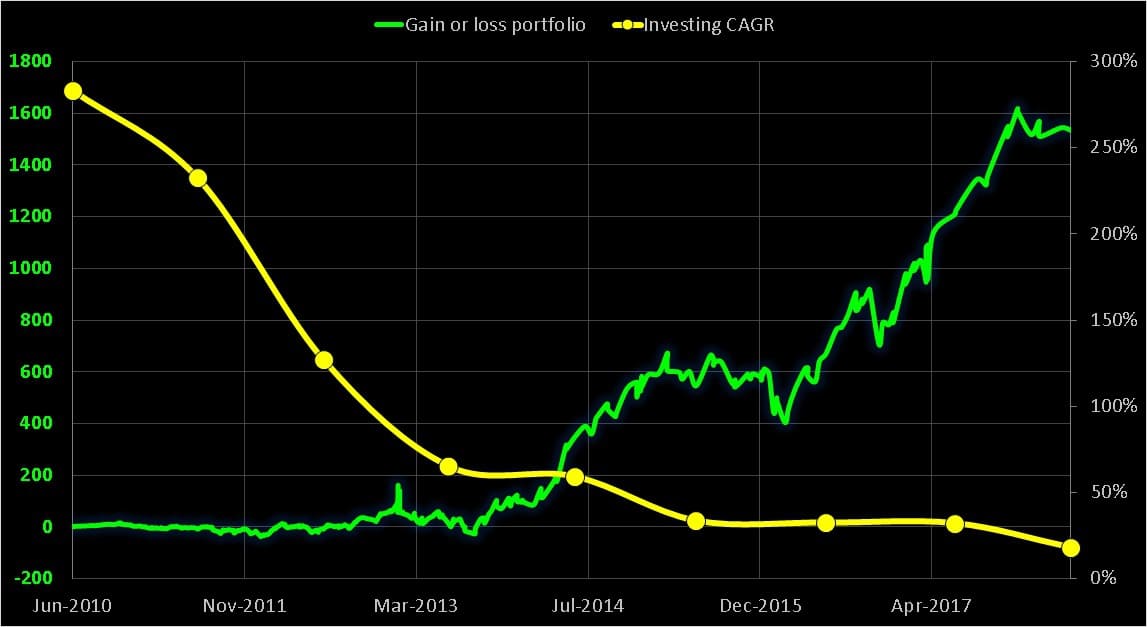
The gain or loss is again plotted (green). The yellow dots represent the annual increase in investment amount. Or What I call the investing CAGR (not investment CAGR). Notice the huge year-on-year growth in the amount invested in equity MFs in 2010, 2011, and 2012. When you dump in money when the market moves sideways, you reap the gains when the tide turns – in my case, around the time when economic conditions were favourable -sheer coincidence.
For updated portfolio details, see:
- Portfolio Audit 2023: The annual review of my goal-based investments
- 15 years of mutual fund investing: My Journey and lessons learned
To answer the reader’s question, multiple factors were at play that enabled me to stay invested through those years.
- I owed my brother-in-law Rs. 3 lakhs (he bailed us out paying for my father’s hospital expenses). I owed myself never to be in debt again. Driven by the fear of debt, I was extremely emotional about financial independence at retirement. And fear is a great stimulus. How the fear of repeating mistakes drove me to financial independence
- I used what I refer to as emotional logic to stay invested. I convinced myself about the need to beat inflation and told myself that I could never do this if I did not invest in equity.
- I recognised that I had immense time – more than 25 years to normal retirement. I could afford to sit it out. Time on our side is the most effective risk mitigation weapon against equity.
- I do not follow the news or opinions on social media at all. This helped me stay calm.
- I tracked how much I invested far more than I looked at the portfolio’s current market value. I should also be thankful that I was not tracking returns.
I was occasionally jittery about seeing the portfolio in red all the time, and I did ask myself if I was doing the same thing. I reassured myself that this was the only way. As Dolly Parton said, “If you want the rainbow, you have to put up with the rain”.
Equity returns are always clumped. Sometimes, it will rain and rain, and sometimes it will dry to the bone. Everyone is yearning for those bumper life-changing returns. It is much simpler to wait for those by being in the market (and investing as much as possible systematically) than staying away from the market and waiting for the right time to enter (or exit).
Caveat: Long-term investing in equity comes with no guarantees of success!