Last Updated on December 14, 2025 at 2:46 pm
I evaluate the performance of my retirement portfolio and my son’s future portfolio each year in a personal finance audit. This is the 11th edition. Published from 2013 onwards, these audits provide a sense of accountability and ensure I do not fall prey to fear of missing out, preventing bad investment decisions. They also point out the fruits of systematic goal-based investing.
I am proud and delighted that several readers have also published their audits at freefincal, inspiring the next generation of DIY investors. We now have close to 50 such articles from readers. See, for example, going from a net worth of Rs. 6000 to auto-pilot goal-based investing. The full list of articles is available at the end of this audit.
Archive: This is the archive of personal finance audits published before: 2013 audit, 2014 audit, 2015 audit, 2016 audit, 2017 audit, 2018 audit, 2019 audit, 2020 audit, 2021 audit and 2022 audit.
To perform a similar audit, refer to this guide – How to perform a portfolio audit? – and use the freefincal robo advisor tool. Then, you can Review and track your goal-based investment portfolio with this auditing tool.
🔥Secure your future with our Robo-advisory tool trusted by over 3,500 investors and advisors. From effortless retirement planning to funding your children’s biggest dreams, turn your financial goals into reality. 🔥
Subscribe for money management solutions via email! (Link takes you to our email sign-up form) Join 32,000+ readers in our community.
👉 New Tool Alert! NaviPlan: A Privacy-Focused Multi-asset Tracker and Goal Planner 👈
Disclaimer: This is a personalised financial audit. No part of this audit should be considered investment advice. My current portfolio is the residue of past mistakes, and my asset allocation reflects my changing goal-based risk appetite.
Overview: 2023 was a quiet year on the portfolio front. I have not rebalanced my portfolio so far. The focus has been on systematic investing and systematic increases in investments. See: Why increasing investments each year is crucial for financial freedom.
These yearly audits took quite a bit of time to publish, but since I shifted from Excel to the freefincal Google Sheets stock and mutual fund portfolio tracker the entire process is automated. One can compare the portfolio anytime with identical investments in benchmark or passive funds (see graphs below).
My wife sold her ancestral property, which was added (after tax) to our retirement corpus. I thought long and hard about whether to shift most of it to fixed income and maintain 60% equity in the portfolio, but considering the time left for retirement (about 16 years), I decided to invest it all in equity.
This was a decision based on greed, and I am not terribly proud of it. Those investments so far have made about 9% absolute return over three months. So, it’s not bad, but the party could come crashing down anytime. The longer that takes, the less regret I would feel. Please note that such asset allocation calls are contextual and unsuitable for everyone.
Retirement
- Asset Allocation: Equity: 64.3%; Fixed income: 35.7% (I don’t know the exact value of my PPF account – long story – the numbers are approximate).
- Equity comprises 88.2% of mutual Funds, and the rest is direct equity.
- Analysis of the stock portfolio is available each month.
- Fixed income with weights (wrt to total fixed income)
- NPS 61.77%, Xirr: 9%
- PPF Wife 8.71%
- PPF Pattu 4.6%
- Cash 4.11% (ICICI Arbitrage + Quantum Liquid)
- ICICI Gilt 17.48% Xirr: 6.07%
- Parag Parikh CHF 3.32% Xirr: 13.85% (This is a recent addition. So don’t get excited)
- Note: The NPS has 15% equity + long-term gilts (majority). The reader, particularly those with the default govt NPS allocation, is cautioned that long-term gilts are extremely volatile. My NPS corpus returns dropped almost half after the July 2013 bond crash. See 13 years of investing in the NPS.
Equity mutual funds
- Overall XIRR since June 2008: 16.99% (last year, it was 14.64% and before that, 19.57%).
- This should not be taken seriously: On March 23rd 2020, after the biggest intraday fall, my retirement equity MF portfolio return was 2.75%. If, after 12 years, the returns could crash to that level, we must learn to evaluate our portfolio by different metrics. This is why goal-based investing is crucial. You cannot buy groceries or a college education with impressive XIRR data!
- Parag Parikh FlexiCap XIRR: 21.21%, Weight: 56.28%
HDFC Hybrid Balanced XIRR: 15.23%, Weight: 19.16%
Quantum Long Term Equity XIRR: 13.26%, Weight: 12.31%
UTI Low Volatility: XIRR: 27.60%, Weight: 12.25% (This is a recent investment, so don’t get too excited!) - Financial independence status: If I retire now, I could live off my corpus for the rest of my insipid life and draw an income that increases with inflation at a rate equal to the portfolio return rate (zero real return).
- My current initial withdrawal rate is about 2%. For an explanation, see: I plan to retire in 25 years; what should be my safe withdrawal rate?
- Those interested in planning for early retirement can consult this free e-book: Early Retirement in India -How to Retire Early Safely.
This is the normalized evolution of my MF retirement portfolio since its inception (Jun 2008), along with an equivalent investment in Nifty 50 TRI. This was plotted with the freefincal portfolio tracker.
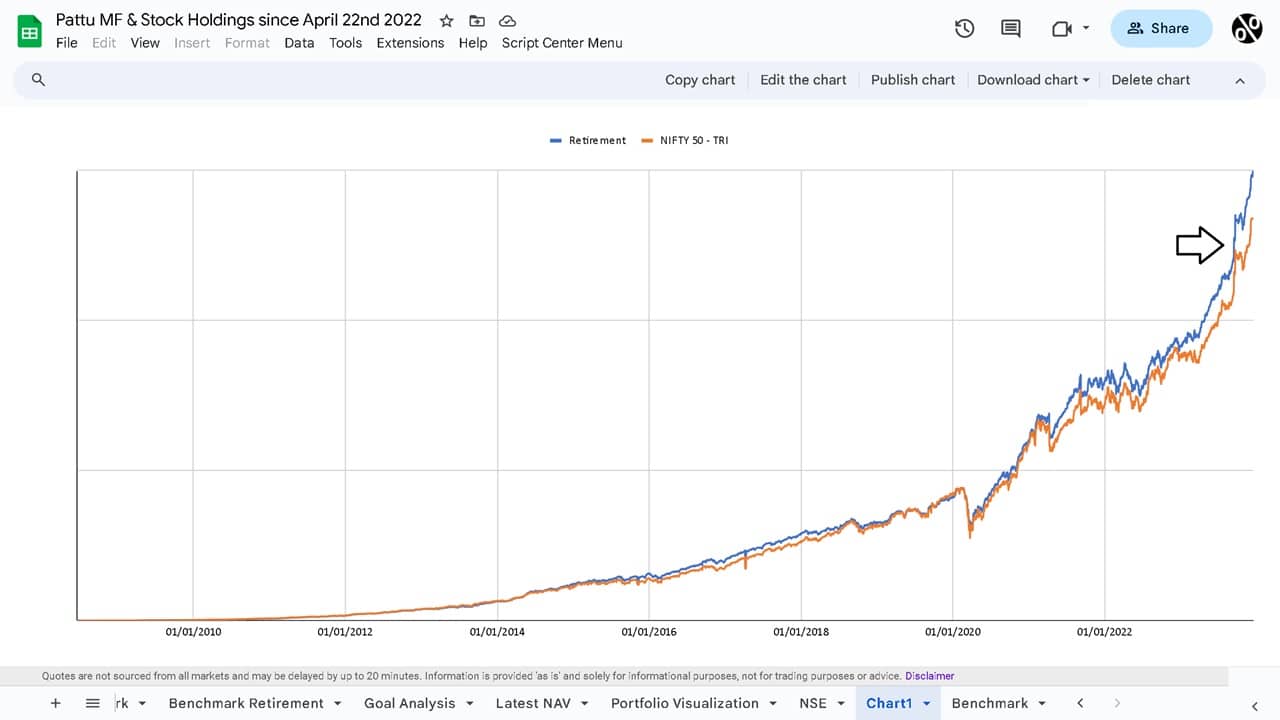
Please do not read too much into the outperformance compared to Nifty 50 TRI. Sometimes it has, and sometimes it has not. It depends on when you look.
The arrow denotes the artefact due to the lump sum investment mentioned above. It is not due to market movement.
Child’s Education
I have invested to fund my son’s future since December 2009 (a month before his birth). Then it was an 18-year-old goal, and now it has become a 4-year-old goal. I reduced the equity allocation from 67% to 55% in 2020. It is currently about 55.6%.
I have not bothered reducing the equity allocation because there are enough fixed-income funds to fund his UG and even PG degree at current costs.
Asset allocation
- Equity: Asset allocation 55.6%. Overall portfolio return: 16.46%
- HDFCBalAdv Xirr: 19.83%, Weight: 30.03%
- ICICI Multi-asset Xirr: 18.26%, Weight 47.40%
- Mirae Largecap Xirr: 15.23%, Weight 22.45%
- HDFC Sensex fund is a recent addition with a small exposure (0.12%). See: My 13-year-old begins his investing journey with an index fund.
- Fixed income Asset allocation 44.4%
- ICICI Arbitrage Xirr: 5.71%, Weight: 25.13% (wrt to total fixed income)
- ICICI Gilt Xirr: 5.95%, Weight: 19.24%
- Parag Parikh CHF: Xirr: 15.10%, Weight: 16.41% (again a recent investment)
- PPF Weight: 39.2%
This is the normalized portfolio evolution since its inception (Jan 2010), along with an equivalent investment in Nifty 50 TRI. This was plotted with the freefincal portfolio tracker.
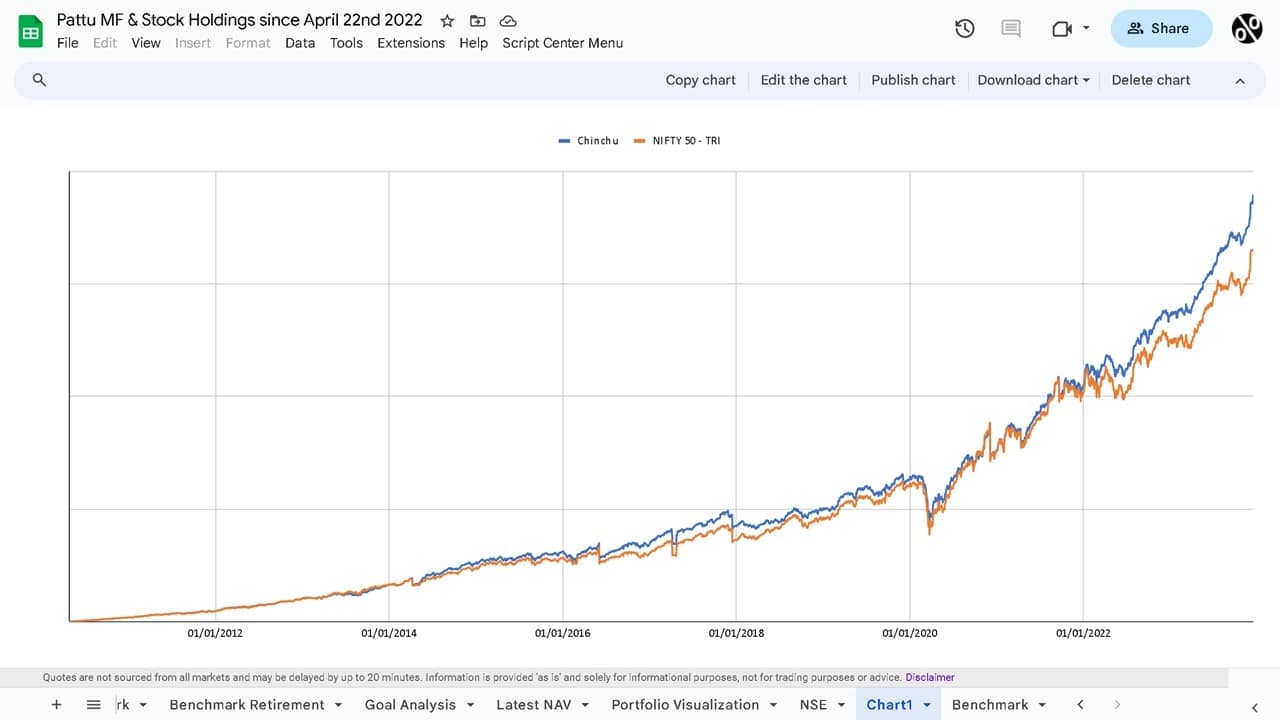
Again, the outperformance should not be taken too seriously. “Chinchu” is one of our many nicknames for our son and the inspiration behind: Teach your kids financial decision-making with our book, Chinchu Gets a Superpower!”
Outlook & Summary
The key advantages I have had are time (starting early) and starting on a clean slate. Time allows you the luxury of handling market downturns, and it also changes your risk outlook.
Ten years ago, I would have said 60-65% equity at age 48 is a bit much. However, I am comfortable with it today and wonder what I should do to leave it at 50-60% even after retirement. Remember, it is all about what the remaining 50-40% in fixed income is worth and building a diversified retirement portfolio. See: How to build the ideal retirement portfolio. So, time changes the way we view market risk. Not starting early can be a severe handicap regarding how much risk we can take and how we handle it later.
If there is one takeaway from my journey, it is to invest like a machine regularly as much as you can without worrying about market movements. If you have the time and mental strength to wait* for two bull runs, your life can change, provided you keep investing regularly as much as possible. * Wait here means wait with the right asset allocation and regular goal-based risk management.
The rate I have increased my investments is higher than its XIRR. See: Why increasing investments each year is crucial for financial freedom. A lavish lifestyle or servicing too much debt can hamper our ability to pay for future goals or maintain our lifestyle in future. Finding a balance is crucial. I am still trying to find mine.
I urge readers to take advantage of the holiday season and vacation (if applicable) to evaluate how much they need to invest for their goals, tag their existing investments to different goals and plan their 2023 investment schedules. The freefincal robo advisor tool can help you create a full financial plan. Then, you can Review and track your goal-based investment portfolio with this auditing tool.
Reader audits published
You can share your investment journey as an article with freefincal readers. Here are some examples.
- First audit: How Suhas tracks his MF investments and reviews financial goals.
- Second audit: How Avadhoot Joshi evaluates his investment portfolio.
- Third audit: How a single mom is on track to financial freedom
- Fourth audit: How Gowtham started goal-based investing & took control of his money
- Fifth audit: Why my financial independence & early retirement plans were postponed by four years
- Sixth audit: How Abhisek funded his marriage & is on track to financial freedom.
- Seventh audit: How Rohit’s early struggles defined his investment journey
- Eighth audit: Why my investments are still on track despite job loss and lower income.
- Ninth audit: How a retirement planning calculation scared me to take action
- Tenth audit: I made several investment mistakes but have turned my life around.
- Eleventh audit: My net worth doubled in the last financial year, thanks to patient investing!
- Update: How I achieved investing nirvana.
- Twelveth audit: My financial journey: from novice to goal-based investor.
- Thirteenth audit: My journey: from a negative net worth to goal-based investing.
- Fourteenth audit: From Fixed Deposits to Goal-based investing in MFs.
- Fifteenth audit: My 10-year financial journey – mistakes made and lessons learnt.
- Sixteenth audit (part 1): How I achieved financial independence without mutual funds or stocks.
- Sixteenth audit (part 2): Lessons from my financial independence journey and future investment plans.
- Seventeenth audit: How I plan to achieve financial independence and move to my native place
- Eighteenth audit: I used the current bull run to reduce my mutual funds from 14 to 4!
- Nineteenth audit: How a conservative investor created his financial plan
- Twentieth audit: I plan to achieve financial independence by 46; this is my master plan
- Twenty-first audit: I have made many investment mistakes but am on course to financial independence by 45.
- Twenty-second audit: I felt worthless six years ago but have achieved financial stability today
- Twenty-third audit: My financial journey was directionless until age 40: this is how I made up for lost time
- Twenty-fourth audit: Why I increased equity MF investments by 275% and reduced PPF contributions.
- Twenty-fifth audit: How I track financial goals without worrying about returns
- Twenty-sixth audit: I am 24 and started investing 1Y ago, but what am I investing for?
- Twenty-seventh audit: How we plan to achieve a retirement corpus 50 times our annual expenses.
- Twenty-eighth audit: I thought equity investing was a gamble, but now I aim to hold 60% equity for retirement
- Twenty-ninth audit: My journey: From 5 lakhs in debt to building a corpus worth six years in retirement
- Thirtieth audit: My investment journey: From random purchases to a goal-based portfolio
- Thirty-first audit: My investment journey: from product-driven to process-driven
- Thirty-second audit: How a young couple is trying to balance travelling and investing
- Thirty-third audit: My journey: From Rs. 30 bank balance to financial independence
- Thirty-fourth audit: Our journey: From scratch to a net worth of 18 times annual expenses.
- Thirty-fifth audit: From a net worth of Rs. 6000 to auto-pilot goal-based investing
- Thirty-sixth audit: How I retired from corporate bondage at 46, two years ago!
- Thirty-seventh audit: How I learnt to keep it simple and build a net worth 19 times my annual expenses
- Thirty-eighth audit: How Abhineeth plans to achieve financial independence and build a house.
- Thirty-ninth audit: How Sahil plans to achieve financial independence by efficient tracking
- Fortieth Audit: My Journey to a Ten Crore Portfolio
- Forty-first audit: Burdened with debt for several years, I am now aggressively investing in equity
- Forty-second audit: From Engineer to Librarian after Financial Independence and Early Retirement (FIRE)
- Forty-third audit: I lost six months’ income in F&O and ditched it for systematic investing
- Forty-fourth audit: My retirement plan to handle the harsh realities of the IT industry
- Forty-fifth audit: My investment journey: mistakes, 10 years of MF investing and recovery
- Forty-sixth audit: My MF portfolio is worth six crores despite multiple mistakes
- Forty-seventh audit: Saving, Investing, and Running Marathons: My 25-year Journey to Financial Independence
- Forty-eighth audit: Never Too Late to start: How I became financially savvy at 40
These published audits have had a compounding effect on readers. If you would like to contribute to the DIY community in this manner, send your audits to freefincal AT Gmail. They could be published anonymously if you so desire.