Last Updated on May 11, 2024 at 3:18 pm
A reader asks, “Sir, I have been reading about the safe withdrawal rate in retirement planning. I am, however, surprised that you do not talk about it. Why is this so? Is there a way to calculate my safe withdrawal rate when I retire 25 years from now? I am presently 30″.
What is a safe withdrawal rate? The safe withdrawal rate (SWR) is the annual withdrawal amount in the first year of retirement divided by the available retirement corpus. Backtests are usually used to determine an acceptable rate. We use equity and debt market data to determine which rate results in the best results: corpus outliving the individual more often than not. Note: The SWR is only the withdrawal rate in the first year of retirement. Withdrawal rates after that will be naturally higher.
Based on US market history, backtests initially determined the SWR to be about 4%, although recent market data have indicated its limitations. For some history and why we need to look for alternatives, see: Why we need to stop using Safe Withdrawal Rate (4% rule) for retirement planning.
There is little point in backtesting using Indian market data because the available history is too short. In any case, our retirement plan should reduce the sequence of returns risk with a combination of retirement buckets and annuities. This is, of course, so much easier to do when retirement is far away, as with your case.
🔥Secure your future with our Robo-advisory tool trusted by over 3,500 investors and advisors. From effortless retirement planning to funding your children’s biggest dreams, turn your financial goals into reality. 🔥
Subscribe for money management solutions via email! (Link takes you to our email sign-up form) Join 32,000+ readers in our community.
👉 New Tool Alert! NaviPlan: A Privacy-Focused Multi-asset Tracker and Goal Planner 👈
The only use for an SWR is to determine if a retiree has enough corpus to distribute them into buckets to try and beat inflation or if she should buy an annuity and not take on market risk. For example, if the SWR (annual expenses in the first year of retirement divided by available corpus) turns out to be 6%, then an annuity is safest.
Even though the income cannot match up to inflation with an annuity, there will be some income for the retiree’s lifetime. If, on the other hand, we hand taken on market risk with the corpus, it may get depleted before she passes.
But this is easy to deduce for high SWRs. What about 5% or even 4% (since widespread agreement exists that even this is high)? This is why our robo advisory tool never bothers with the SWR.
To combat a bad sequence of returns at the start of retirement, we use an income bucket that guarantees an inflation-indexed income for the first 15 years of retirement. The rest of the corpus is invested in a low-risk, medium-risk, and high-risk bucket with a separate emergency stash. This minimises bucket maintenance and uncertainty.
Detailed illustrations are available here:
- I am 30 and wish to retire by 50 how should I plan my investments?
- Retirement plan review: Am I on track to retire by 50?
In addition, two further options are available.
- We can set up an income floor. That is, buy an annuity or an RBI bond for some portion of the annual expenses in the first year of retirement. This income is guaranteed for the lifetime of the younger spouse. See, for example: Creating the ideal retirement plan with income flooring!
- We can periodically buy such bonds (bond ladder) or annuities (annuity ladder) so that the stress of managing retirement buckets is further reduced. See: Use this annuity ladder calculator to plan for retirement with multiple pension streams.
So our aim should not be to focus on some fixed SWR. It should be to ask, “how best am I prepared for poor returns from equity and fixed income after retirement?”
For what it is worth, we mention the withdrawal rates for the above scenarios using the freefincal robo advisory tool.
Assumptions and inputs
- Age 30; Age of spouse: 28
- Current monthly expenses that will persist in retirement: Rs 50,000
- Retirement age: 55
- Years to retirement 25
- Total average monthly expenses (annual/12) 50,000
- Percentage by which your monthly investments can increase each year (until you have accumulated enough for retirement) 10%
- Post-tax return expected from equity investments 10%
- Post-tax return expected from current taxable fixed income 5%
- Rate of return expected from current tax-free fixed income 6%
- Inflation before retirement 7%
- The assumed life expectancy of the younger spouse: 90
- Inflation during retirement 6%
- Monthly expenses in the first year of retirement Rs. 2,71,372
- Years in retirement (until younger spouse reaches age 90) 37
- Corpus already accumulated is assumed to be zero for convenience.
Result 1: Corpus required with no income flooring or laddered annuity: Rs. 9.82 Crores. Withdrawal rate: 3.31% (withdrawal rate here only refers to the value for the first year in retirement).
Result 2: Corpus required with 100% income flooring (single monthly annuity = monthly expenses in the first year of retirement): Rs. 13.08 Crores. Withdrawal rate: 2.49%
Result 3: Corpus required with annuity laddering: Rs. 25.40 Crores. Withdrawal rate: 1.28%
This is an example. The steps can be altered as desired via the inputs in the robo tool.
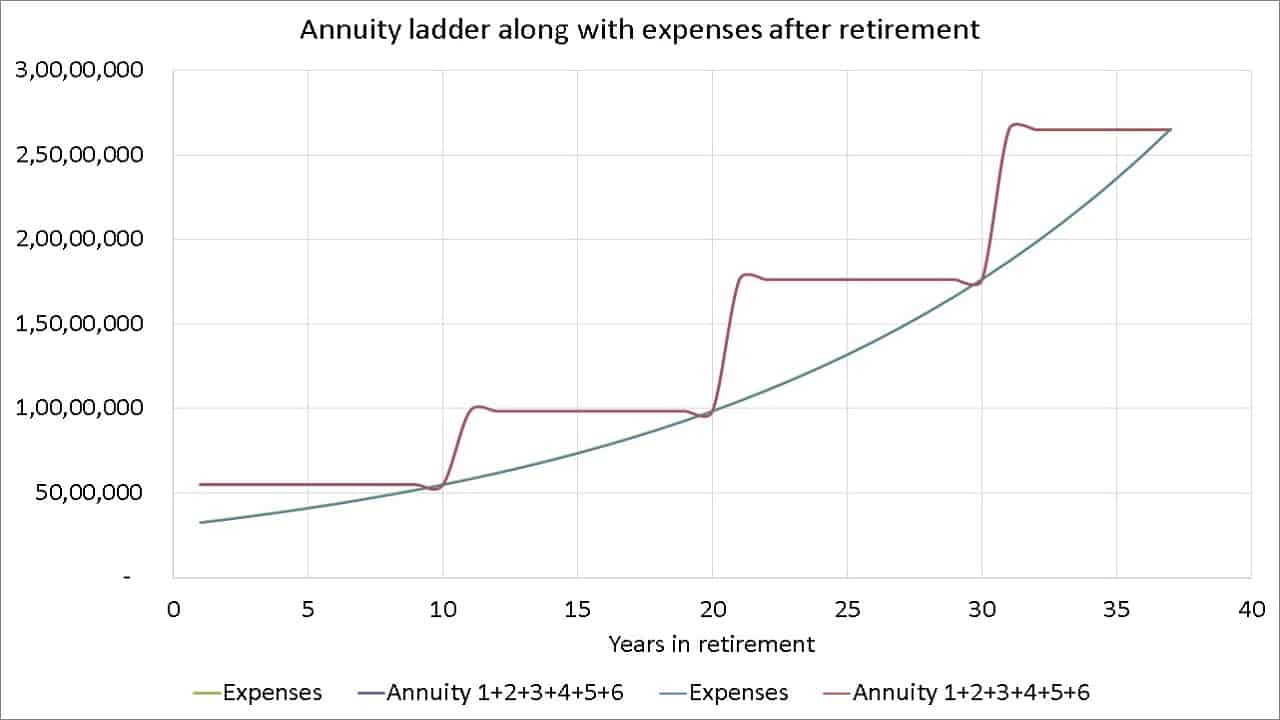
Most people reading this would say this is an unachievable corpus. Yes, that is how it would seem when you get started. As your corpus grows, so will your confidence to build stronger moats for your retirement castle. So aim for result one, and then as the year’s pass, you can modify your retirement plan.
In summary, please do not fixate on any particular SWR. Focus on investing as much as possible for retirement and plan to combat returns risk sequences first in the initial years of retirement and later beyond. As your wealth grows, so will your perspective.