Last Updated on December 19, 2021 at 7:19 pm
Technological advances in the past 25 years have reduced information access time from days/hours to seconds. However, our ability to process this information has not changed much and if anything, has only decreased due to an information-excess. Yes, most of us are addicted and slowly drowning in information that we practically have no use for. In this post, I discuss how and why less information can make us more informed.
What is an information diet?
When we have understood and implemented (if applicable) the essential ideas of a topic (art/finance/science etc.), there is no further need for information that reinforces the same ideas. Avoiding such information is an information diet.
In the context of personal finance, before I read an article, book, or social media post, I ask, “will reading this benefit me in any way, change the way I invest or make be a better investor?”. Almost always the answer is no and I do not read it. Soon, it becomes a habit, and there is no need to ask that question.We can shut ourselves out from such news.
Take for example, the best advice that can be squeezed into an index card (these were used for cataloguing books or inventory before the advent of computers) by Scott Adams.
🔥Secure your future with our Robo-advisory tool trusted by over 3,500 investors and advisors. From effortless retirement planning to funding your children’s biggest dreams, turn your financial goals into reality. 🔥
Subscribe for money management solutions via email! (Link takes you to our email sign-up form) Join 32,000+ readers in our community.
👉 New Tool Alert! NaviPlan: A Privacy-Focused Multi-asset Tracker and Goal Planner 👈
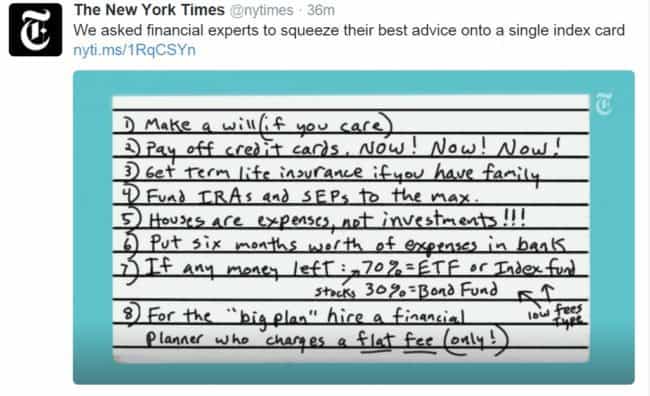
I have decoded what this means in the Indian context here: The best financial advice on a single index card!
Now, we begin to take an active interest in money management via different routes. For some, they chance upon an article that says their insurance policies are useless. For some, it is because of friends and colleagues. For a few, due to parents. For others (like me) it can be a sudden change in personal circumstances etc.
Whatever the cause, we become information hungry in the first few months. This is natural and even healthy. If we complete each task in this Personal Finance Self-Evaluation Checklist, at the rate of one a week, it will take no more than 1-2 years to complete them and realise why Scott Adams feels that money management principles can fit on an index card (the image is almost real size).
So until we understand the basics and implement then, a hunger for information is natural. After that, it is redundant. Recognising this is the key to an information diet. The rest follows naturally.
What does it take to adapt to an information diet?
Over this period of a year (or two), our ability to process information or immediately recognise the core idea in an article should improve. Without this ability and associated confidence, it is not possible to go on an information diet.
Not everyone who reads the intelligent investor becomes one. Unless I can process information fast and implement them faster, reading is of no use. Asking for book recommendations is of no use.

First principles, Clarice. Simplicity. Read Marcus Aurelius. Of each particular thing ask: what is it in itself? What is its nature?
My Information Diet
Allow me to discuss my case: It amuses me to no end when people assume that I have “read a lot” (of financial/business books) to be able to write in freefincal. If there is a recognition for least-read-published-author, I stand a good chance of winning it.
I strongly believe in not reading anything unless I have a clear idea of what I am looking for. Looking for books on personal finance? Know what to look for first! And as mentioned above, it did take me 1-2 years of information hunting to know what to look for.
The same is true of Excel. I knew nothing about Excel, when I made my first calculator, circa 2009-10. I had a specific goal, and I entered that into Google, and it did the rest. God bless the Excel forums and the people who take the time to respond there.
I have probably completed at most 4 books on finance and as regular readers would have guessed, they all discuss market risk in some form.
And today, I don’t want to read news article or magazines because I am scared I will lose my originality. I know that sounds stupid, but I hate posts that quote Buffett, Munger or Marks, every second paragraph. To me, that is not original. I prefer lateral reading. Read stuff unrelated to finance and I find that it keeps the creative juices flowing.
I prefer textbooks on finance because it gives me ideas to push the boundaries of freefincal. And here, what I learn is new and exciting. For example: The 80/20 rule: Making sense of richest 1% Indians owning 58% wealth! or the Fractals: The True Nature of Stock Market Returns Sure, not many takes for such posts, but I become a better person while learning. That is good enough incentive.
I do not know who manages my mutual funds. The current market trends or my portfolio value. Once a month, I run my portfolio tracker and enter the amount invested in my investment tracker. That is it. The rest is noise.
Asan Ideas for Wealth is my only information source and even here, my presence has reduced considerably. And thank God for Facebooks, block-person feature. Although I have 2000+ friends on FB, near-3000 likes on freefincal FB page, 2200+ followers on Twitter, my social media presence is minimal. Thank God for productivity tools like IFTT and revive-post plugins.
Less Information Can Make us More Informed?
Yes indeed. When do we stop seeking information? When we recognise what to look for. When we assimilate the basic principles = more informed.
If you have implemented the basic steps of money management and feel that the constant chatter from FB, Twitter, Whatsapp is making you more confused, it is time for you to give an information diet a try for say, a month. Can’t hurt. The basics principles of investing and money management are centuries old and have stood the test of time. I am sure not much can change in a month.
This applies to freefincal as well. There are many readers who have travelled with me for the last 4+ years. If you think, freefincal has no more use for you (I am assuming it did earlier, apologies, if wrong), it is time for you to move on. The same applies to me too.
Over to you. What do you think?