Last Updated on November 28, 2022 at 7:08 am
The Nifty Next 50 is a strange index. Although theoretically part of the large cap universe, due to large impact costs (significant difference between buy and sell price), its volatility is comparable to that of a mid cap index, as repeatedly pointed out by us: Warning! Nifty Next 50 is NOT a large cap index!
It can also be a frustrating index hold. Its returns can be below that of Nifty for extended periods, and since early 2018, we have witnessed one such phase. See: Is it time to exit from Nifty Next 50?
This and the emergence of the Midcap 150 index have displaced the Nifty Next 50 from the “top preference” list of several investors. See: Nifty Midcap 150 beats Nifty Next 50 for the first time.
We show below that AUM inflow into ICICI Nifty Next 50 has considerably reduced over the last two years. The ICICI fund is chosen as representative of all index funds tracking the index as it is one of the oldest and most popular. The corresponding fund from UTI is relatively recent and does not have enough history.
🔥Secure your future with our Robo-advisory tool trusted by over 3,500 investors and advisors. From effortless retirement planning to funding your children’s biggest dreams, turn your financial goals into reality. 🔥
Subscribe for money management solutions via email! (Link takes you to our email sign-up form) Join 32,000+ readers in our community.
👉 New Tool Alert! NaviPlan: A Privacy-Focused Multi-asset Tracker and Goal Planner 👈
Note: We continue recommending Nifty Next 50 in our Handpicked List of Mutual Funds Oct-Dec 2022 (PlumbLine). What is presented here are some facts. This article should not be considered a recommendation to exit. We have always maintained that Nifty Next 50 is a risky index, and only those who can stomach the risk and wait for performance should invest in it.
Trailing returns of Nifty 50 TRI and Nifty Next 50 TRI
| Benchmark | NIFTY 50 – TRI | NIFTY NEXT 50 – TRI |
| 1 Year | 4.0658 | 0.0190 |
| 2 Years | 21.4781 | 23.4428 |
| 3 Years | 16.8469 | 15.9794 |
| 4 Years | 16.1231 | 13.1722 |
| 5 Years | 13.5953 | 8.9029 |
| 6 Years | 15.5775 | 13.2028 |
| 7 Years | 14.5170 | 13.5779 |
| 8 Years | 11.7123 | 12.7490 |
| 9 Years | 14.6548 | 16.8132 |
The AUM of a fund has two contributions. One due to in- or out-flows and the other due to market-linked gains or losses. To approximate the AUM due to in/outflows, we compute the following:
Aum over NAV = Monthly Change in AUM of the fund minus the monthly change in NAV.
This removes the market-linked change from the AUM.
The AUM over NAV and NAV for ICICI Nifty Next 50 index fund is shown below.
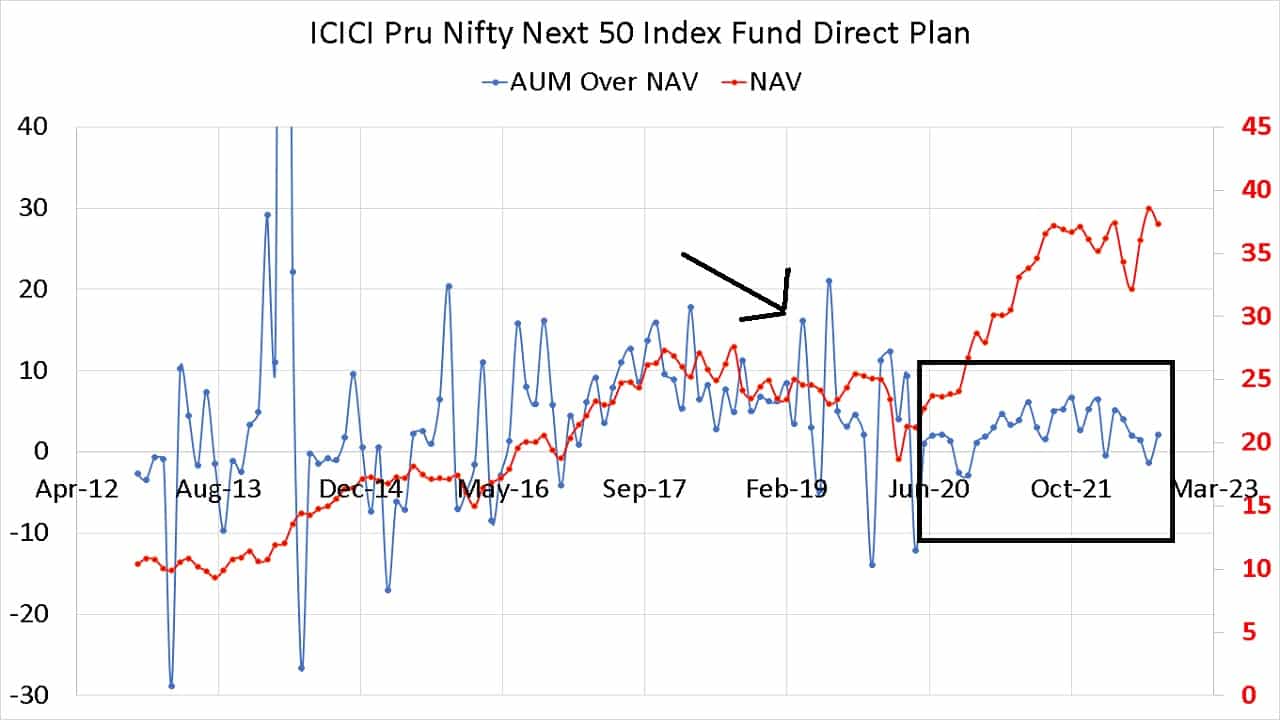
The gradual drop in AUM over NAV in the run-up to the March 2020 crash. After that, there has been a marked drop, meaning investors have started investing elsewhere. They have likely left their existing Nifty Next 50 fund units as is. They are probably frustrated waiting for a turnaround and lost interest in the index.
This is AUM over NAV data for UTI Nifty Next 50 Index fund. There is a similar drop but this fund is much younger.
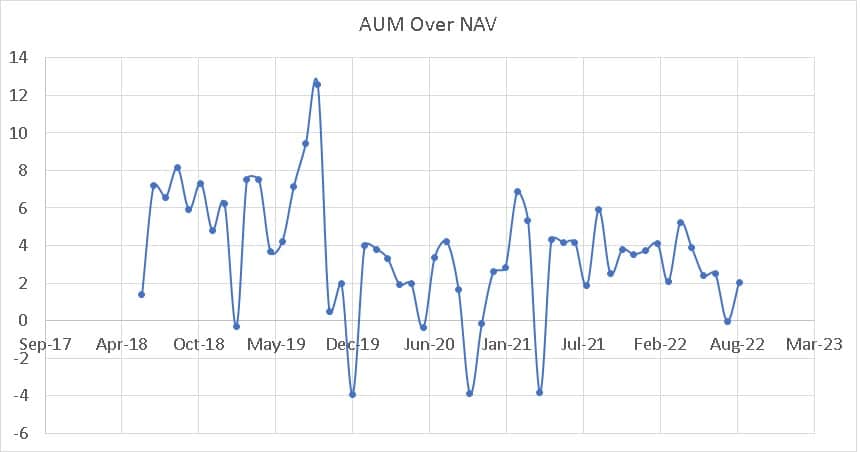
Our recommendation wrt Nifty Next 50 remains the same. If you wish to expand beyond Nifty 50 (there is no need to, but if that is what you desire), then Nifty Next 50 is still the most convenient, mid-cap-like passive option. However, be aware of the risks and be ready to face extended periods of poor performance. Please note that this risk warning also applies to mid cap or small cap funds (active or passive). As always, we do not recommend straying outside the Nifty top 100 universe, as the tracking errors of passive options are quite high: Not all index funds are the same! Beyond the top 100 stocks tracking errors are huge!