Many parents would like to know if they should include an international equity fund in their portfolio for their child’s education to account for currency depreciation against the US dollar. A discussion.
The short answer to “Should I invest in an international fund for my child’s education?” is, that it is unnecessary. There is, however, no harm done if you have one. The primary requirements for such a goal is, (1) The right asset allocation and risk management strategy; (2) Investing the necessary amount taking (1) into account.
If these two are in place, it matters little if the equity portfolio is geographically diversified or not (with the reasonable assumption that our country does not face collapse).
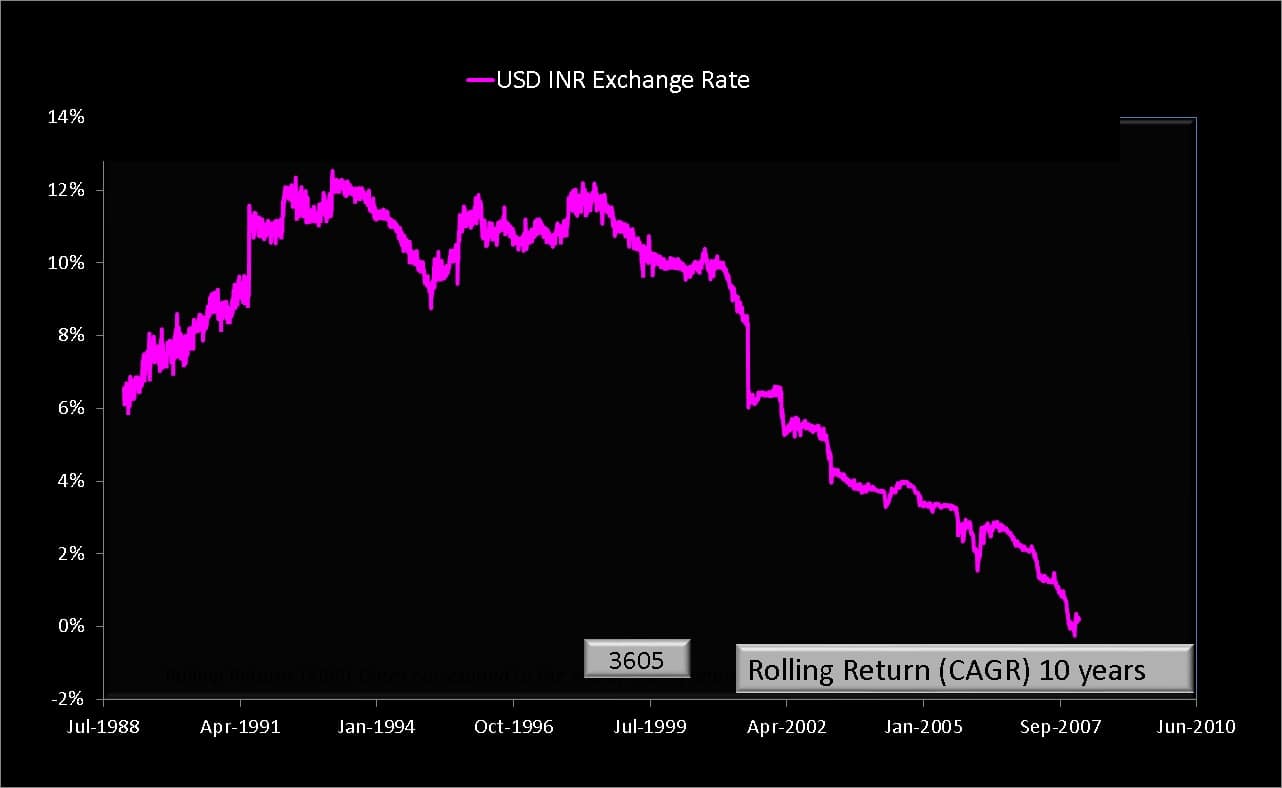
We have shown several times that over the long term, the “return” on the USD-INR rate is quite low and has been on a decreasing trend. See: Why does the Rupee fluctuate in value against the US Dollar?
See, for example, the 10-year rolling returns of the USD-INR exchange rate. The graph is likely to fluctuate, but the “returns” seen before 2000 are unlikely to be seen again as long as our economy grows.
🔥Secure your future with our Robo-advisory tool trusted by over 3,500 investors and advisors. From effortless retirement planning to funding your children’s biggest dreams, turn your financial goals into reality. 🔥
Subscribe for money management solutions via email! (Link takes you to our email sign-up form) Join 32,000+ readers in our community.
👉 New Tool Alert! NaviPlan: A Privacy-Focused Multi-asset Tracker and Goal Planner 👈
So the underlying stock market return is the primary source of gain from international investment. This can be quite volatile even for a developed country like the US. Many of us are biased by seeing US stock market returns after the 2008 recovery.
However, a closer inspection reveals that the Indian market has done quite well. See: Sensex vs S&P 500 vs Nasdaq 100: Which is better for the long term? 15-year Sensex returns measured since mid-2018 have underperformed, but cyclic behaviour is to be expected in this as with any other market phenomena.
For some backtests with 10% to 50% S&P 500 exposure in a portfolio, see: This is how buying US stocks will affect your portfolio.
In our opinion, the standard returns from equity assumed in a financial planning calculation like 10%-12% can be obtained from the Indian market alone without the need for US stock exposure. If we can invest enough, we should be able to afford a US degree for our child. If we cannot invest enough (with reasonable assumptions of inflation and return), no amount of “international diversification” will help.
Even if you do desire US stock exposure, there are two caveats (1) the government is unlikely to offer too much room to AMCs for accepting inflow into international funds as it would weaken the rupee. So many of the popular funds would face or are currently facing investment restrictions. (2) The tax on such funds is higher – 20% with indexation instead of 10% with the first one lakh of capital gains tax-free for Indian equity funds. This will remove much of the “forex advantage” from the return.
Then there is the task of portfolio maintenance with regular rebalancing and de-risking. Most investors cannot pull this off, with the majority fearing tax incidence (due to the rebalance).
We, therefore, feel international mutual funds are unnecessary. Parents should focus on setting the correct goal target and investing the right amount combined with systematic risk management.
Related resources:
- As new parents, how should we start investing for our child’s future?
- Fourteen Years of Mutual Fund Investing: My Journey and lessons learned