Last Updated on May 11, 2024 at 6:56 pm
Over the past few weeks, several readers have asked us if this is a good time to buy gilt funds, corporate bond funds, or long-duration debt funds as the interest rate cycle appears to have peaked and is all set to move down — a discussion.
When RBI starts decreasing the overnight rate, gradually, the effect would permeate into the bond market, and freshly issued long-term bonds would have a lower coupon rate than existing long-term bonds. The price of the existing bonds would increase, their demand would increase, and hence the NAV of gilt funds or any debt fund holding long-term bonds will increase.
There are ways to enter and exit long-term funds tactically. For instance, our moving average tactical buy and sell tool (which can be used for equity, gold and bonds) uses 10Y bond PE (1/yield). These are backtested results: Can we get better returns by timing entry & exit from gilt mutual funds? Please read the disclaimers before using the tool.
This is the current trend line of the 10Y gilt bond PE, it’s 12 and 6-month moving average (MMA). The signal in the dotted line is sell (0) if the PE is less than the 12MMA and 6MMA, or it is a buy (1).
🔥Secure your future with our Robo-advisory tool trusted by over 3,500 investors and advisors. From effortless retirement planning to funding your children’s biggest dreams, turn your financial goals into reality. 🔥
Subscribe for money management solutions via email! (Link takes you to our email sign-up form) Join 32,000+ readers in our community.
👉 New Tool Alert! NaviPlan: A Privacy-Focused Multi-asset Tracker and Goal Planner 👈
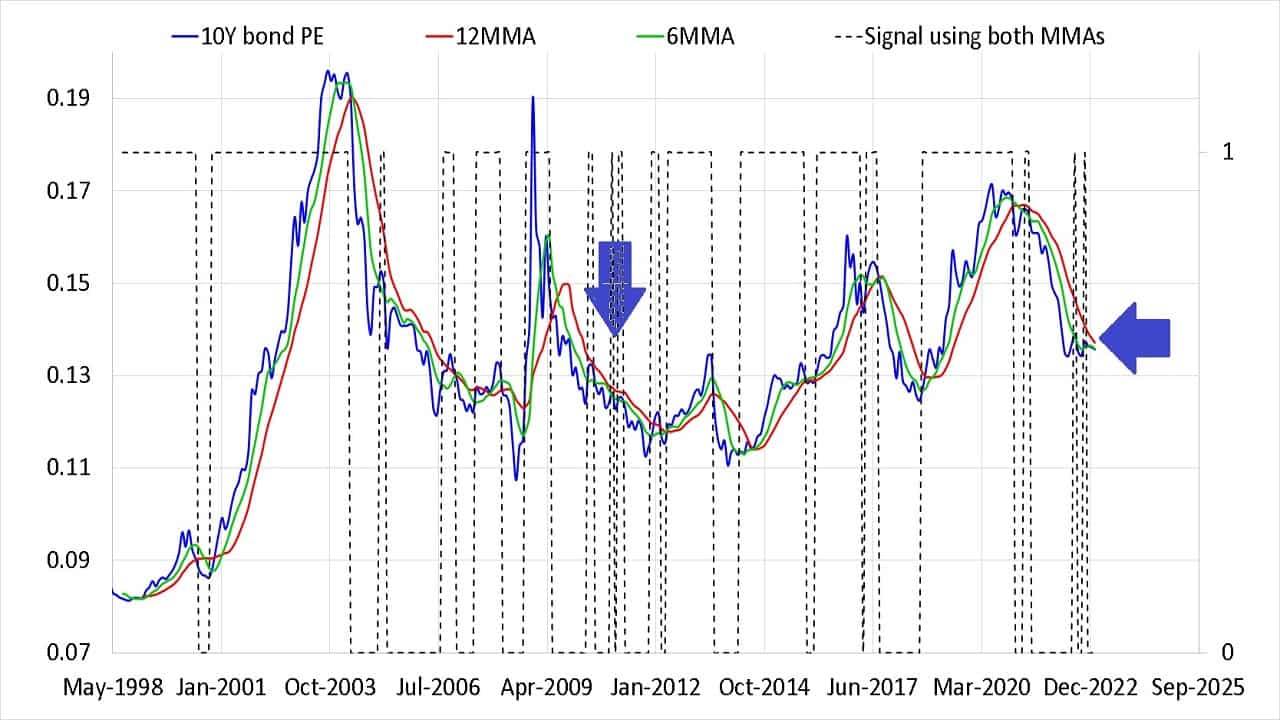
The horizontal arrow indicates the current trend – uncertain. Traders would call this a signal whipsaw – it is zero(sell) in a month and one (buy) the next. There is no clear indicator. This is similar to the vertical arrow around 2011.
Bond yields have not yet started falling persistently (corresponding to a PE increase) to claim that those who buy now would reap the rewards soon. At the time of writing, Retail inflation rose to a 3-month high of 6.52% in January. So there is no clear indication that interest rates will decrease soon.
ICICI Mutual Fund publishes a fixed income valuation index based on ” WPI, CPI, Sensex returns, Gold returns and Real estate returns over G-Sec yield, Current Account
Balance, Fiscal Balance, Credit Growth and Crude Oil Movement”. This is a screenshot from their January 2023 factsheet – the index is still in the “cautious zone”. Please read the disclaimers before using the index.
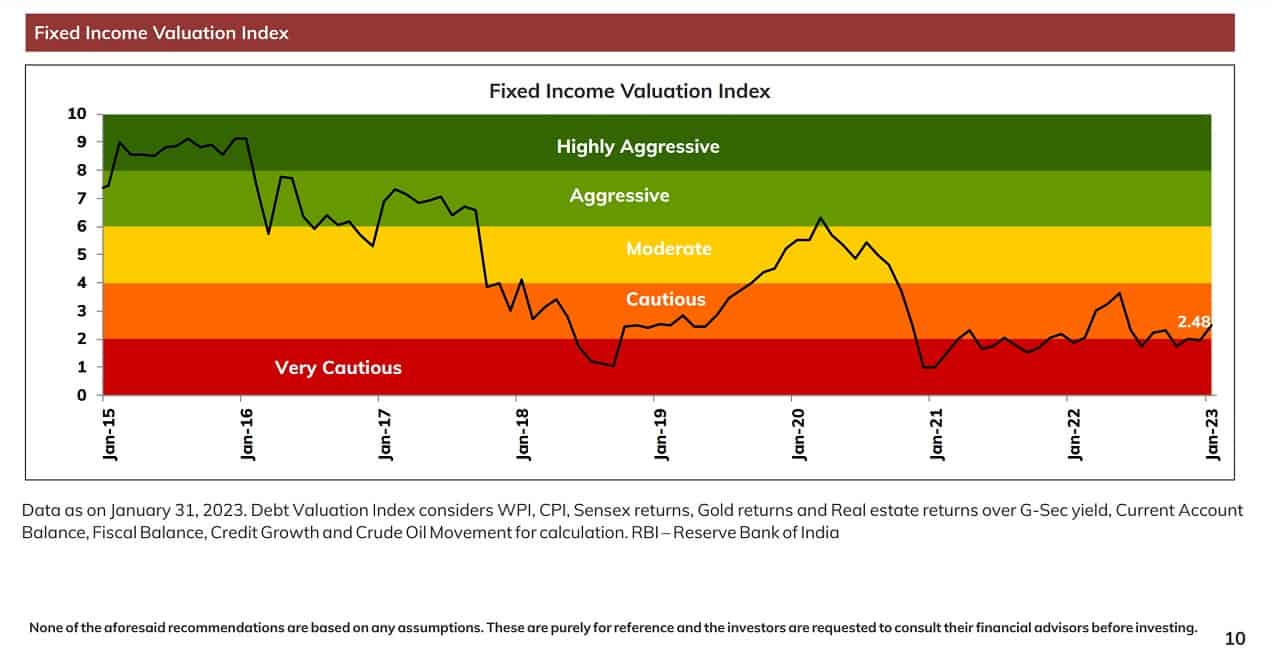
Buying long term debt funds now may not result in immediate gains and could result in a prolonged wait. The bond market is tricky, where demand and supply depend on several factors. It is folly to assume bond yields will behave as theoretically expected.
The blunt truth is most investors wondering about entering long term debt funds do so based on piecemeal information sourced here and there. If they did have a clear entry and, more importantly, an exit strategy, they would not be asking us, would they?!
Duration play or tactical/entry-exit in long term debt mutual fund is only for experienced and informed investors who will not be stricken with guilt and regret if things do not go their way. Thus it is unsuitable for most investors, and we strongly recommend against it.
Those who appreciate interest rate risk (or duration risk) in bonds can consider using gilt funds or corporate bonds for their long term goals. It is best to invest systematically in these funds regardless of interest rate movements and rebalance the portfolio from time to time. Gilt funds are essentially dynamic bond funds and engage in tactical duration play. This takes the burden of timing away from investors and is typically fruitful and less risky.
Resources that may be of help:
- How to choose a gilt mutual fund
- Gilt funds vs Dynamic Bond Funds vs Corporate Bond Funds: Which is the better choice?