Last Updated on October 1, 2023 at 5:41 pm
The freefincal robo advisory software template released on Sep. 7th 2017 has had an enthusiastic response from readers. Thank you for your support. As always I look forward to your feedback and feature enhancement suggestions. In this post, I discuss some of the key features of the robo template.
As of 29th June 2021, 567 investors and financial advisors are using the template. The template was recently featured in the Economic Times: Meet Pattabiraman, the man who helps many plan a better retirement through his calculators.
The template is an Excel file with macros. It will work on Mac Excel and Windows Excel. All inputs are fully customisable. It can be used for commercial use as well. Users will get all future updates as well.
Equity asset allocation before and after retirement
Regardless of when a person wishes to retire, the robo template calculates the equity allocation from the current age to age 90 of the older spouse (if married). If retirement is not immediate, the post-retirement equity allocation is not output.
🔥Secure your future with our Robo-advisory tool trusted by over 3,500 investors and advisors. From effortless retirement planning to funding your children’s biggest dreams, turn your financial goals into reality. 🔥
Subscribe for money management solutions via email! (Link takes you to our email sign-up form) Join 32,000+ readers in our community.
👉 New Tool Alert! NaviPlan: A Privacy-Focused Multi-asset Tracker and Goal Planner 👈
There is no point in a 30-year-old taking the suggested equity allocation at 60 seriously. That can be done after crossing 50.
This is the equity exposure after retirement
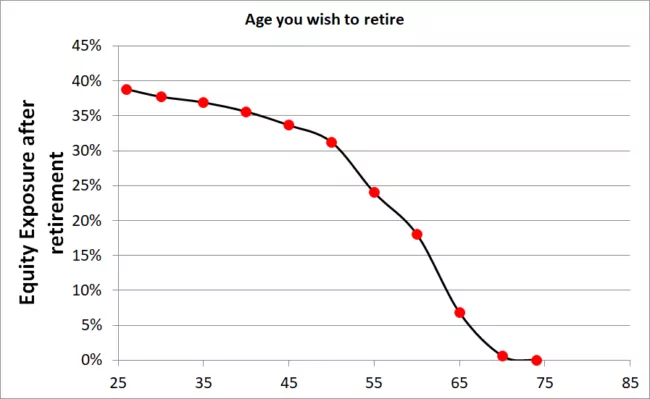
Notice that even early retirees are not suggested an equity exposure of more than ~ 30% – 40%. This might come as a surprise and would not be acceptable to the many fiery young financial independent seekers who are not old enough to understand that wanting to be frugal is quite different from actually being frugal. These guys are banking on their ability to beat inflation by 2-4% (thanks to reading irrelevant US based blogs which got popular after the 2008 layoffs) and talk about “safe withdrawal rates” without understanding that they are variable. Well, good luck to them. They are going to find the robo template unpalatable.
I have a simple definition of financial independence:
Divide the retirement years in two: A +B (where possible)
A = first 15 years
B = rest of the years
1) A person can be financially independent in retirement if she can generate an inflation protected income for A + B years (entire retired life)
In this case, the robo template will provide a detailed investment bucket strategy
2) if a person can only be financially independent for the first 15 years (A, not B), then depending on the inadequacy, the template will tell you the shortfall and if it is too much, a possible annuity purchase. This is a bit of grey area so in the advanced version the user can try a DIY bucket management solution.
3) If a person cannot be financially independent for even the first 15 years, (not even A), the recommendation is to not take any risk and buy a pension plan.
This logic is applied to early retirees also. They must have enough fixed income assets to generate an inflation protected income for first 15 years and then rest can be market linked.
If you disagree, you have two choices: don’t use the robo template or buy the open source version and modify it at will (see below).
This is the suggested equity exposure for a 30-year old wanting to retire by 55.
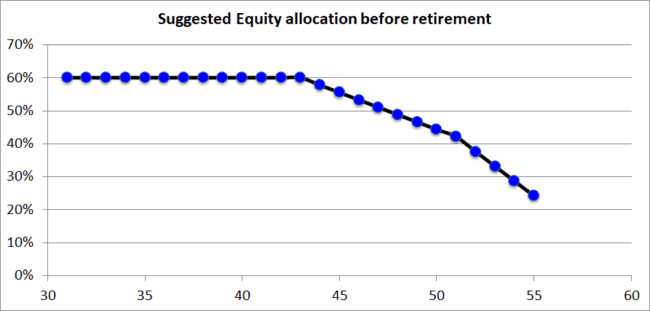
The user need not follow these suggestions to a tee. The idea is to factor in some kind of variable asset allocation from day one. Portfolio management in real time is almost always playing it by the ear. Robotic solutions may work, but as the user becomes experienced in market linked product, her experience may change for the better or worse. This is the reason why the robo template calculations must be redone at least once a year.
Equity return expectation = 10%
This is a good 8% to 2% lower than what financial advisors use. They cannot afford to use 10% because their clients will run away. A 10% return is what I use and going forward will be more and more likely. It keeps me calm and I tend to tinker with my portfolio less. Since expectations are low, I am easily pleased. An 11% XIRR makes me feel my one-star and two -rated funds are doing well. I invest more and focus on other hobbies (like making calculators)
Fixed income is set at 7% post-tax. Sooner than later this may need a downward revision!!
Flexible vs inflexible Financial Goals
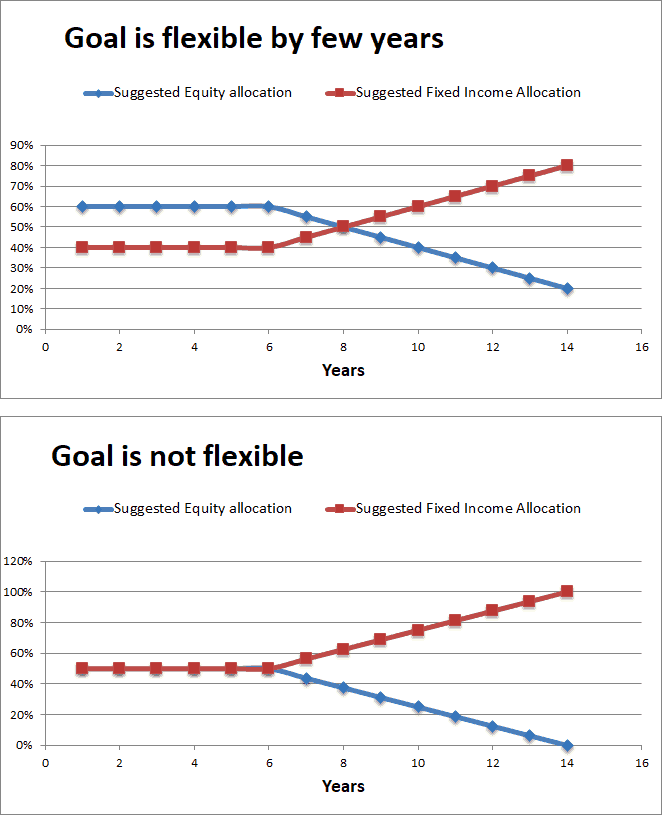
The template makes a small distinction bet goals that are flexible (spending can be delayed or hastened) and inflexible goals in terms of the variable asset allocation model used
Features to be incorporated
1). Current investments for other financial goals are prescribed an asset allocation along with future investments and factored into the calculation. In the case of retirement, current investment are not prescribed an asset allocation, other than a verbal suggestion to gradually move towards what is prescribed. I am thinking of ways to handle this better.
2) Many users want assets that do not produce income (real estate in most cases) but can be sold for handling retirement expenses. It would be hard to handle this year before retirement. At or after retirement, one can enter a nominal value for the holding in step 2; cell b18 – Any other amount you will get upon retirement (after tax)
3) Pension or income that starts a few years after retirement. At present only income that will start from day one of retirement can be factored in.
Warning: Do not enter income that you receive years from now! Life is not that predictable!
Get the Robo Advisory Template.
The template is an Excel file with macros. It will work on Mac Excel and Windows Excel. All inputs are fully customisable. It can be used for commercial purposes as well. As of June 29th 2021, 567 investors and financial advisors are using it. Users will get all future updates as well.
Get the robo template by paying Rs. 5160 (Instant Download. No refunds allowed). For support write to freefincal [AT] Gmail [DOT] com.
Outside India? Then use this Paypal link to pay USD 80 (Kindly write to freefincal [AT] Gmail [DOT] com after you pay).