Last Updated on July 22, 2024 at 4:57 pm
For a person who has been investing in equity (directly/indirectly) for several years, the question, “how much equity exposure should I have after retirement?” is not so hard to answer. However, that is not the case for most 50+ investors heading towards retirement. They would have little or no experience with equity or any market-related product. The retirement withdrawal rate or the initial retirement withdrawal rate, to be exact gives an approximate idea of the quantum of risk a retiree can take after retirement.
Before we begin, would like to clarify that I prefer a more detailed calculation to answer the above question. That tool can be found here: When should senior citizens purchase an annuity?
What is the retirement withdrawal rate?
The withdrawal rate is simply the pre-tax annual withdrawal from a retirement corpus divided by the available corpus (before withdrawal). This article was first published on Mar 17th, 2013. It is repeated for the benefit (hopefully!) of new readers.
So if I have an annual expense of about 3L and a corpus of 75L, the withdrawal rate in the first year of retirement is 4%.
🔥Secure your future with our Robo-advisory tool trusted by over 3,500 investors and advisors. From effortless retirement planning to funding your children’s biggest dreams, turn your financial goals into reality. 🔥
Subscribe for money management solutions via email! (Link takes you to our email sign-up form) Join 32,000+ readers in our community.
👉 New Tool Alert! NaviPlan: A Privacy-Focused Multi-asset Tracker and Goal Planner 👈
There is a tonne of material (analysis and debate) available on the 4% withdrawal rate – Is it safe to last a lifetime, or not. Personally, I do not care much for this.
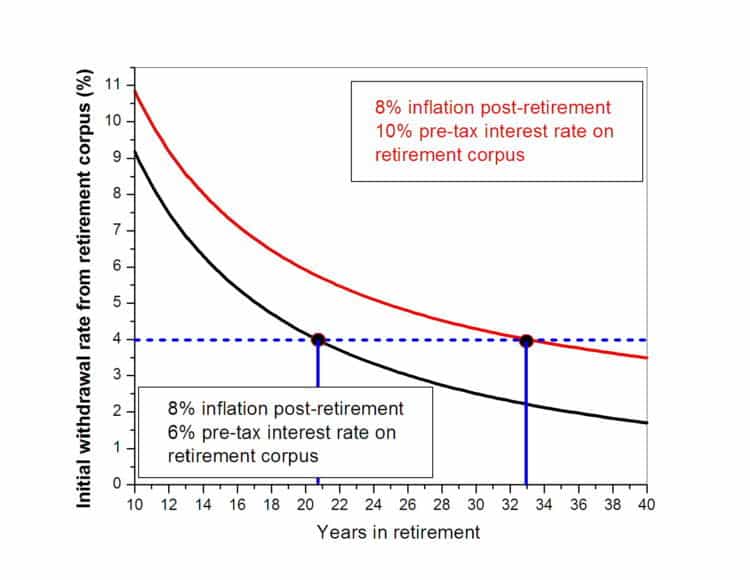
Any significant deviation from this 4% level is considered to be risky. That is my expenses are higher, say 5L, then the initial withdrawal rate is 6.7%. This means, that I will be drawing a lot of money from the corpus. If I take a risk and lose some money, then I will run out of money soon. So it is dangerous to consider equity exposure if the initial withdrawal rate is upwards of 4.5%*. Perhaps a small amount, but there should be enough corpus left to handle expenses. If we start withdrawing from the principal instead of generating an interest income (annuity), it will not last long.
This is the dilemma facing current retirees. If they lock their money in an annuity, they cannot handle inflation down the line. If they take risk and lose money, they will not be able to manage expenses down the line. It is important to recognise that there is no such thing as notional losses for a retiree. This is because they will need that money for income and if they withdraw from a depleted corpus, it will run out faster.
* In any standard, “how long will my money last?” calculator, for 25 years in retirement and interest rate = inflation (zero real return), the withdrawal rate for the first year will be 4%. So with zero real return, if the withdrawal rate is 4.5% or more, it is better to think real hard before using equity mutual funds or “balanced advantage” funds!
Note: Thumb rules were necessary at a time calculations could only be done by hand. Today we can get any complex calculation done in under a minute on our mobiles. So to hell with the 4%, ‘rule of 72’ kind of rules. They are inaccurate and misleading.
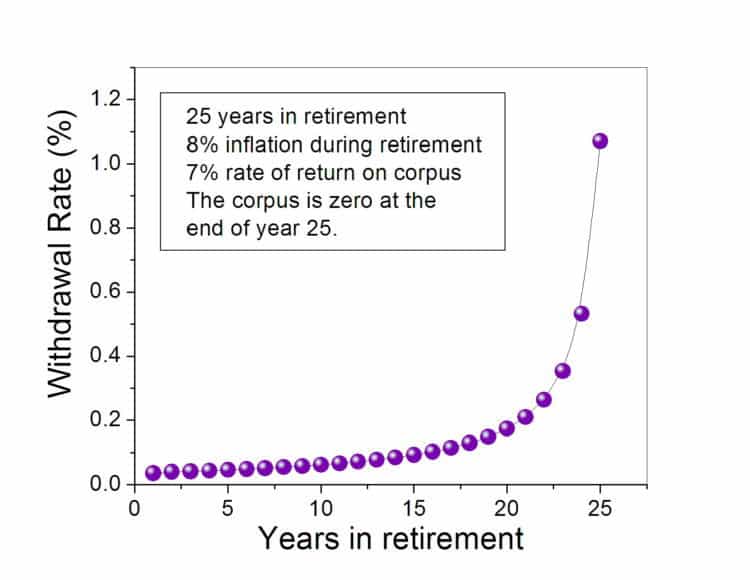
The withdrawal rate (let’s denote this by w) is not a constant (common misconception!). In order to calculate the withdrawal rates for the 2nd, 3rd, 4th … years in retirement, we need to realise that it depends on
- the rate of inflation during retirement (i)
- the rate of return on the corpus (r)
- duration of retirement (k)
This is the formula connecting w, i,r and k (feel free to ignore it if math nauseates you!)

This is how the withdrawal rate typically looks for each year in retirement. The initial rate (for 1st year) is 3.5% in this example. (Click on the picture for a clearer view)
Here are some further insights about the initial withdrawal rate (Click the pictures for a clearer view)
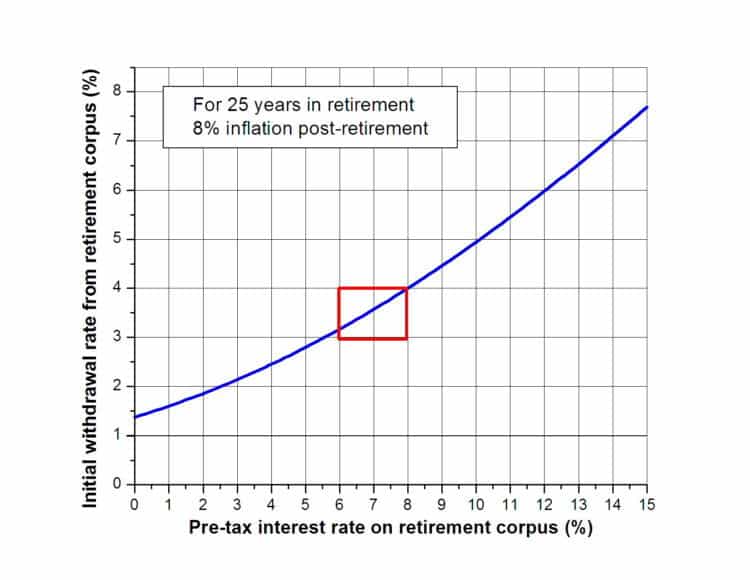
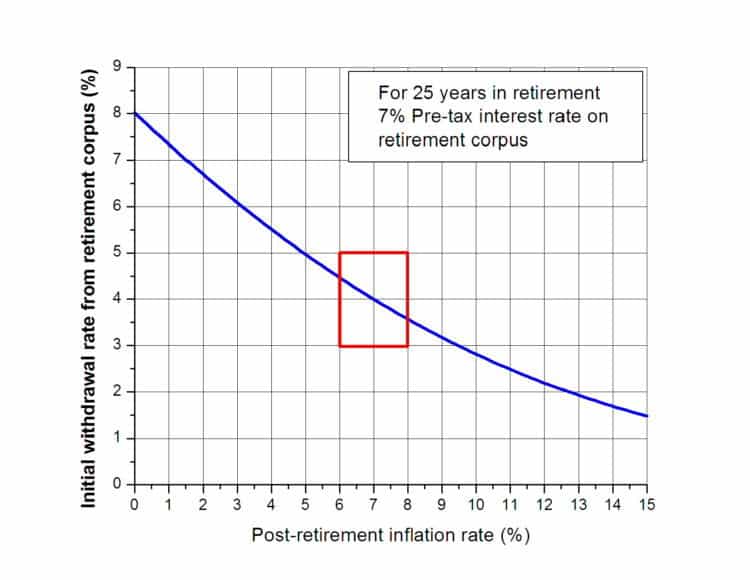
This tool has been replaced by the freefincal robo advisor.
=-=-=-=-=-=-=
Kolkata DIY Investor Workshop May 28th, 2017
Register for the Kolkata DIY Investor Workshop May 28th, 2017
You Can Be Rich Too With Goal-Based Investing
You can be rich too with goal based investing is my new book with PV Subramanyam. If you have not yet got the book, check out the reviews below and use the links to buy.
Reader Quotes:
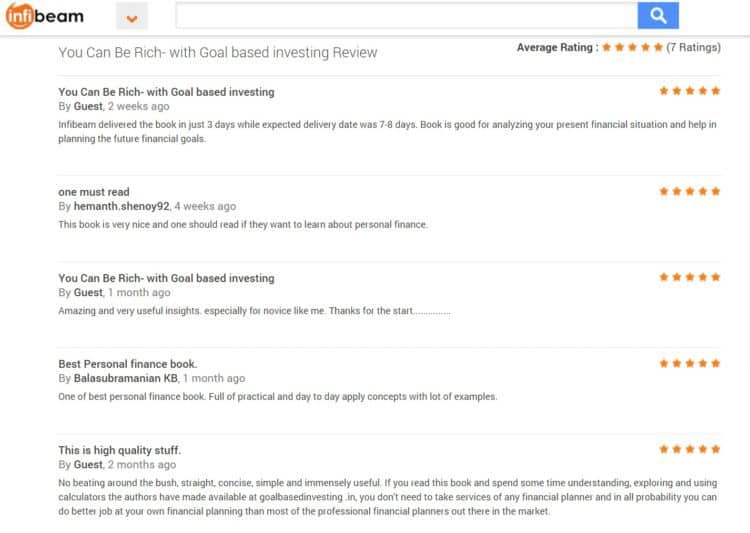
Gift it to your Friends and Relatives whom you care more. Already follower of Pattu and Subra’s forum. Ordered 4 more copies to give gift to my friends and eagerly waiting to read
The best book ever on Financial Freedom Planning. Go get it now!
Your first investment should be buying this book
The (nine online) calculators are really awesome and will give you all possible insights
Thank you, readers, for your generous support and patronage.

Amazon Hardcover Rs. 317. 21% OFF
Kindle at Amazon.in (Rs. 307)
Google
Infibeam Now just Rs. 307 24% OFF.
If you use a mobikwik wallet, and purchase via infibeam, you can get up to 100% cashback!!
Bookadda Rs. 344. Flipkart Rs. 359
Amazon.com ($ 3.70 or Rs. 267)
Google Play Store (Rs. 244.30)
- Ask the right questions about money
- get simple solutions
- Define your goals clearly with worksheets
- Calculate the correct asset allocation for each goal.
- Find out how much insurance cover you need, and how much you need to invest with nine online calculator modules
- Learn to choose mutual funds qualitatively and quantitatively.
More information is available here: A Beginner’s Guide To Make Your Money Dreams Come True!
What Readers Say