Last Updated on August 8, 2026 at 4:01 pm
It is now seven months since direct mutual fund plan were introduced. Using NAV history of HDFC Top 200, I have calculated the actual difference in returns between the regular-plan and direct-plan (growth option) obtained so far (Excel sheet attached).
Let use recall that regular funds will have a higher expense ratio than direct funds. A typical expense ratio breakup can be found here: Should We Switch To Direct Mutual Fund Plans? Calculate and Consider
First let us look at how the difference between direct plan NAV and regular plan NAV looks like as a function of time.

🔥Secure your future with our Robo-advisory tool trusted by over 3,500 investors and advisors. From effortless retirement planning to funding your children’s biggest dreams, turn your financial goals into reality. 🔥
Subscribe for money management solutions via email! (Link takes you to our email sign-up form) Join 32,000+ readers in our community.
👉 New Tool Alert! NaviPlan: A Privacy-Focused Multi-asset Tracker and Goal Planner 👈
Notice that the NAV difference is a straight line for a good part and then deviates a bit. This is because the difference in expense ratios has decreased a bit. On 25th Jan it was 0.59%. The difference is currently 0.55%
Assuming I have invested some sum on Jan 1st 2013 (I actually did!) I have calculated the internal rate of return on a daily basis using Excels IRR function. I have then calculated the difference in IRR between regular and direct options and converted it to an effective annualized CAGR difference. This is plotted below as a function of time.
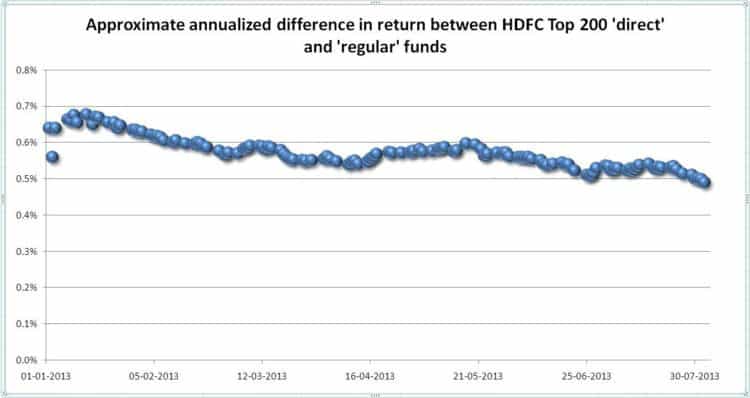
This suggests that HDFC Top 200 direct has approximately 0.5% higher (annualized) return than HDFC Top 200 Regular fund (if the regular fund has returned -5% then the direct fund has returned -4.5%!). Thus the difference in return is approximately equal to the difference in expense ratios.
How do we make sense of this? Suppose I say, this 0.5% difference will approximately remain the same whether you invest for 1 year or 10 years, is it good news or bad?
Many people view this as bad news? What! Only 0.5% difference in returns? Why should I bother with direct mutual fund then?
This result is so counter-intuitive that on another occasion, I heard this ‘what, only 0.5%!?’ response, from an expert who constantly writes on compounding!
The correct statement is, the difference in returns is 0.5% for each year of investment.
If I invest a sum in HDFC Top 200 Regular and Direct:
- after 1 year: If the regular fund has a value A, the direct fund will have value (approximately)
- A x (1+0.5%)
- after 3 years: If the regular fund has a value B, the direct fund will have a value (approximately)
- B x (1+0.5%) x (1+0.5%) x (1+0.5%) and so on.
- In the above I have assumed 0.5% as a constant difference in expense ratios. If this difference is 0.5% in year 1, 0.4% in year 2 and 0.6% in year 3 then we will have:
- B x (1+0.5%) x (1+0.4%) x (1+0.6%)
So if someone has the disciple to stay invested for a long period of time in a ‘good’ fund then can be a significant difference in corpus.
For example, in the above example,
- after 5 years, the direct fund value will be about 2.5% higher than the regular fund.
- after 10 years, the direct fund value will be about 5% higher than the regular fund.
This is an approximate illustration. Use this calculator for a more accurate estimate:
- Impact of MF Expense Ratio Calculator (I will post an updated version soon)
Download the HDFC Top 200 Direct vs. Regular Returns Comparison Excel File
######
Note: I have also calculated the annualised return (CAGR) on a daily basis using Excels XIRR function. The difference between XIRR for direct and regular funds will also give the annualized return difference directly. This difference is a little higher than the one calculated with IRR.
Credits: NAV history from Personalfn
Related articles
- Should We Switch To Direct Mutual Fund Plans? Calculate and Consider
- On Direct MF Plans, Ethics, Conflict of Interest and All That Sort of Thing
- Step-by-Step Guide to Selecting a Mutual Fund
- Comparing SIP Returns: Monthly vs. Daily vs. Quarterly SIPs