Last Updated on December 29, 2021 at 6:22 pm
I started an Rs. 500 SIP in Sundaram Midcap Fund (then known as Sundaram Select Midcap) for an extended family member higher education in Aug 2009. Here are some lessons on investment risk and reward from the investment.
Kindly note that I do not count this investment as part of my net worth and have double the amount sometime back. It is an all-or-nothing high-risk, possible-high reward idea. I figured if it failed, I would pay for it from elsewhere. Kindly do not reproduce this idea for your own goals. The data shown below is for Rs. 500 SIP only.
When we published, Myth Busted: SIPs do not reduce risk or enhance returns! Some claimed it was a “theoretical” study. Here are lessons with real money.
I had earlier reviewed the fund in Feb 2019. Twelve years ago, as a rank newbie, I did not quite recall how and why I chose this! Perhaps, I was under the incorrect assumption that “over the long term: midcap funds would beat large cap funds. Since my first investment was in Sundaram Tax Saver, and I knew the AMC office, I picked this one! Read more: Ten Years of Mutual Fund Investing: My Journey and lessons learned.
🔥Secure your future with our Robo-advisory tool trusted by over 3,500 investors and advisors. From effortless retirement planning to funding your children’s biggest dreams, turn your financial goals into reality. 🔥
Subscribe for money management solutions via email! (Link takes you to our email sign-up form) Join 32,000+ readers in our community.
👉 New Tool Alert! NaviPlan: A Privacy-Focused Multi-asset Tracker and Goal Planner 👈
Yes, I was a “direct-to-AMC” investor in regular plans. The AMC was pocking commissions from this fund until Jan 1st 2013. On 28th Jan 2013, I switched from regular to direct plan.
I had earlier written about the journey of this SIP in Mar 2018. The XIRR (annualised return) was an excellent fat 20% (after nine years). Things change pretty fast in this space! In Aug 2019, it dropped to about 13% (after ten years). Last year the XIRR was 10% (after 11 years), and today it is close to 17% (12 years).
The most important lesson is, no matter how old your SIP, it will always react to market ups and downs. Risk does not get averaged and returns in an unmanaged SIP is down to luck or what time you decide to check it!
The 12-year SIP in Sundaram Midcap Fund
This is the evolution of the total investment and value.
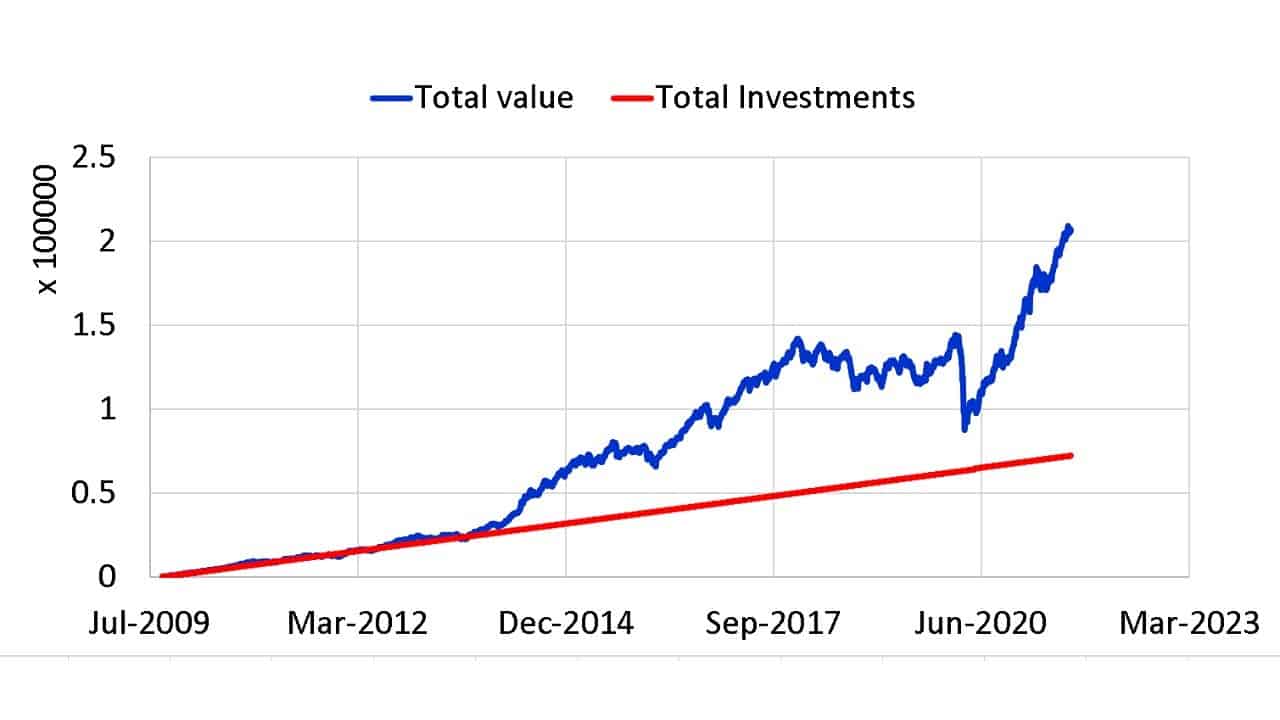
It is pretty easy and convenient to make some lazy conclusions such as SIPs make one disciplined (no, they do not) and how SIPs always work in the long term (no, they do not). If you wish to see what you wish to see, the rest of the article may not help. If you wish to dip deeper and understand risks, then let us begin.
First, look closely. For the first four years, the return is zero (-2% to be exact). The percentage abolute gain or loss is shown below and illustrates how much SIP gains can swing.
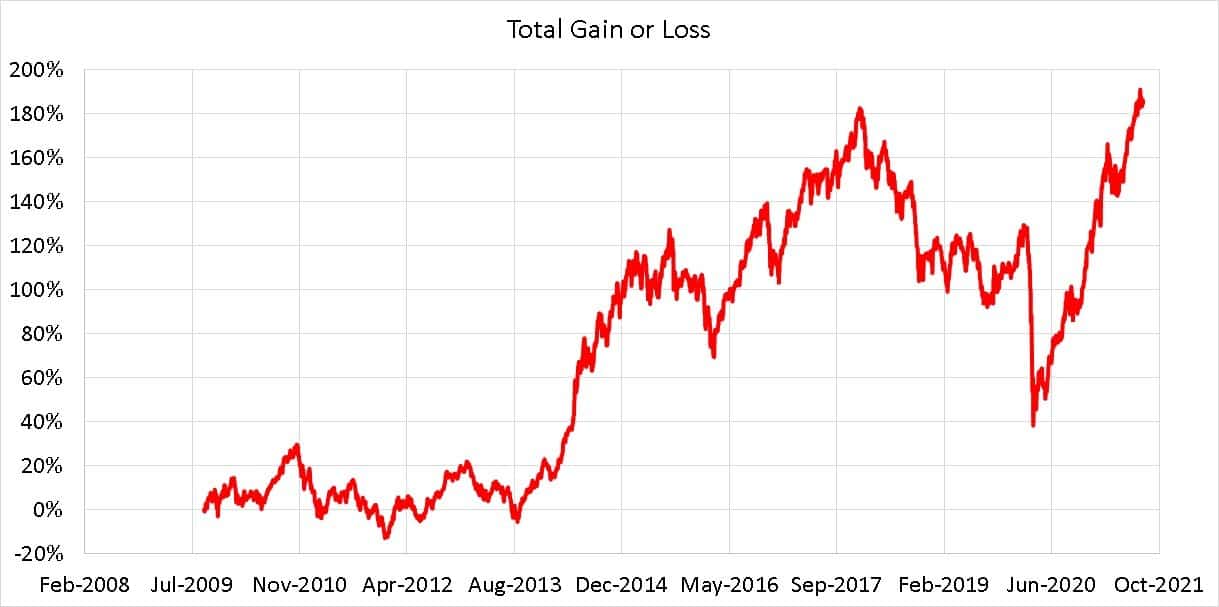
From 0% gain to 120% in about two years from Sep 2013 and 130% drop in gains from Feb 2018 to March 2020 and then another 140% gain!
This is the percentage gain or loss for a theoretical SIP started in April 2006. When the market started to correct in Feb 2018, the SIP was two months short of completing 12 years. About 175% of the accumulated gains were lost between Feb 2018 and March 2020, followed by a ~ 290% gain.
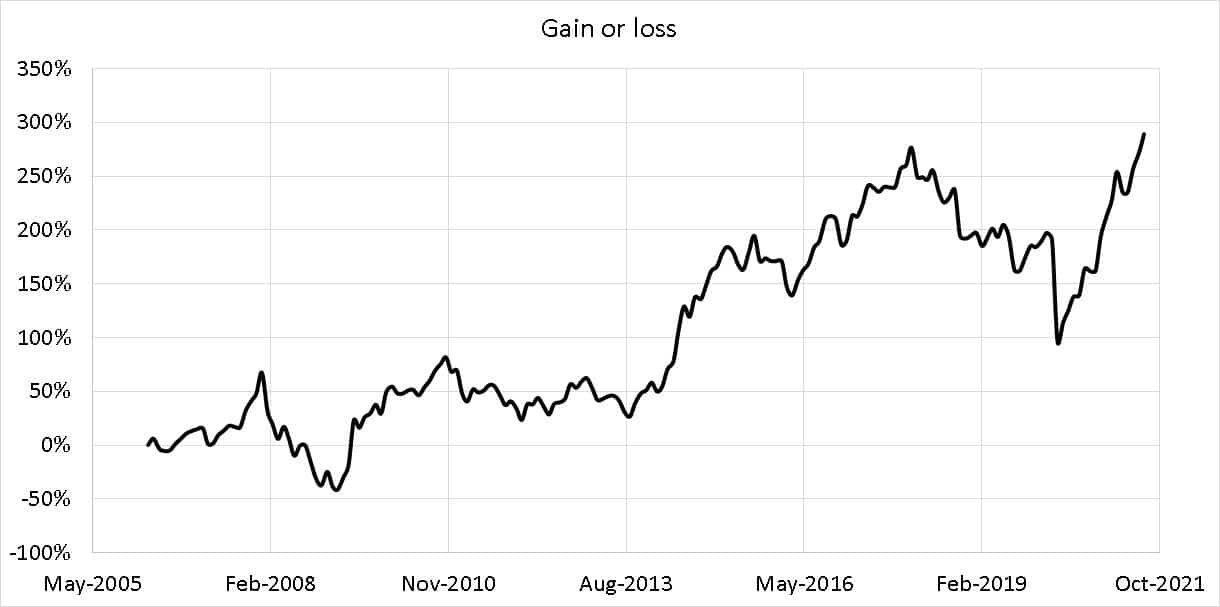
Where is the so-called risk averaging benefit of SIP? Well, it does not exist. You can run a SIP for 100 years and the risk will never decrease. If the market moves up, returns increase, if the market falls, returns fall.
Read more: Mutual Fund SIPs Do Not Reduce Risk! Beware of Misinformation
One can see this in a better way. The NAV of the fund and the SIP value are plotted together below. To highlight how the SIP value depends largely on the final value of the SIP (and not the “average” buying price), the two plots are normalised to their values on 16th Aug 2021.

Initially, the number of units accumulated via SIP is small, and the movement is largely determined by the investment month after month. Once the value of the units accumulated is significant, the SIP returns depend on NAV movement.
This is the reason I keep talking about the SIP as filling water into a bucket on shaky ground. Imagine filling a bucket with small mugs of water. These mugs are monthly instalments. Most people worry about filling the bucket when the market is shaky (when is it not?!) or when to add the next instalment.
They fail to realise that the bucket is on shaky ground. If the bucket falls, then the SIP, no matter how old, will always result in a loss. That is the reason I keep saying SIPs do not reduce risk. Sales guys do not care about the shake in the bucket. They only want you to keep filing water no matter what.
Using the SIP XIRR Tracker tool, we can plot the annualized return month after month. The impact of the fall
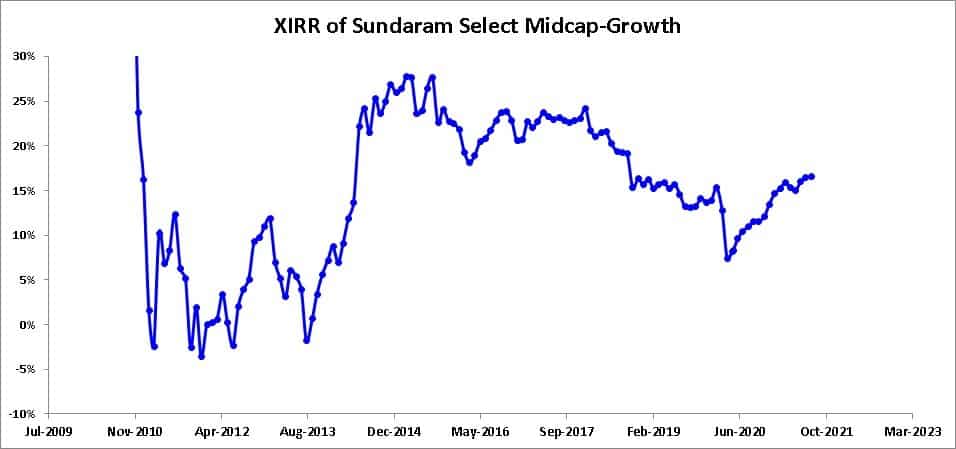
Notice that the XIRR has been falling since the end of 2014!! A 20% return after 8-9 years was reduced to about 10% after 11 years a year ago and has now recovered to 17%. The risk never decreases in the long term unless we actively manage it, and SIP will not help in any way! Bull market or bear market lessons on risk do not change!
If you are confused, let us clarify: systematic, disciplined investing in equity is key to building wealth. SIP is just buying mutual fund units on the same date each month. SIP is not systematic investing. SIP is automated investing.
There is nothing wrong with automated investing as long as a system is in place: A clear goal, a clear asset allocation, a clear risk management strategy. If you leave a SIP running in the hope that it will work in future, then you are leaving the fate of your investments to luck. Surely your money deserves better!
One can systematically invest each month AND systematically reduced risk in the portfolio. They are not mutually exclusive. To understand this better, you can start with this video: Basics of portfolio construction: A guide for beginners.