Last Updated on December 29, 2021 at 6:18 pm
In this article, we review a new index from NSE. The Nifty Microcap 250 Index has 250 companies beyond the Nifty 500, with weights determined in terms of free-float market capitalization. That is, any stock part of the Nifty 500 will not be part of this new index.
Companies ranked within the top 1000 based on the average daily turnover and average daily full market capitalization based on previous six months period data are eligible for inclusion. Among these, stocks in the bottom 250 are typically part of the Nifty Microcap 250 Index.
From this, stocks in the NIfty 500 are excluded. Then the next top 350 stocks which rank in terms of average daily full market capitalisation based on the previous six months are excluded.
Stocks with a 6-month average full market capitalization rank between (and including) 351- 675 will always be part of the index. Other stocks are selected with additional eligibility criteria listed in the methodology document (page 15). So it should come as no surprise that the volatility of the Nifty Microcap 250 Index would be fairly high.
🔥Secure your future with our Robo-advisory tool trusted by over 3,500 investors and advisors. From effortless retirement planning to funding your children’s biggest dreams, turn your financial goals into reality. 🔥
Subscribe for money management solutions via email! (Link takes you to our email sign-up form) Join 32,000+ readers in our community.
👉 New Tool Alert! NaviPlan: A Privacy-Focused Multi-asset Tracker and Goal Planner 👈
The evolution of the Nifty Microcap 250 Total Returns Index (dividends reinvested; black line) is compared with Nifty 50 TRI (red line) and NIfty Next 50 TRI (green line). It must be kept in mind the entire data set from 1st April 2005 to May 7th 2021 is the rest of a back-calculation. The index was launched on May 10th 2021.
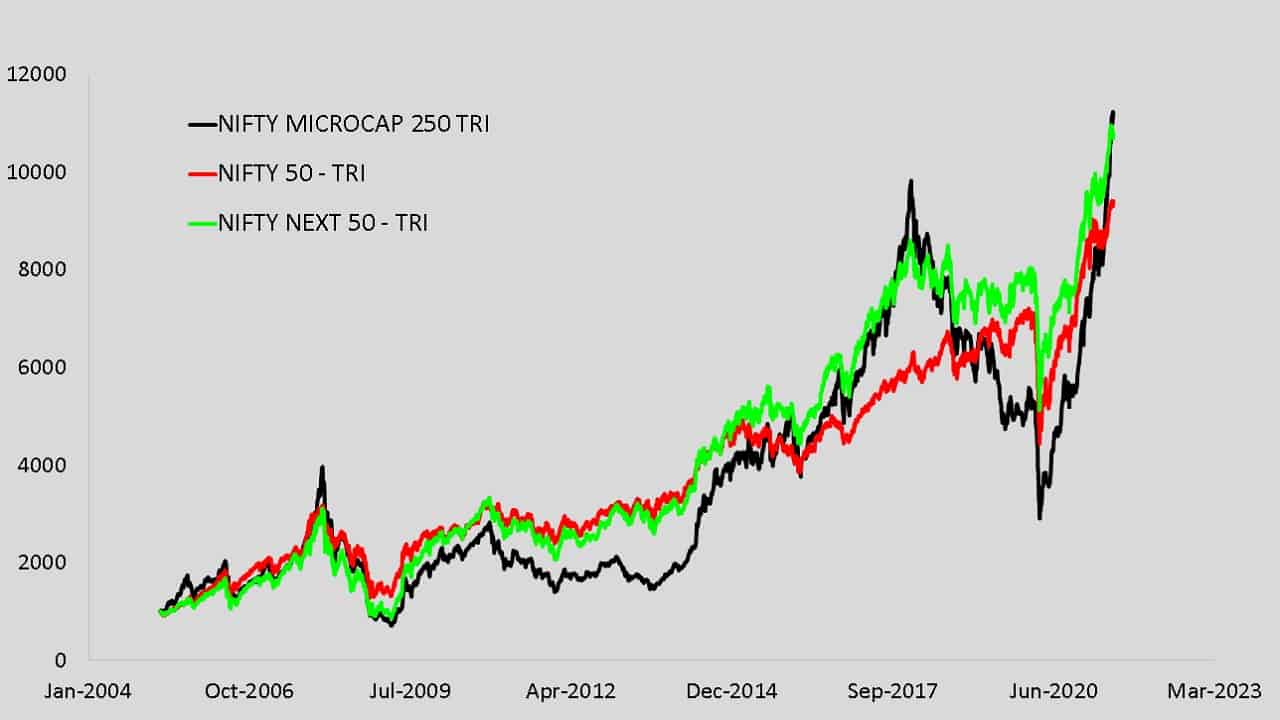
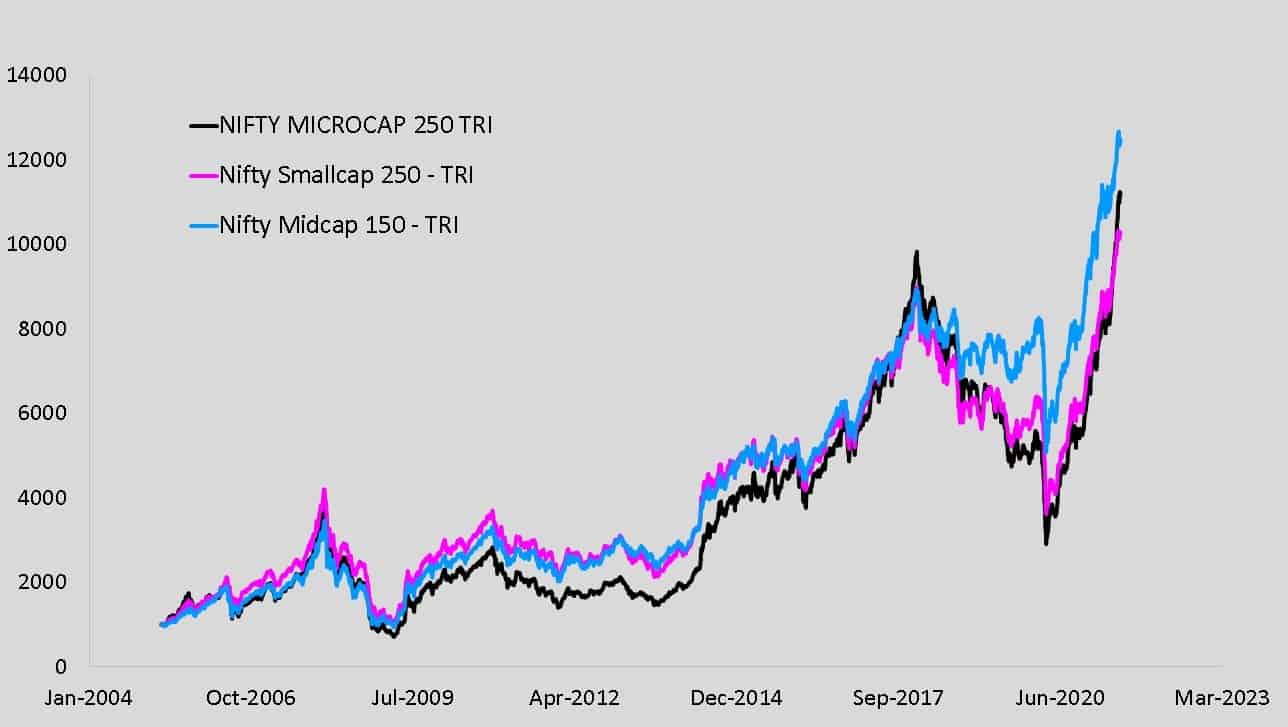
The long periods of underperformance and the huge drops from an all-time high for the microcap index are quite clear. The microcap index is comparable in volatility to the midcap and small cap indices but has underperformed during a sideways market (post-2009 recovery) to 2014. Also, this again shows that there is no credibility to the popular notion that a portfolio with a low market cap will do better (than a portfolio with a higher market cap) in future. Also, See: Large Cap vs Mid Cap vs Small Cap Funds: Which is better for long term investing?
As per the latest factsheet, these are the top 10 stocks as of May 31st, 2021.
- CG Power and Industrial Solutions Ltd. 2.64%
- Praj Industries Ltd. 1.94%
- Mastek Ltd. 1.40%
- Magma Fincorp Ltd. 1.38%
- Religare Enterprises Ltd. 1.33%
- Gateway Distriparks Ltd. 1.20%
- Reliance Power Ltd. 1.08%
- Eveready Industries India Ltd. 1.08%
- PTC India Ltd. 1.03%
- JSW Holdings Ltd. 1.00%
This the sectoral distribution as of May 31st 2021.
- Industrial manufacturing 15.54%
- Consumer goods 12.93
- Financial services 12.16
- Construction 6.86
- Chemicals 6.46
- Metals 6.11
- It 6.05
- Pharma 5.18
- Power 4.91
- Automobile 4.67
- Services 3.80
- Textiles 2.74
- Consumer services 2.24
- Cement & cement products 2.12
- Oil & gas 2.02
- Telecom 2.01
- Paper and jute 1.10
- Media, entertainment & 0.87
- Fertilisers & pesticides 0.84
- Healthcare services 0.83
- Utilities 0.54
Nifty Microcap 250 Index risk-reward analysis
The 10-year rolling returns of Nifty Microcap 250, Nifty Midcap 150 and Nifty Next 50 indices are shown below. Each line has 1552 10-year return data points.
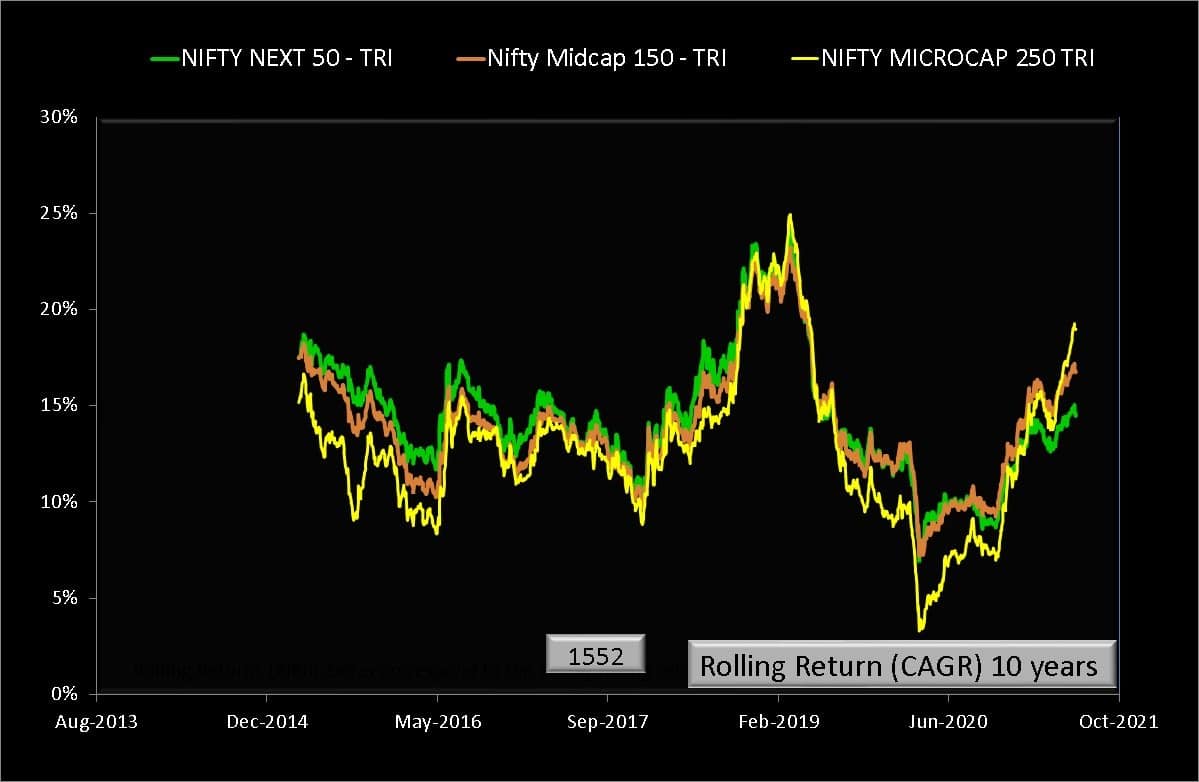
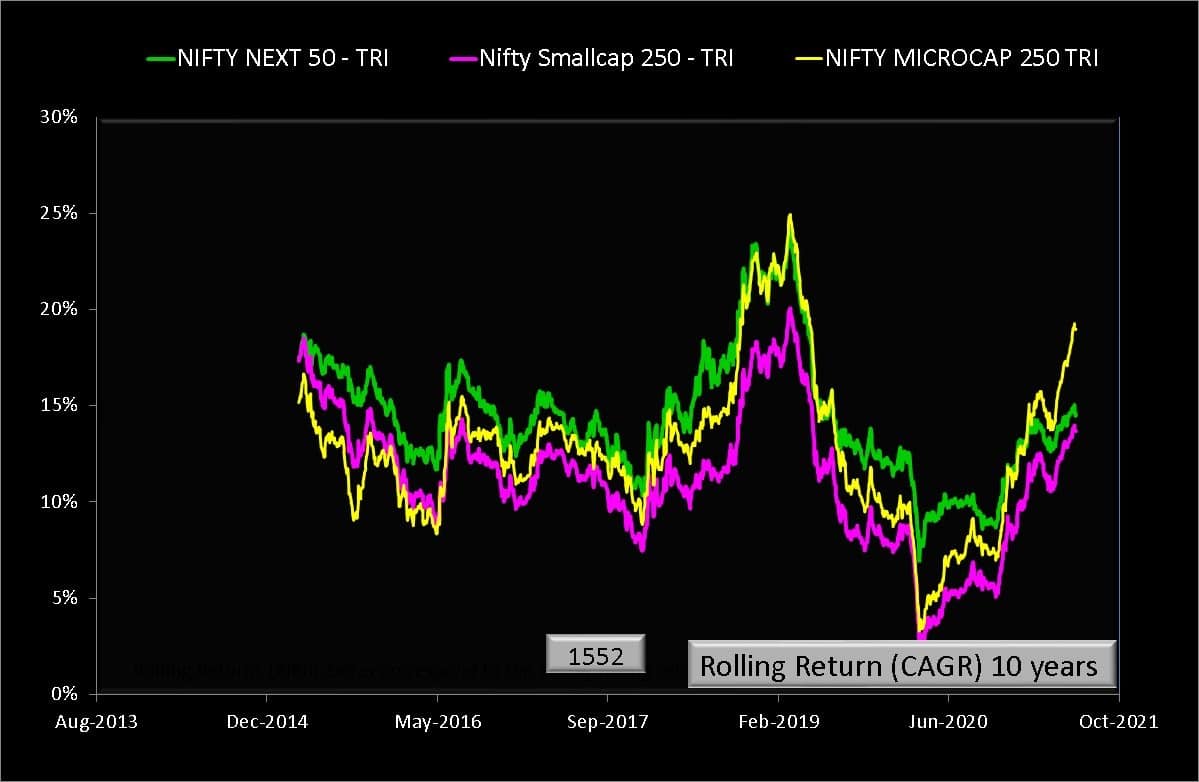
Notice that the microcap index (yellow) sometimes underperforms the other two indices and sometimes matches up to them. In the graph below, the midcap index is replaced by the smallcap index. The microcap index seems to have done better than the smallcap index over 10-year periods.
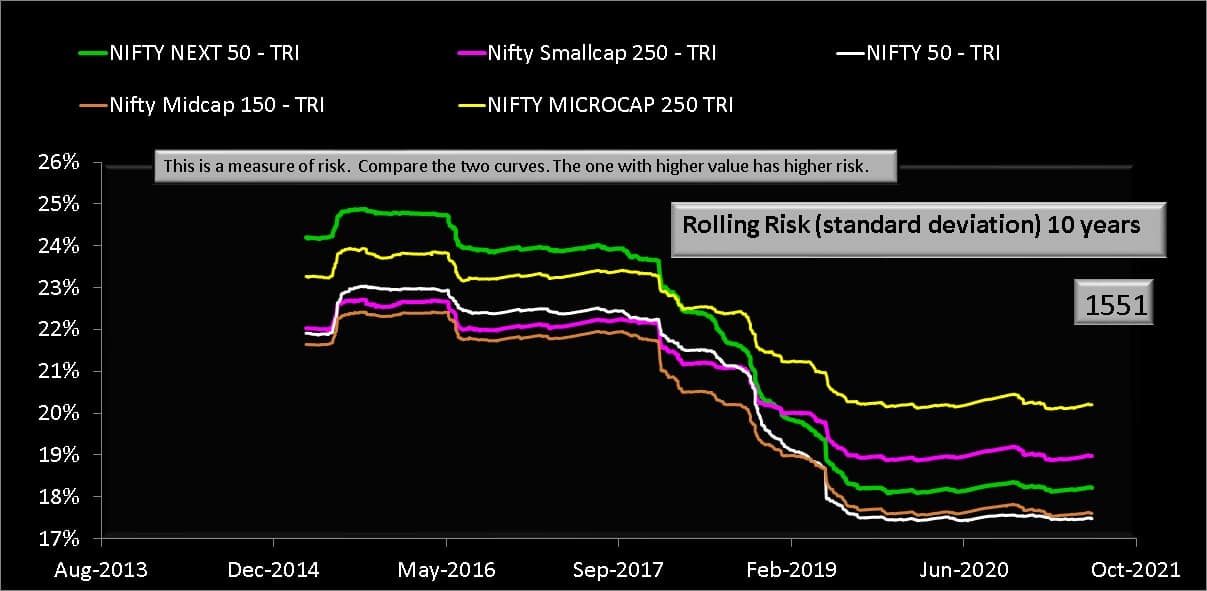
This is the rolling standard deviation (a measure of volatility) for all the indices. The line which is on top is the most volatile. The microcap is rightfully there.
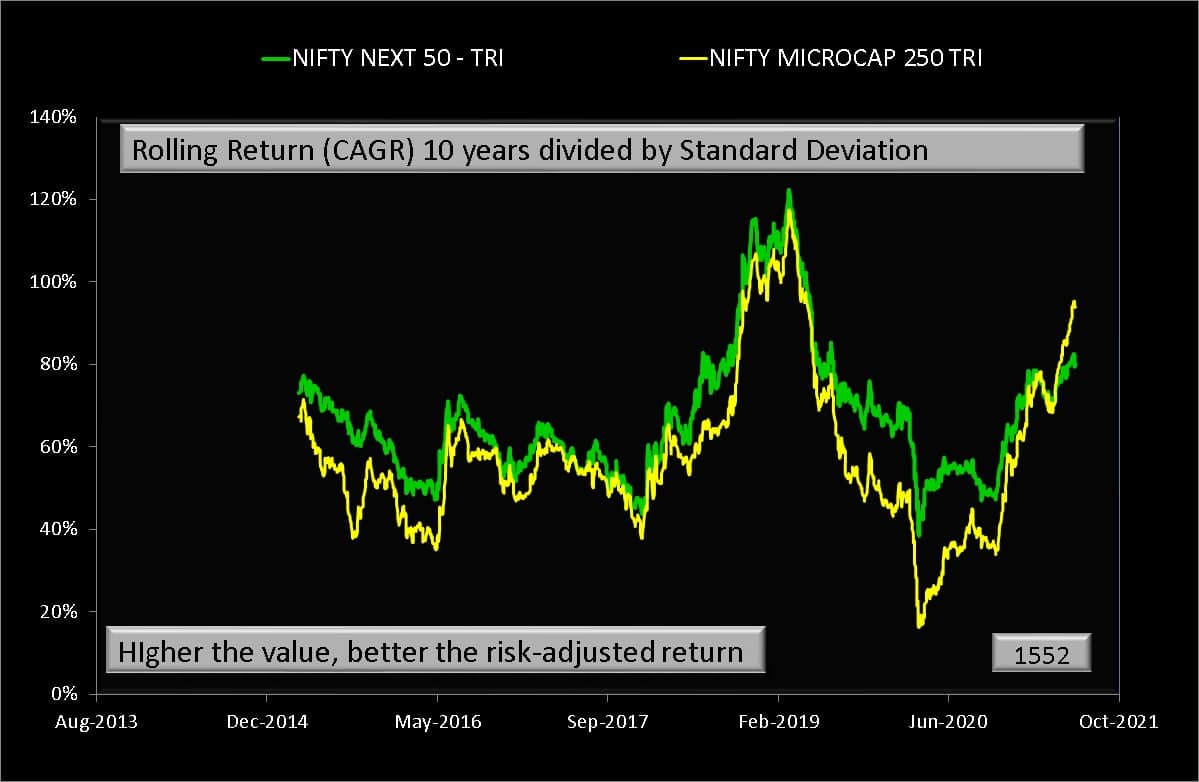
If you consider the risk-adjusted return as measured by simply dividing the return by standard deviation, the Nifty Next 50 consistently does better. This means the reward associated with the Nifty Microcap 250 index comes with too much risk and does not justify its reward.
What is surprising is the high volatility of Nifty Next 50 in the past (comparable to the microcap index). This has drastically come down in the last few years. The Nifty 50 also displays a similar trend. What this means for future returns of both indices remain to be seen. See: Do not expect double-digit returns from Nifty Next 50 index funds!
In summary, the Nifty Microcap 250 index comes with guaranteed higher volatility and occasional periods of good performance. We sincerely hope no AMC decides to comes with an ETF or index fund tracking this! The tracking error would be huge! See: Not all index funds are the same! Beyond top 100 stocks tracking errors are huge! As we have pointed out earlier, investors are better off avoiding midcap and smallcap indices. The same reasoning applies to this microcap index with greater vigour!
Related resources:
- Motilal Oswal Nifty Midcap 150 Index Fund: Should you invest?
- Motilal Oswal Nifty Smallcap 250 Index Fund: Will this make a difference?