Smallcase is a basket of stocks selected by an algorithm based on model, theme, sector or smart beta. In this review, we discuss what you need to know before investing in such an idea. Investing in a basket of stocks is a feature that many brokers have. Smallcase is perhaps the first instance in India where a separate entity is offering such baskets that several brokers can access.
Currently, in addition to Zerodha (which made Smallcase popular), investors with demat accounts in 5paisa, Kotak Sec, HDFC Sec, Edelweiss, Alice Blue and Axis Direct can also access the Smallcase baskets. Broker access is essential for the investor to track the baskets.
Smallcase investing vs Mutual Funds: Which is better?
Many investors want to compare Smallcase investing with mutual funds and wish to know which is better. As mentioned above each Smallcase basket is based on a particular idea filter. Each quarter, the qualifying stocks would change or their weights in the portfolio would change.
You would then receive an intimation from your broker about this. You can either agree to make changes in your portfolio as per the revised stock basket or ignore it. If you make changes, stocks will be purchased or sold as per the new basket allocation. The associated short term or long term capital gain or loss and brokerage costs will have to borne by the investor.
🔥Secure your future with our Robo-advisory tool trusted by over 3,500 investors and advisors. From effortless retirement planning to funding your children’s biggest dreams, turn your financial goals into reality. 🔥
In the case of a mutual fund, when the fund manager churns the portfolio, the investors do not need to pay tax. Thus brokerage and taxes would eat into smallcase gains continuously. It is simply impossible to say which is better though.
From my interactions with investors, I find many scared to even rebalance fearing taxes. Therefore, for most investors, this kind of basket investing is unsuitable as they will not stick to quarterly resets. Another reason why a comparison with mutual funds is not possible.
How is each smallcase basket constructed?
There 55 such baskets as on date! These are classified into four categories: Model-based, thematic, sector-tracker, smart beta. Here are a few examples from each category. You can explore all of them here. You will need an account to know the stocks and weights. As explained in the video below, some baskets are based on ETFs too.
Model-based Smallcase
R&D Spenders: Companies that spend on research to be future ready. Stocks currently in portfolio (need account to know this): Aravind Ltd, Ajanta Pharma, Ashok Leyland Etc.
Zero Debt: Companies with high earnings growth track record. The current portfolio includes Automotive Axles, Bharti Infratel etc.
Similarly, there are baskets with companies that have increased dividends, consistent dividends, low beta, positive momentum, sustainable earnings etc.
Thematic SmallCase
Halal Street: Shariah-compliant companies
Rural Demand/Middle class: Companies that will benefit from Rural demand or Middle class (two separate baskets)
Housing demand etc.
Sector Tracker
Insurance, pharma, realty, metal, medial sectors.
Smart Beta
As we have discussed several times before – Are Nifty Smart Beta (strategic) Indices better than the Nifty Next 50 – smart beta stock picking refers to methods that defy the conventional notion of higher risk is necessary for higher reward. There are three baskets here: Quality (sustainable business), Low volatility and high dividend yield.
The backtest
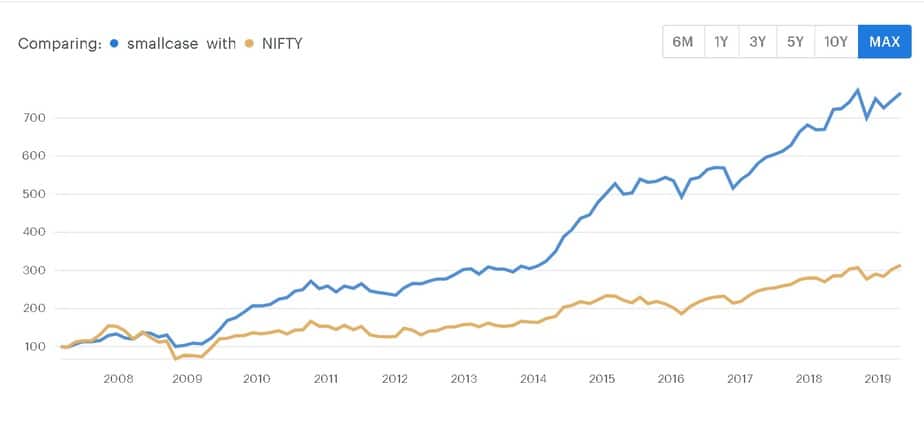
Each basket shows a backtest of the methodology. For example, this is the screenshot of the Low Volatility Smallcase. According to the return calculation methodology, taxes, brokerage have been excluded. It does not talk about corporate action and dividends. Investors should understand that taxes can significantly erode the gains shown in the backtest
SmallCase Reviews
The following comments were received on Twitter and Youtube in response to my small case review video (see below).
Sir previously i was investing in smallcase but during quarter rebalance approx 40% stocks changed so its not good idea because as ur investment increase and every quarter 40% change causes a big impact due to taxes. Dr. Satyendra
I have been a smallcase user for more than a year with -25% return. Please look into what you are investing and also look at the risk classification level before investing Kalai
Just want to add a couple of points from my experience. As Pattu sir pointed out here, the charts shown as performance are only the backtest for the current portfolio of stocks. Actually if it is very essential for you to see the historical peformance of the smallcase as an idea itself, you won’t see different cuts ie., if the smallcase has existed for two years, the charts are not going to show you the actual performance over 1Y, 2Y etc w.r.t. say NIFTY. There is only one inception to date metric which can show its actual performance. To add to it, from what I had seen much churn in a portfolio (turnover upto 50% 60% sometimes) that some smallcases represented by ideas like “companies expected to benefit over the next 5 years” don’t make sense at all. Such high turnover also means that the analysing the charts they show don’t make sense if you are looking for a long term solution. Girish
Verdict: Should you use Smallcase?
First the video review:
As an idea, Smallcase is fantastic. However, it will work only if the investor follows it to a tee. For this, they may have to churn the portfolio a bit too much and pay taxes. This is neither desirable not acceptable for many.
If you wish to try this out, please be prepared for the churn and associated costs. Do not start immediately. Watch the change in the portfolio for a few quarters and then decide. If you have a small exposure as an experiment, it will not help your portfolio too much. An alternative is to track a basket of stocks or a smart beta index and start with a few stocks from the top 10 and hold until they fall out of the index (30 or so stocks). Since the index will be rebalanced only twice a year and it may take a while for the top stocks to exit the index, the churn would be significantly lower. However, the discipline involved would be the same.
How to buy your first stock without breaking your head!
Are you using smallcase? What has your experience been?
Do share this article with your friends using the buttons below.
Create a complete financial plan with our Robo-advisor!
Trusted by 3500+ investors and advisors! Use code robo25 for a 20% discount!