Last Updated on December 29, 2021 at 1:00 pm
Bond defaults and downgrades are becoming daily occurrences and these would only increase if we do not see corporate earnings driven stock market movement. The latest is Reliance Home Fin & Reliance Commercial Fin. Each time there is a change in the credit rating of a bond, the NAV of the debt funds that hold it falls sharply*. So a natural question to ask is, can Banking & PSU debt funds be used to avoid credit risk?
If you are new to debt mutual funds, check out six free e-books and download the beginners’ guide to debt mutual funds. Also check out the latest freefincal Youtube videos: how much do I make from youtube and what is your risk appetite?
The assumption being that debt funds holding banking and PSU debt funds are less susceptible to rating changes and risk of default. Let us find out if this is possible. Avoiding credit risk and interest rate risk is quite possible and easy too. Why our AMCs are not taking this up is baffling: Open Letter to AMCs: Why are you not pushing Risk-free Debt funds enough?
* If the AMC declares the bond as junk immediately. As we saw recently in the ZEE-FMP fiasco – Eroding trust: Are mutual funds really market-linked products? – they need not and it can complicate matters in an already complicated space: Understanding Debt Mutual Fund Categories and why it is so hard to choose a debt fund! So now we should happy if the AMC devalues junk bonds immediately! See the fall in Reliance debt and hybrid funds today.
🔥Secure your future with our Robo-advisory tool trusted by over 3,500 investors and advisors. From effortless retirement planning to funding your children’s biggest dreams, turn your financial goals into reality. 🔥
Subscribe for money management solutions via email! (Link takes you to our email sign-up form) Join 32,000+ readers in our community.
👉 New Tool Alert! NaviPlan: A Privacy-Focused Multi-asset Tracker and Goal Planner 👈
What is a Banking & PSU Debt Fund?
What is credit risk in mutual funds?
When the repaying ability of a bond issuer goes down, the value of the bond in the market goes down. Proportionally, the NAV of the fund holding that bond would also fall. Read more: Understanding Credit Rating Risk in Debt Mutual Funds
What is interest rate risk in mutual funds?
The price of a bond in the market depends on demand and supply. In a simplistic scenario, when interest rates fall, existing bonds (with a higher rate) become more in demand and the NAV would increase and vice versa. Read more: Understanding Interest Rate Risk in Debt Mutual Funds
How oil price affects the bond market
Other factors also play a role. Although RBI has reduced the repo rate by 0.5% this year, bond prices have fallen since April because of an increase in oil price (and fear it could increase more). Thus this results in lower demand for bonds with more than a year in tenure, as investors cannot afford to lock in money. Thus the NAV falls.
Can Banking & PSU debt funds be used to avoid credit risk?
Short answer: No. Long answer: Even if we assume (incorrectly) that PSUs and banks will not default, these funds can still hold 20% of risky bonds and so things can still get pretty bad. While shopping for a banking and PSU fund (if you want one, long term goals only) focus on 3-star funds and check out their portfolio holding history. Why?
Well, a fund which sticks only to banking and PSU bonds of good rating will have fewer stars! Unfortunately, there are other problems too.
Interest rate risk in banking and PSU debt funds
Even if we assume these funds hold safe debt, the bonds are a few years in duration. This means they are susceptible to interest rate risk. Unlike credit risk, this can pull down the NAV on a daily basis (by a much smaller amount though). Check out the following two screenshots from Value Research of banking and PSU funds from Axis and L&T.

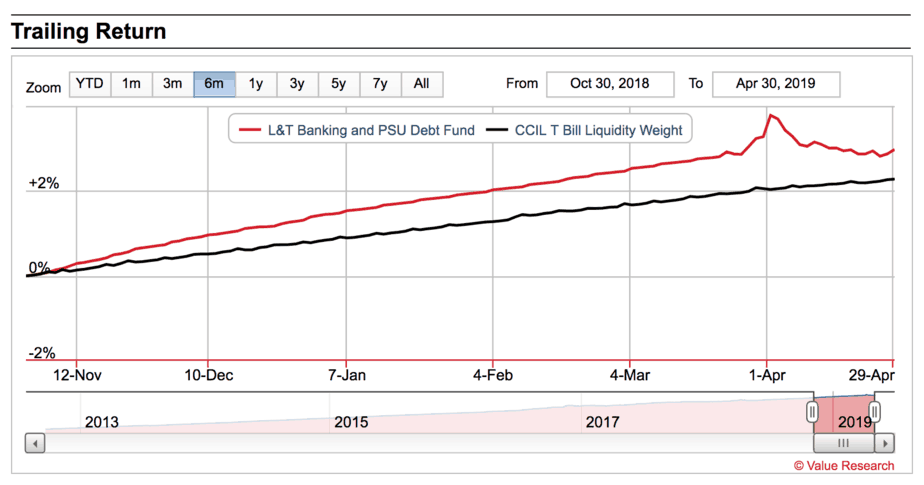
The fall in NAV since April is due lower demand for such bonds triggered by oil prices. The NAV for both funds moved up a bit when RBI dropped the interest rate fro 6.25% to 6%. Often such upward or downward movement occurs before the actual event in anticipation – what people like to call as “market pricing in the event”.
Thus, if you want to choose banking and debt funds, you must be ready to face such interest rate risk. Question is, are you? Most debt fund investors are not. They want higher than FD returns, lower tax and no risk. Classic wanting to eat the cake and have it too syndrome.