This article analyses the historical Nifty 50 portfolio over the last ten years (Oct 2012 to Sep 2022). This data is not available or free on the NSE website, so we use the portfolio history of Nifty BeES ETF as a proxy.
Eighty-four entities have been part o the Nifty 50 over the last ten years – 79 of them are stocks and five rights issues.
The 31 stocks are (in alphabetical order):
- Asian Paints Ltd.
- Axis Bank Ltd.
- Bajaj Auto Ltd.
- Bharat Petroleum Corporation Ltd.
- Bharti Airtel Ltd.
- Cipla Ltd.
- Coal India Ltd.
- Dr. Reddy’s Laboratories Ltd.
- HCL Technologies Ltd.
- HDFC Bank Ltd.
- Hero MotoCorp Ltd.
- Hindalco Industries Ltd.
- Hindustan Unilever Ltd.
- Housing Development Finance Corporation Ltd.
- ICICI Bank Ltd.
- Infosys Ltd.
- ITC Ltd.
- Kotak Mahindra Bank Ltd.
- Larsen & Toubro Ltd.
- Mahindra & Mahindra Ltd.
- Maruti Suzuki India Ltd.
- NTPC Ltd.
- Oil & Natural Gas Corporation Ltd.
- Power Grid Corporation Of India Ltd.
- Reliance Industries Ltd.
- State Bank Of India
- Sun Pharmaceutical Industries Ltd.
- Tata Consultancy Services Ltd.
- Tata Motors Ltd.
- Tata Steel Ltd.
- Ultratech Cement Ltd.
The following stocks had a minimum weight of greater than 1%. This means they spent considerable time among the top ten stocks of Nifty 50 over the past decade. Please note that these are weights of the Nifty BeES ETF and not that of NIfty 50. However, this should not significantly alter conclusions as the ETF is one of the most efficient in the country. Source: ETF tracking error screener October 2022
| Stock | Min weight | Max Weight |
| HDFC Bank Ltd. | 5.8214 | 11.2458 |
| Housing Development Finance Corporation Ltd. | 5.3856 | 8.4171 |
| Infosys Ltd. | 4.6237 | 9.2135 |
| Reliance Industries Ltd. | 4.6118 | 14.8933 |
| ICICI Bank Ltd. | 4.1754 | 7.9334 |
| Tata Consultancy Services Ltd. | 3.2141 | 5.9324 |
| ITC Ltd. | 2.4835 | 10.2317 |
| Larsen & Toubro Ltd. | 2.2582 | 5.4053 |
| Hindustan Unilever Ltd. | 1.7102 | 4.5779 |
| Axis Bank Ltd. | 1.4776 | 3.4300 |
| State Bank Of India | 1.4445 | 3.4414 |
| Kotak Mahindra Bank Ltd. | 1.2503 | 4.9941 |
| Adani Enterprises Ltd. | 1.2490 | 1.2490 |
The Nifty 50 portfolio weights of select stocks are given below.
🔥Secure your future with our Robo-advisory tool trusted by over 3,500 investors and advisors. From effortless retirement planning to funding your children’s biggest dreams, turn your financial goals into reality. 🔥
Subscribe for money management solutions via email! (Link takes you to our email sign-up form) Join 32,000+ readers in our community.
👉 New Tool Alert! NaviPlan: A Privacy-Focused Multi-asset Tracker and Goal Planner 👈
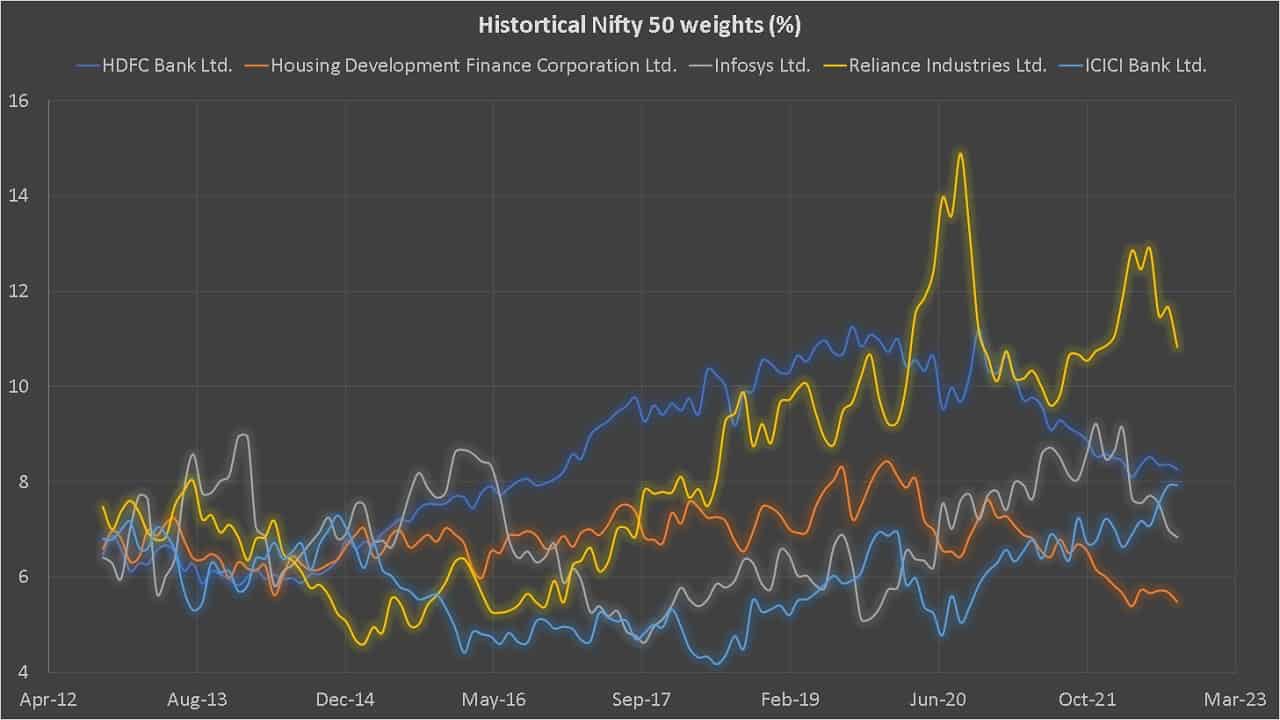
We have pointed out several times that the bulk of Nifty 50 returns stems from only a handful of stocks. Only ten stocks make up nearly 60% of Nifty 50 weight. A benchmark index needs to be stable, so weighting based on free-floating market capitalization helps. The downside is concentration risk. See: Do index fund returns depend upon just a few stocks (Concentration risk)? And, Almost 60% of Mutual Fund Equity AUM is from Nifty 50 stocks!
The sharp increase in RIL weight illustrates this. Perhaps it is no more than coincidence, but during the first build-up of RIL weight before the March 2020 market crash, the performance of Nifty 50 and Sensex funds came into the spotlight.
Any fund manager not invested in the top ten Nifty 50 stocks in significant amounts is guaranteed to underperform if other stocks in the market do not have enough momentum. See: Return difference of Nifty 50 vs Nifty 50 Equal-weight index at an all-time high! And Active Large Cap MFs recover along with equal-weight indices.
This is not to defend active fund managers but to point out that the high fee the industry charges is unjustified since many of them struggle. See: Actively managed mid cap mutual funds also struggle to beat the index!
A point worthy of debate is whether the Nifty 50 should have a limit on weights like several of its factor or smart beta indices. This will limit the concentration risk. Index inclusion/exclusion rules are arbitrary and variable. For example, for S&P 500 stocks‘ “most recent quarter’s earnings and the sum of its trailing four consecutive quarters’ earnings must be positive.” An IPO with just three months of listing history can enter the Nifty if other criteria are met. Also see: Should I exit Nifty Next 50 because of Paytm, Zomato and Nykaa?