Last Updated on April 5, 2023 at 6:48 am
A new reader took exception to our view of the Nasdaq 100, leading to an interesting conversation, parts of which are reproduced. “Why do you keep saying not to invest in the Nasdaq 100?”
As discussed earlier, the main reason for our recommendation is “Not many investors appreciate that the NASDAQ 100 is a highly volatile thematic index. After it crashed in the 2000s, it was underwater for nearly 15 years. Are you ready to stomach this if such a scenario repeats? The S&P 500 also suffered the same fate for about 12 years after 2000”. From: Is this a good time to Invest in NASDAQ 100 and S&P 500?
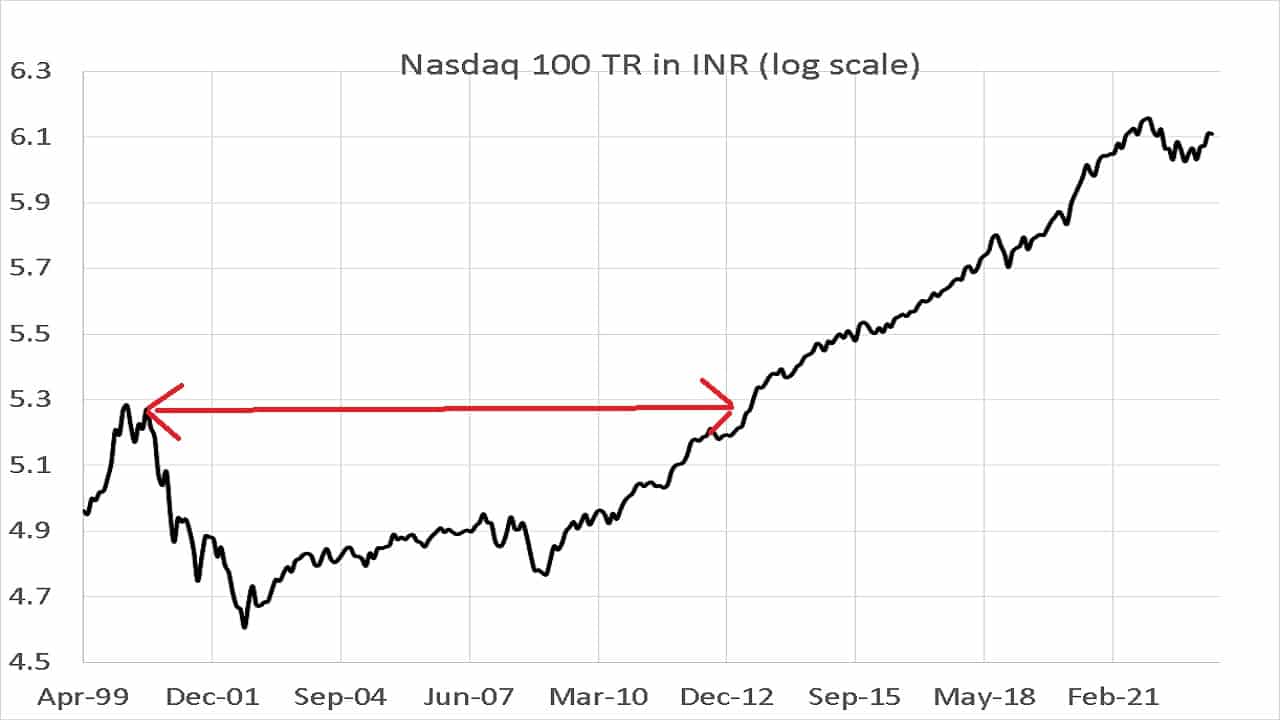
Then I learn that the investor has just started a “small” SIP in the NASDAQ 100. He asked me if it could be continued. It was too small to do harm or good at 10-15% of his total equity exposure. So I said, “Leave it be if it makes you happy”.
He said, “ok, how much return can I expect from this if I continue my SIP for ten years?”
🔥Secure your future with our Robo-advisory tool trusted by over 3,500 investors and advisors. From effortless retirement planning to funding your children’s biggest dreams, turn your financial goals into reality. 🔥
Subscribe for money management solutions via email! (Link takes you to our email sign-up form) Join 32,000+ readers in our community.
👉 New Tool Alert! NaviPlan: A Privacy-Focused Multi-asset Tracker and Goal Planner 👈
I gave my standard “no one knows, one can know, but thankfully no one needs to know” response. See: Do not expect returns from mutual fund SIPs! Do this instead!
He said, “How can you say this? The index has zoomed up so much in the past; it has already moved up close to 20% this year. Along with this, there is rupee depreciation. So surely I should get a good return, is it not?
“No one knows, no one can know. All you can reasonably expect is that the ride will be quite bumpy. There is no data to support any specific return expectation”.
Frustrated, he said, “Can you prove this?”. I have to admit I was waiting for this. So let us do this.
Nasdaq 100 Total return data is only available in the public domain from April 1999. So until April 2023, that gives us only 19 ten-year SIP windows, unlike the S&P 500, for which 123 years of data is available (and that would equally surprise you!) – The stock market always moves up in the long term, but returns move up and down!
Next, we get USD/INR forex data and create the Nasdaq 100 Total Return INR index. Those interested can do the same with DIY Investing and Analysis data sources.
We use our proprietary rolling return SIP Excel sheet to get rolling SIP return data. For details, see: Join the freefincal investor circle for exclusive benefits! And this is what we get.
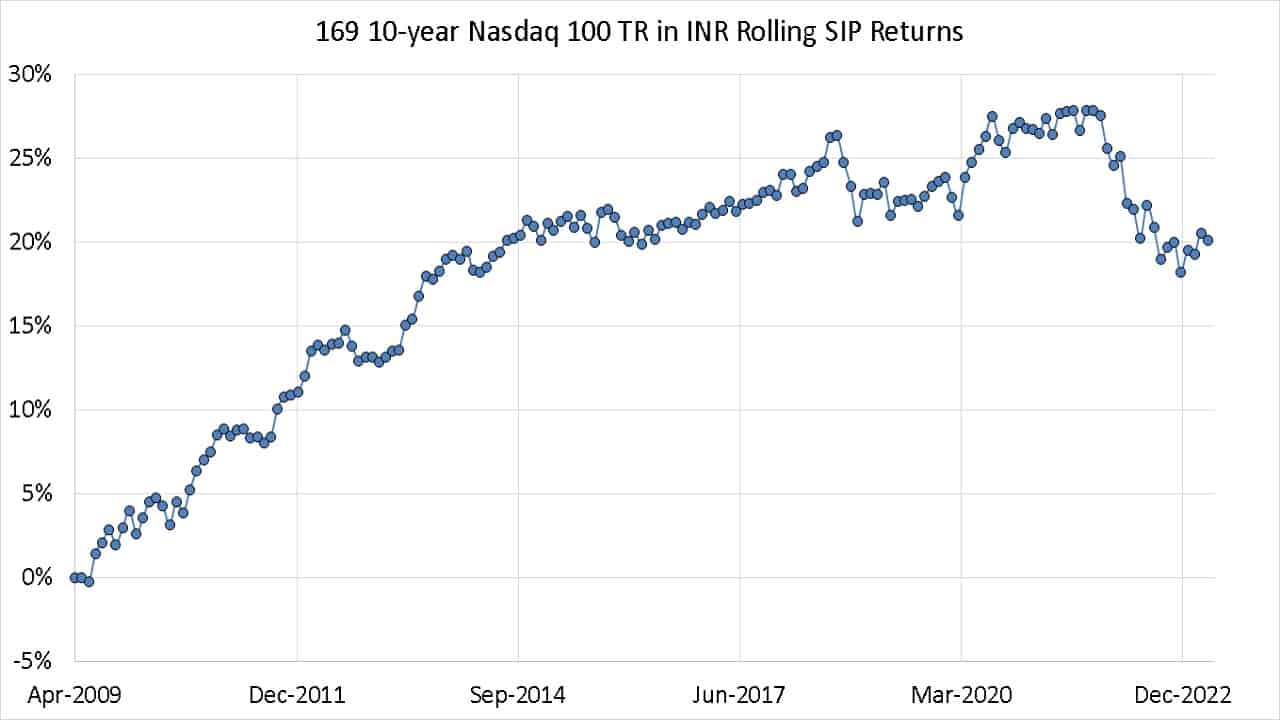
The minimum 10-year SIP return is -0.25%. The maximum 10-year SIP return is 27.88%. What do you think yours will be if you start now? The honest answer is we do not know. We cannot know.
There is no point taking an “average” out of these numbers. They would never fall on a “bell curve”. Knowing when not to take the average is >> than knowing how to take the average!
As regards INR depreciation, don’t go betting against the Rupee! It is getting stronger and stronger. See: Basics: Why does the Rupee fluctuate in value against the US Dollar?
There is little point in pursuing a risky asset like the Nasdaq 100 over the long term based on just hope. If you want a slice of the action, at least have the prudence to shift gains from the Nasdaq to Indian equity or fixed income occasionally.
Also see: Do we need to invest in international mutual funds?
The “do not expect returns” logic applies to any capital market-linked asset class. So, how can we invest if we are clueless about what return to expect?
As shown before – How to reduce risk in an investment portfolio, no matter what the sequence of returns is (which is the reason for the return variations), one can, with a clear asset allocation plan and stepwise reduction of equity can, help us reach a target corpus.
So the solution is to replace target return (= expectation) with a target corpus. This is possible only when we are clear about the purpose of the investment. You can use the Freefincal Robo Advisory Tool and create a concise plan for each goal. You can sign up for lectures on goal-based portfolio management to plan your asset allocation strategy.
An alternative to this is to play it by ear, gradually increase the fixed income corpus, and ensure there is enough money to meet the goal, so returns do not matter. See Portfolio Audit 2022: The annual review of my goal-based investments.
Whatever method you choose, there is no need to act like there is no point in equity investing. It is only a matter of having a goal and a system to reduce risk. Only then we have a “systematic” investment plan.