The impact of inflation over the long term can be devastating to our finances as shown recently – Inflation has reduced Rs. One Lakh to just Rs. 5741 in 41 years! The only way to beat inflation or at least keep pace with it is to invest right. But what does “investing right” mean?
Many investors are obsessed with returns. They assume getting higher returns will ensure we can beat inflation and take on more risk. This is an ill-informed strategy as we have recently shown: Equity may beat inflation but that doesn’t mean you will!
To beat inflation three factors are essential (ranked in order of importance)
- Time. Trying to beat inflation over the short term is both risky and unnecessary. Inflation dominates only over the long term and therefore beating inflation is essential only for long term goals (more than 10Y).
- Money. We need to invest the right amount otherwise even if the return is much higher than inflation, the corpus will not beat inflation (see examples below).You can beat inflation by investing in FD/RD or endowment policies by simply investing enough. See here for an example: Can I Plan My Retirement With Recurring Deposits and Fixed Deposits?
- Returns. Yes, returns matter (but of tertiary importance) but not returns from equity. Returns from the overall portfolio after-tax. It is enough if this overall return is as close as possible to the expected or anticipated inflation. Outperforming this is tough. See: Fee-only advisor Avinash Luthria warns real investment returns will be zero!
Returns from equity are completely out of control. We can however reasonable limit the fluctuations in the overall portfolio return by using a systematic de-risking strategy. Also see: Do not expect returns from mutual fund SIPs! Do this instead!
Let us now consider some examples. These images are slides I use in DIY investor meets to provide some context to the “investment return”.
🔥Secure your future with our Robo-advisory tool trusted by over 3,500 investors and advisors. From effortless retirement planning to funding your children’s biggest dreams, turn your financial goals into reality. 🔥
Subscribe for money management solutions via email! (Link takes you to our email sign-up form) Join 32,000+ readers in our community.
👉 New Tool Alert! NaviPlan: A Privacy-Focused Multi-asset Tracker and Goal Planner 👈
Consider some product or a service or a fee that costs 10L today. For an inflation rate as shown below (8%), the cost will increase with time as shown by the blue line. The green line represents the growth of the monthly investment amount at the average annual interest rate as shown above.
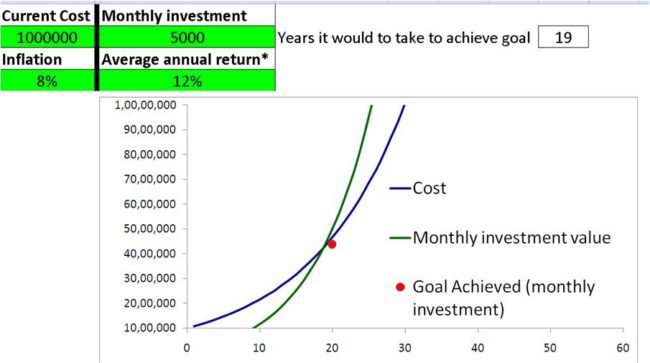
After 19 years the value of the investment will overtake the cost. Meaning we would have to wait 19 years to make the purchase. The real return (approximately) in this scenario is 12% -8% = 4% Now, what if the inflation was 10% instead of 8%?
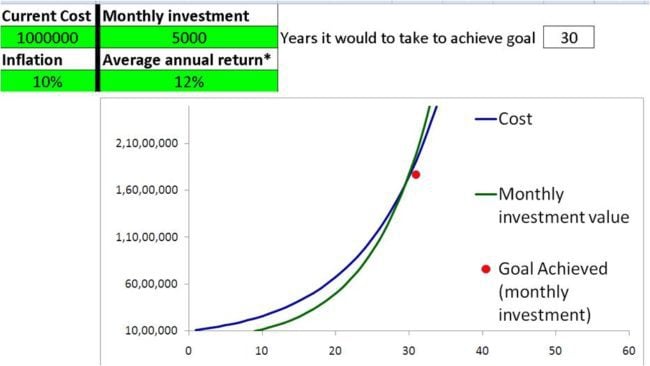
When inflation increases to 10%, it would take 30 years to make the purchase for the same investment. The return is still above inflation, but the does not help much. The purchase is significantly delayed. Why? Now consider this,
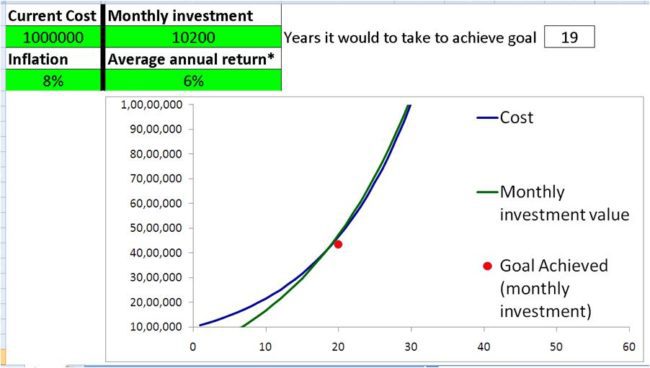
More than double the investment, with less than half the return, a real return of about -2% produces the same result as a real return of +4%: purchase after 19 years. What if we invest like we would expect a real return of -2% in an instrument that would give us a positive real return?
What if we invest 10200 each month in an instrument that has the potential to deliver double-digit returns? Unfortunately, many do the opposite. They invest less than the required amount (10,200) in instruments that offer negative real returns.
Loss of capital: Loss does not always mean a negative balance or an actual decrease in value.
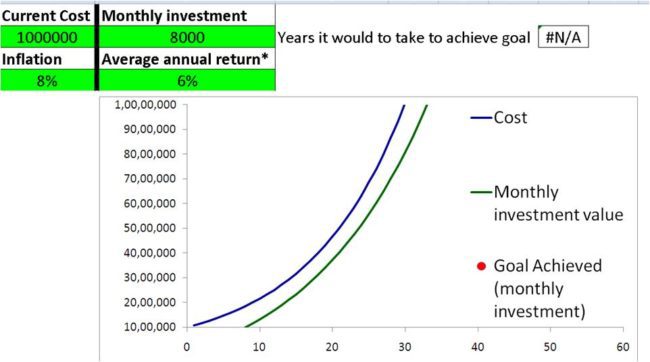
The result: permanent loss of capital (notice the gap between the curves at 19 years). I use the word permanent because these are the people who are scared of notional short-term losses. They may never be able to make the purchase.
Not investing enough is an ailment that can affect those who hope to earn a real return too!
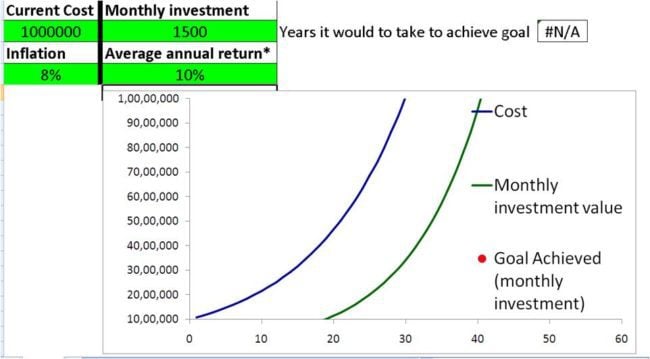
A real return of +2% means nothing if one does not invest enough. There is yet another side to this story. Those who can only invest little (say 1500 pm) cannot take excessive risk in the hope of getting a higher real return. This scenario can be produced in an excel sheet but is unlikely in real life. At least it is quite uncommon.
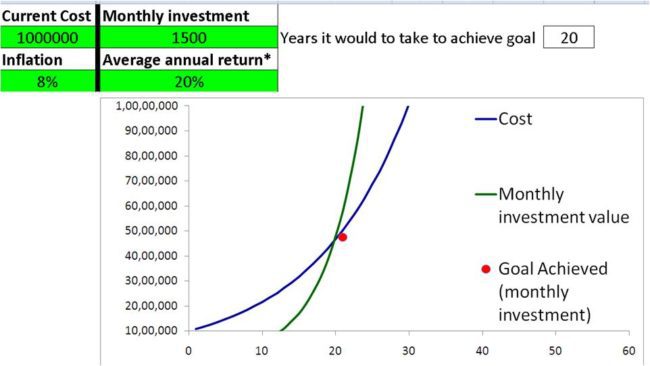
When an expense crops up (planned or unplanned) the only thing that matters is the money available to us. At that point in time, the return we have got, and how much it is above or below existing inflation rates is irrelevant.
The goal behind investing is to obtain a big fat corpus. The goal is not to beat inflation. The goal is not to obtain a real return. The goal is to recognise the importance of inflation.
To summarize, we can beat inflation by
1) investing in aggressive assets – that is in assets with the potential to earn a positive real return (return higher than inflation) – provided there is enough time to do so and there are enough fixed-income assets in the portfolio to balance out the risk.
2) investing enough capital. This could even be in assets with a guaranteed post-tax return lower than inflation.
If we combine the two, we can change our social station in life for the better. For an example see: Why increasing investments each year is crucial for financial freedom.