Last Updated on May 11, 2024 at 6:53 pm
This is a simple thumb rule for computing how much money we require for financial independence and retirement – normal or early (aka FIRE). You can also download a free e-book, an Excel sheet and an android app to answer questions like (1) what is the corpus required? (2) How long will a corpus last? (3) How much can I draw from a corpus each year? (4) What is the rate of return required?
The thumb rules discussed should only be used a rough starting point. They suffer from limitations and more rigorous planning is necessary (links below).
What is FIRE? FIRE stands for financial independence and early retirement. Early retirement is a stage in life when you have enough money to draw an inflation-protected income for the rest of your life without having to work anymore. This does not mean one stops working. It only means one need not work for a living. Also early is a loose term. Early could be 35 or 45 or 55 or 65, it is what you say it is.
🔥Secure your future with our Robo-advisory tool trusted by over 3,500 investors and advisors. From effortless retirement planning to funding your children’s biggest dreams, turn your financial goals into reality. 🔥
Subscribe for money management solutions via email! (Link takes you to our email sign-up form) Join 32,000+ readers in our community.
👉 New Tool Alert! NaviPlan: A Privacy-Focused Multi-asset Tracker and Goal Planner 👈
Financial independence could stand for early retirement or it could mean having enough corpus to not worry about an income for the next 5Y or 10Y until we pursue a new degree, a new startup etc. Obviously, if FI is sought only for a few years, a much lower corpus would be required than for early retirement.
It is crucial to understand that the mathematics of planning for normal retirement, early retirement or FI is identical.
So if you understand how the math works, you will not worry too much about making distinctions. Also, many people do not understand that FIRE is a calling. They do not recognise the difference between “not having the need to work for a living” and “not wanting to work for a living”. FI or RE does not mean the person will sit idle! Also, there is nothing wrong with wanting to retire normally.
Thumb rule chart for financial independence and early retirement
So let us get straight to it. Suppose your annual expenses are 4 lakh and you want to be financially independent for 5 years. Assuming 8% inflation and 8% post-tax return on the entire portfolio, you will need 5 x 4L = 20L. That is if inflation = portfolio return, the real return (excess return) = 0. For no real return, if you want FI for 5Y, the corpus will be 5 times your current annual expense. If you want it for 15Y, the corpus will be 15 times expenses and so on. Now read the following table for 0%, 1%,2% and 3% excess return above (8%) inflation. Use these as an extremely approximate initial guideline. Compared to other thumb rules, this is fairly exact (mathematically) but still has serious problems as we will discuss in the next post.

Notice that, longer the FI tenure, the more the corpus falls as the real return increases. For 30Y, the corpus falls from 30X to 21X as we increase the real return. This fall is less dramatic as we decrease the tenure. Can you guess why? Many FIRE seekers especially those who take blogs like MMM seriously complain that I am too conservative with the use of a 0% real return. We will soon see how even conservative assumptions are seriously flawed.
I have seen FIRE blogs where the advice is to hold 70% in stocks. This is atrociously bad advice. The freefincal robo advisory template recommends lower equity allocation, earlier the retirement age. We will consider why this has been done in future posts. My aim with this is series is to build a tool to check the robustness of any retirement or FI corpus. The Excel calculator and android app linked below can answer the following questions
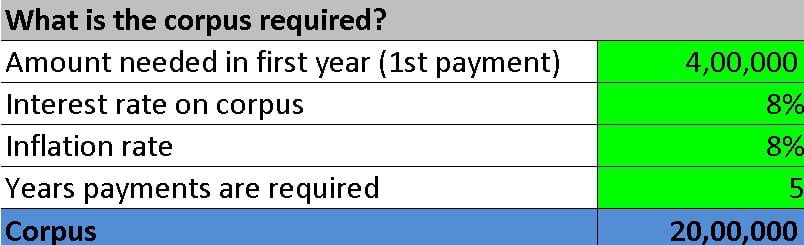
What is the corpus required for FIRE?
Given the initial annual expense (payment), return on corpus (post-tax), inflation rate and FI tenure, the corpus required can be calculated as =PV((1+return)/(1+inflation)-1,years,-payment,,1)
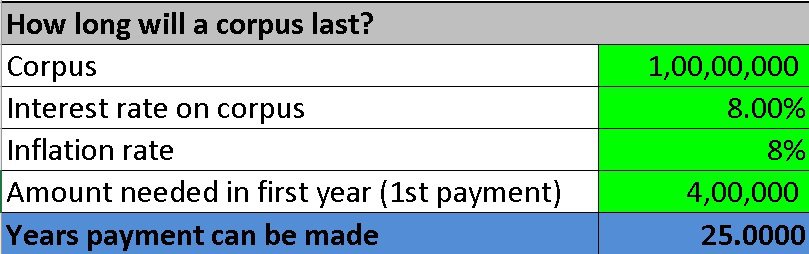
How long will a FIRE corpus last?
Given a corpus, portfolio return, inflation rate and initial annual expenses (payment/withdrawal), we can find out how long the corpus will last =NPER((1+return)/(1+inflation)-1,-payment,corpus,,1)
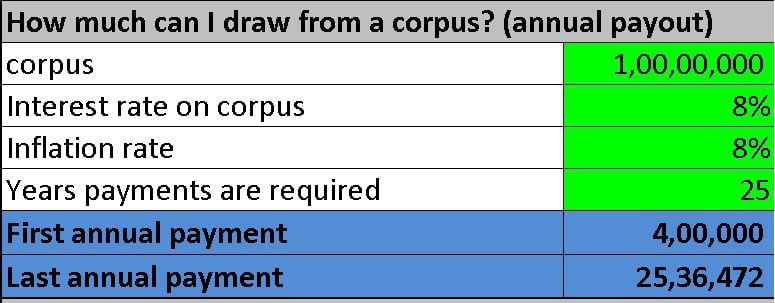
How much can I draw from a FIRE corpus?
Given a corpus, return (int rate), inflation, and FI tenure (years), we can find the how much we can withdraw in the first and last year.
1st payment: =PMT((1+return)/(1+inflation)-1,years,-corpus,,1)
last payment: =PMT((1+return)/(1+inflation)-1,years,-corpus,,1)*(1+inflation)^(years-1)
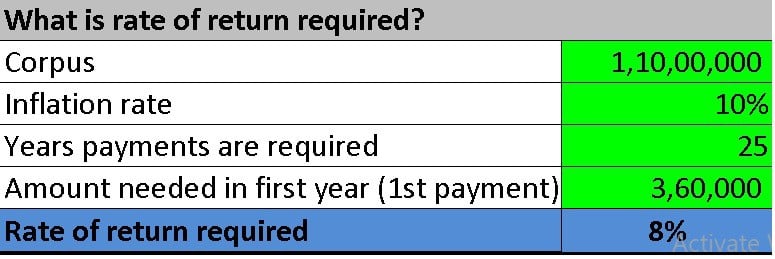
What is the portfolio return required for FIRE?
Given a corpus, inflation rate, Fi duration, initial annual expenses the portfolio return required can be calculated as =RATE(years,-payment,corpus,0,1)*(1+inflation)+inflation)
Resources
Play around with these tools and let me know what you think.
- Get the free E-book: How to retire early in India
- Download the set FIRE calculators (excel, will work on Windows, Mac, Google sheets)
- Get the Android app from Google play: Financial Freedom Calculator.
- Use the key features of the freefincal robo advisory software template to create a start-to-finish financial plan.
Remember that is only a ballpark estimate to get started. Serious FIRE planning will require us to understand the drawbacks of these calculations:
- Beware of incorrect assumptions while planning for early retirement (FIRE)
- Want to be financially free? Do not count on frugality! Worry about the sequence of returns risk!