Last Updated on December 29, 2021 at 6:06 pm
There are many popular “beliefs” surrounding mutual fund investments. One of them is that the best day for monthly investment is the last Thursday of the month when the Nifty futures and options contract expires. Several “experts” have also claimed that the best day for SIP is the last Thursday of the month. Since only the SIP date can be fixed and not the day, some advice the investment be made in the latter path of the month like 25th, 28th etc. which would fall close to the last Thursday. Is there any truth to all this? We find out.
In the spot market, a stock trade is carried out immediately. In the futures market, the agreement is drawn today, and the trade is effected later. When two parties agree to buy or sell a stock (or any other tradable asset) at a fixed price in the future, we have a futures contract. If the future sale is not mandatory, we have an options contract.
The monthly futures and options contracts expire on the last Thursday of each month. If that day is a market holiday, it will expire the previous business day. This is also known as “expiry Thursday”. The futures price and the spot price converge as expiry day approaches, and little or no difference when the contract expires. This is the basis for cash-and-carry arbitrage, as explained earlier: How Arbitrage Mutual Funds Work: A simple introduction.
Now, how did this ‘belief’ that “investing each month on expiry Thursday will get better returns” start? Perhaps it stems from trading circle expectations that expiry day trades are high-risk; high-reward trades; that market tends to be volatile on such days? Maybe there are other reasons too. Also, read Quadruple Witching.
🔥Secure your future with our Robo-advisory tool trusted by over 3,500 investors and advisors. From effortless retirement planning to funding your children’s biggest dreams, turn your financial goals into reality. 🔥
Subscribe for money management solutions via email! (Link takes you to our email sign-up form) Join 32,000+ readers in our community.
👉 New Tool Alert! NaviPlan: A Privacy-Focused Multi-asset Tracker and Goal Planner 👈
Somewhere down the lines of human communication, this seems to have embellished into, “the market will close in red (down) on expiry day,” and therefore, the last Thursday of the month is the best day to invest in a mutual fund: so more units are obtained. I have been seeing this idea circle around investing forums for years now. Most recently, someone asked this in the freefincal Goal-based investing Facebook group and on Redditt r/IndiaInvestments. Hence this study. In a poll conducted at Asan Ideas for Wealth, 30% of 445 votes were in favour of an expiry-date SIP outperforming a normal (start of the month SIP).
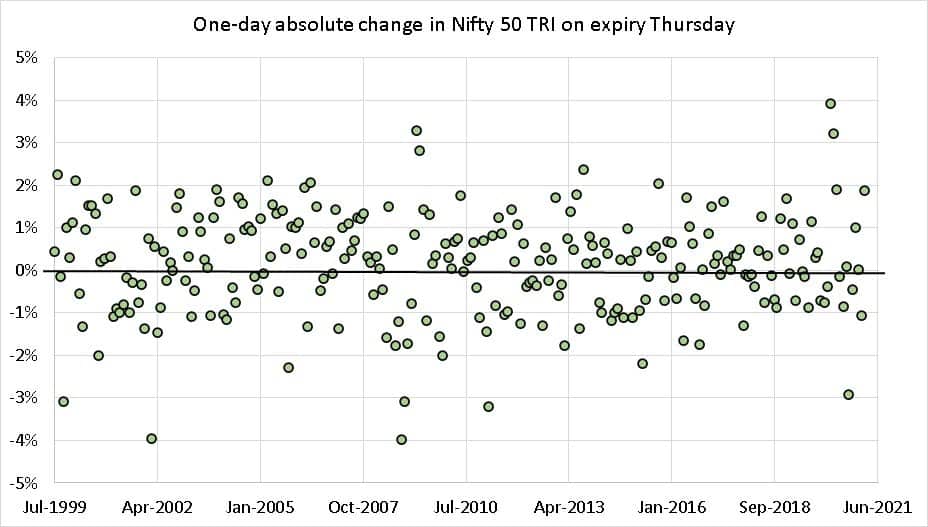
Is there any truth to this notion that the market will close lower on expiry Thursday? There are 260 expiry dates from the 30th of June 1999 (start date for Nifty 50 TRI history). If we compute the interday return (absolute change in Nifty 50 TRI from the day before expiry to expiry day), we can see that it is entirely random! If anything, markets have closed positively more often!
These graphs representing rolling SIP returns over 5, 10 and 15 years should come as no surprise. Here each data point is a SIP over the specified duration. Expiry SIP refers to monthly investments made on “expiry Thursday” (or previous working day if the last Thursday is a market holiday). This kind of SIP is not possible to set up (thankfully). Normal SIP is one where the investment is made on the first business day of the month.
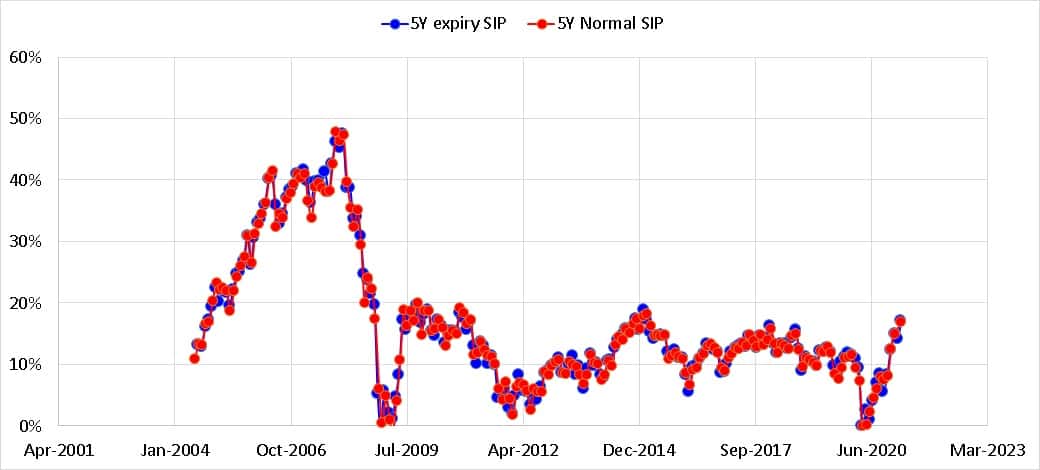

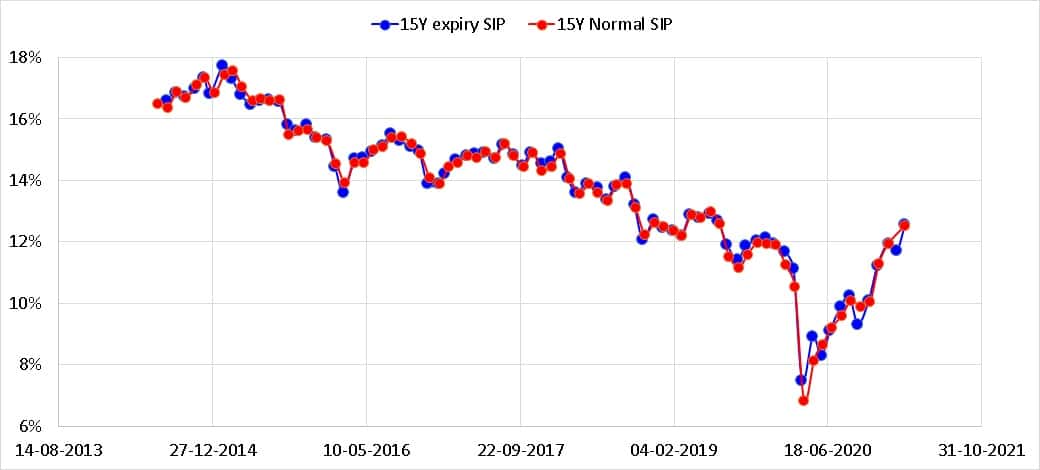
There is no difference between an imaginary SIP done only on expiry Thursday and the first business day SIP. A normal SIP for Rs. 1000 started in June 1999 (Nifty 50 TRI) would have fetched a return of 14.69% and Rs. 16.26 lakhs. The expiry date SIP would have fetched a return of 14.74% and Rs. 16.19 lakhs (the XIRR is a touch higher even though the corpus is a touch lower because of the date differences).
Is there any other preferred SIP date? No, there is not. See our comprehensive earlier study: What is the best date to start a mutual fund SIP? Results from 4000+ 10 Year SIP Returns!
Trying to find patterns from the daily index (or stock) closing prices is quite difficult. There is no special day! The market tends to skew towards positive returns, but it is not possible to spot this from raw price data, particularly in real-time. It will always “look” random.
You will have to eliminate the noise by some averaging and tactical entry (and exit: entry alone, aka buying on dips is for children and will not work), also known as market timing. See our earlier results.”
- If we invested only when the Nifty was “low”, can we beat the market?
- Buying on market dips: How effective is it?
However, market timing will lead to reduced portfolio volatility more often than not. A higher return is not always possible.
- Timing the market will work but not the way we imagined!
- This “buy high, sell low” market timing strategy surprisingly works!
In summary, investors only have two choices:
(1) ‘grow up’ and invest whenever you have money (SIP or manual does not matter!) and manage portfolio risk in a goal-based manner systematically or
(2) time entry and exit with a reasonable strategy with the clear understanding that they are optimising for portfolio risk and not returns.
Ps. There are behavioural issues involved in both approaches, not just timing. Discipline is always more important than the choice of method, but one can only take the Horse to the water.