Last Updated on April 12, 2017 at 8:38 pm
Budget 2014 appears to have struck a cruel blow to debt mutual fund investors and distributors. Here is the latest version of the debt mutual fund vs. fixed deposit calculator to evaluate the utility of debt mutual funds.
Update: Ramesh Mangal pointed out an error in the tool and the graphs. So I have pull out this post briefly to correct the errors. Hope they are all gone! Sorry for the inconvenience.
The finance minister in his budget speech said,
“In the case of Mutual Funds, other than equity oriented funds, the capital gains arising on transfer of units held for more than a year is taxed at a concessional rate of 10% whereas direct investments in banks and other debt instruments attract a higher rate of tax. This allows tax arbitrage opportunity. This arbitrage has hardly benefited retail investors as their percentage is very small among such Mutual Fund investors. With a view to remove this tax arbitrage, I propose to increase the rate of tax on long-term capital gains from 10 percent to 20 percent on transfer of units of such funds. I also propose to increase the period of holding in respect of such units from 12 months to 36 months for this purpose”.
Does this mean fixed deposits are better than debt mutual funds? Not quite.
🔥Secure your future with our Robo-advisory tool trusted by over 3,500 investors and advisors. From effortless retirement planning to funding your children’s biggest dreams, turn your financial goals into reality. 🔥
Subscribe for money management solutions via email! (Link takes you to our email sign-up form) Join 32,000+ readers in our community.
👉 New Tool Alert! NaviPlan: A Privacy-Focused Multi-asset Tracker and Goal Planner 👈
The government wants to remove the tax arbitrage that now exists for debt funds.
Note: When the finance minister said, “I propose to increase the rate of tax on long-term capital gains from 10 percent to 20 percent on transfer of units of such funds”, I assumed the 10% without indexation now becomes 20% without indexation and 20% with indexation.
This seems to be wrong. The 10% without indexation is no longer available. Only the 20% with indexation option is available.
This is good news. Please ignore the ‘without indexation’ curves (green) in the plots below.
Let us now find out which instrument is more beneficial and when. We will assume tax is paid only upon redemption for debt funds and indexation benefits are available at 20%.
Let us consider an investment of Rs. 10,000.
Fixed deposit interest rate: 9%
Debt mutual fund CAGR: 9% (you can play with both rates in the calculator)
Tax Slab: 30%
Here I have assumed the cost inflation index increases each year by only 5%. If it is more, the benefit will be more.
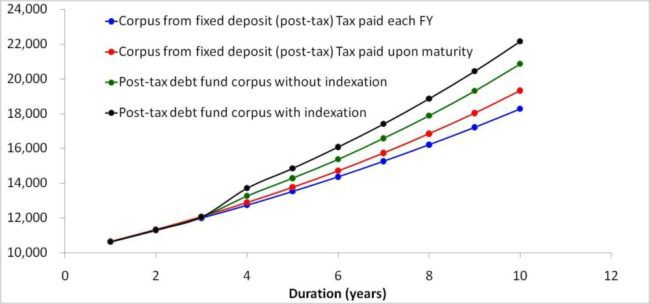
For durations above 3 years, debt mutual funds still make sense for those in the 30% slab. With indexation, the gains are higher.
Fixed deposit interest rate: 9%
Debt mutual fund CAGR: 9% (you can play with both rates in the calculator)
Tax Slab: 20%
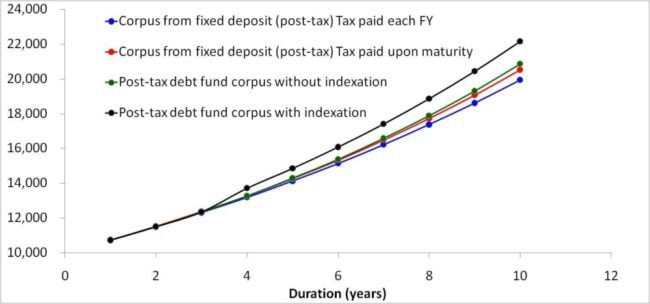
Fixed deposit interest rate: 9%
Debt mutual fund CAGR: 9% (you can play with both rates in the calculator)
Tax Slab: 10%
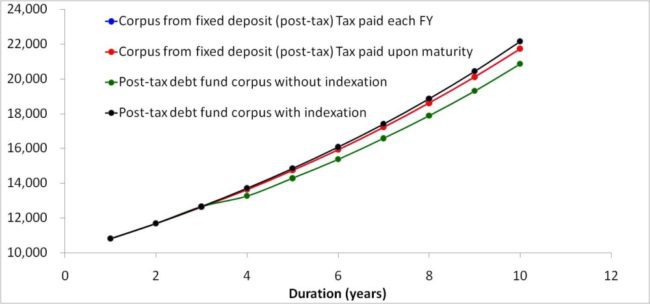
Obviously without indexation, debt funds cannot win. Indexation will in favour of even those in the 10% slab.
Verdict:
- For those in those 30% slab, debt funds are still good instruments for any requirement above 3 years. It does not matter if indexation option is available or not.
- For those in those 20% and 10% slabs, debt funds are still good instruments for any requirement above 3 years if indexation option is available (from what I seen on the web, it is available).
- These changes will not affect those invested in international equity funds much, provided they hold on to it for more than 3 years.