Last Updated on August 22, 2022 at 11:15 pm
A reader asks on Twitter, “Can we use Sovereign gold bonds for retirement planning?” For those who hate tax, the Sov. gold bond is an enticing investment. Buy and hold it for eight years and the returns (if positive!) are tax-free.
So why not do this over a 20-25 year period when a typical investor accumulates a corpus for retirement? Unfortunately, practical implementation has several issues.
As we have shown several times in the past, gold is just as volatile as equity and not as rewarding. Gold has outperformed gilts only in the past decade but is significantly more volatile.
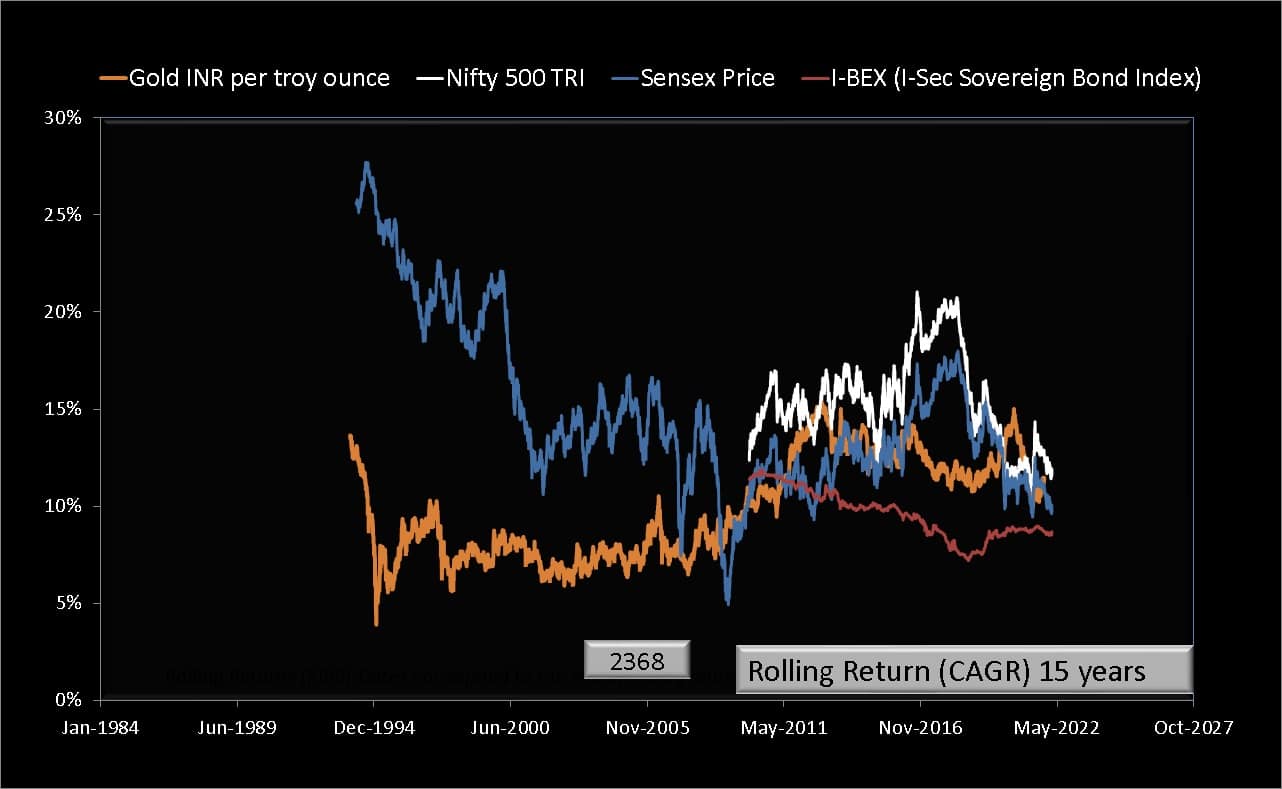
Please note that gilt yields were 12% or more in the 90s and in between 12-10% in the 2000s. That for 15-year durations from the 1970s, Gold INR has outperformed gilts only the last 10 years. Equity has typically outperformed gold over 15 years. Also see: How much return can I get from Sovereign Gold Bonds? And Gold: 11% annualized return in 41 years, but there is a catch.
🔥Secure your future with our Robo-advisory tool trusted by over 3,500 investors and advisors. From effortless retirement planning to funding your children’s biggest dreams, turn your financial goals into reality. 🔥
Subscribe for money management solutions via email! (Link takes you to our email sign-up form) Join 32,000+ readers in our community.
👉 New Tool Alert! NaviPlan: A Privacy-Focused Multi-asset Tracker and Goal Planner 👈
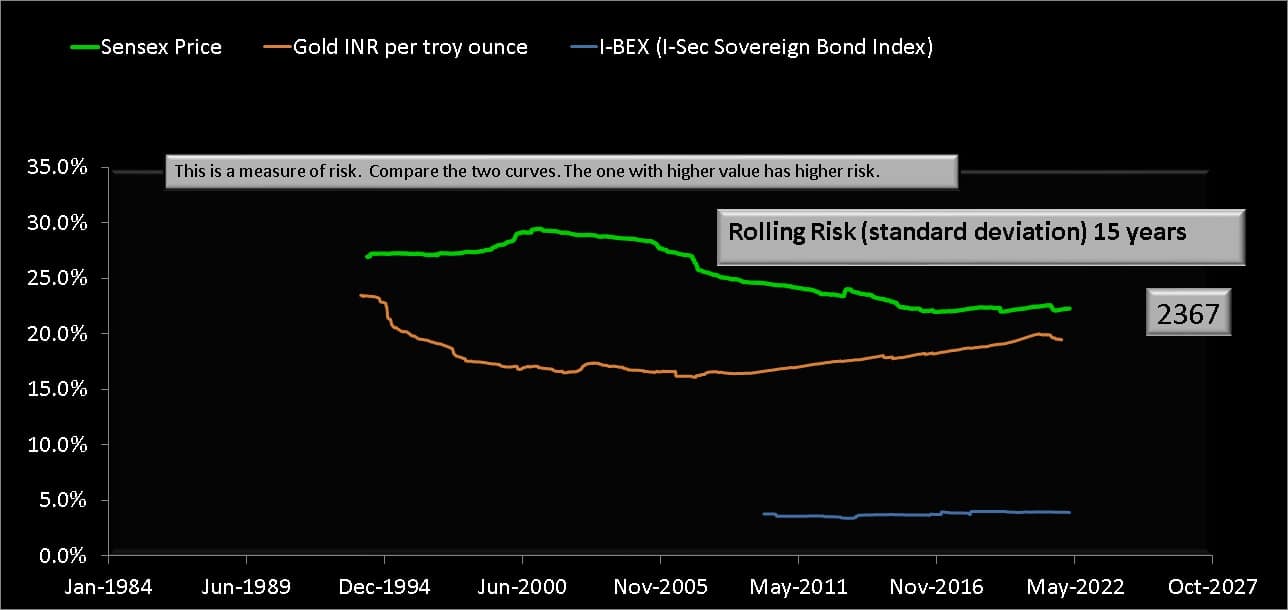
From the rolling standard deviation chart, we see that gold has guaranteed higher volatility than gilts but not always higher returns. Thus the risk taken by a gold investor does not always bear fruit. We have also shown that gold is an unsuitable inflation hedge over the long term or, at best, is an inefficient one: Is gold a hedge against inflation?
Takeaway: Gold is an unnecessary passenger in our retirement planning journey. We had come to the same conclusion by backtesting portfolios with different gold exposures: Will including gold in my portfolio help?
Therefore we do not recommend including gold in a retirement portfolio. Most investors assume a 10% or 15% exposure to gold will make a difference. It will not even if we know how to measure its impact (see link above) – most investors don’t know how to do this.
The inclusion of an asset class implies higher maintenance and higher tax outgo. Most investors are not ready for such responsibilities. Take for example Sov. gold bonds. Say we include 20% of it in a portfolio. It will not stay at that level forever.
Yes, initially investors will be able to adjust the asset allocation by changing the amount they invest. But as wealth builds, this will not be possible without redemption and paying the tax.
Investors cannot buy sov gold bonds in the hope of holding on to them for eight years to escape tax. That will be too risky for the overall portfolio – remember it will have or it should have a good amount of equity if retirement is the long term goal. They will need to sell the sov gold bonds at some point for a rebalance. This means facing market risk while selling and then paying the necessary tax. Most investors are not ready for his as they do not appreciate the basics of portfolio management.
If our child’s marriage is say 8-10 years time, then buying sov gold bonds is a risk-free and tax-free way to accumulate capital for future gold purchases. Retirement planning is a different ball game.
Also, buying sov gold bonds even once a year for say, 20 years (from now until retirement) is not practical. Keeping track of these can be a pain.
In summary, we recommend investors stay away from sov gold bonds unless they have a well-defined goal to buy gold with the proceeds in future. Since retirement planning does come with such a requirement sov gold bonds are not suitable. Other forms of tracking gold price (gold ETFs, gold funds etc) may be better suited but eminently unnecessary.