Last Updated on December 19, 2021 at 7:16 pm
In the last quarter of the financial year, we are likely to encounter advertisements and sales pitches for how ELSS mutual funds are better than other tax saving instruments. A common sales pitch is that ELSS mutual fund investments are locked for three years and hence the fund manager can deploy funds without worrying about redemption pressure. Some have even suggested that this lock-in will help get better returns.
For those who can put two and two together, ELSS mutual funds come with an upfront commission (now, thankfully) capped at 1%. An ELSS SIP is a nice way to set up a constant commission stream for the intermediary and income stream for the AMC, with each instalment locked in for three years.
I had debunked this “myth” earlier: The Myth About ELSS Fund Lock-in but would like to revisit the topic of a lock-in when I saw this advertisement.

🔥Secure your future with our Robo-advisory tool trusted by over 3,500 investors and advisors. From effortless retirement planning to funding your children’s biggest dreams, turn your financial goals into reality. 🔥
Subscribe for money management solutions via email! (Link takes you to our email sign-up form) Join 32,000+ readers in our community.
👉 New Tool Alert! NaviPlan: A Privacy-Focused Multi-asset Tracker and Goal Planner 👈
In particular this image:

It is an image of a man enjoying an up close view of a crocodile while sealed up in a cage.
FYI, this is the full picture and the cage is known as er … “cage of death”!!

This cage of death is a trip “down under offered by Darwin’s Crocosaurus Cove.
Now let us look at the accompanying statement:
If your investments are locked in, you need not worry about market volatility
What is the implication here? The ELSS lock-in protects the investor from market volatility?
Or is it: Funds with a lock-in have lower market volatility?
Or is it: the money is locked-in, so there is no point in worrying about market volatility? 🙂 (would that sell?!)
I will leave the interpretation to you and focus on some hard facts.
ELSS mutual funds are not closed ended funds. The entire AUM collected during the NFO period is locked in for the first 3 years. Many years later, the fund will have a constant stream of inflows and outflows. So even if we assume a lock-in has a benefit (a myth), the AUM is not really locked-in. Investors can rush in to invest and there will always be a trickle of redemptions.
1 ELSS Mutual Funds: Risk vs Reward
The risk measured over a three year period and the return obtained over that period are plotted for all diversified mutual funds (open circles). The ELSS mutual funds are represented by red dots. Notice anything special about them? I cannot. Source: Value Research.
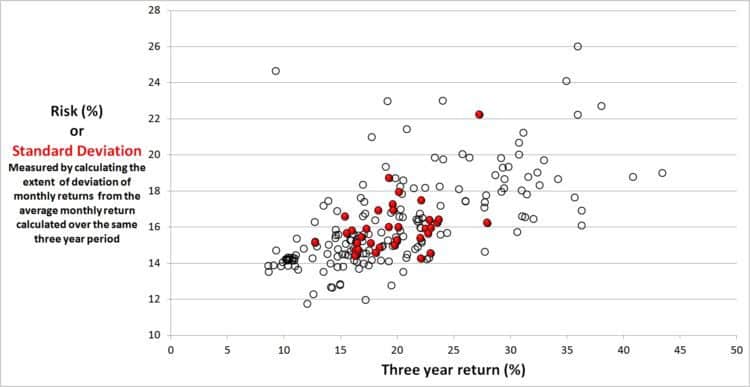
The funds at the higher end of the risk spectrum are mid-cap and small-cap funds
2 Reward: ELSS vs Other Categories
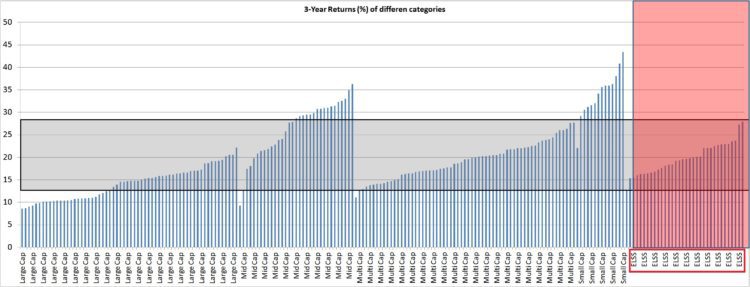
The three-year returns for all categories are shown below (source Value Research). Notice the ELSS funds offer a return quite similar to multi-caps, some mid-caps and a few large caps. Nothing special.
AMCs and their intermediaries are going to sell the way they see fit. It is up to us investors to be informed.
ELSS Mutual Funds Are Just as Risky/Rewarding as Other Diversified Funds
Their only advantage is that they help in saving tax. However, there is no free lunch. This saving comes with a lock-in.
Those who understand the importance of an asset allocation will recognise that there is no need for ELSS mutual funds. EPF, VPF, PPF, mandatory NPS, term insurance premium, or children’s tuition fees or a home loan tax benefit is all that one requires:
Making the best use of section 80C for tax saving: an example
Also see: Do not use ELSS mutual funds to save tax in the last minute!