Last Updated on December 29, 2021 at 5:19 pm
In one of the best examples of the power of compounding, a EPF corpus valued at Rs. 1300 in the financial year 1983-84 grew to an astounding Rs. 71.9 lakh in 2014-15, an increase of 5534 times. A look at the numbers shared by one of the oldest readers of freefincal who prefers to be anonymous.
Naturally, this increase in the EPF corpus over the years includes salary hikes, bonuses, promotions, interest rate changes etc. but is nonetheless illustrates the power of compounding when the corpus is fortunate enough to grow undisturbed.
Before we begin, over 930 members have signed up for the video lecture series on Goal-Based Portfolio Management: Techniques to reduce fear, uncertainty, & doubt. This will discuss strategies to use and manage the right asset allocation no matter what the market condition is. Details about the course and joining.
🔥Secure your future with our Robo-advisory tool trusted by over 3,500 investors and advisors. From effortless retirement planning to funding your children’s biggest dreams, turn your financial goals into reality. 🔥
Subscribe for money management solutions via email! (Link takes you to our email sign-up form) Join 32,000+ readers in our community.
👉 New Tool Alert! NaviPlan: A Privacy-Focused Multi-asset Tracker and Goal Planner 👈
Although the EPF interest can vary from year to year, it is known beforehand. Therefore the growth of an EPF corpus is an example of compound interest or compounding. That is, both the amount invested and previously accrued interest will receive interest.
Readers should recognize that the “power of compounding” or the “magic of compounding” or the “8th wonder of the world” does not apply to market-linked instruments like stocks, mutual funds, gold, oil etc.
Market-linked instruments neither have an “interest rate” associated with them nor increase every year. In fact, they can crash dramatically and their returns over the long term can be well below a traditional fixed income instrument before tax! This has been explained before: Don’t get fooled: Mutual funds have no compounding benefit!
Growth of an EPF corpus
The corpus growth is shown in the featured image above is up to 2014-15. By the time the reader retired (early) in 2016-17, the corpus was 98.8 Lakhs, a 7446X increase. He estimates that the corpus could have grown to 1.75 Crores if he had retired normally!
This is the corpus growth along with the total contribution. For certain years the contribution data is missing. The log scale in the bottom panel is necessary to show the impact of growth from the early years.
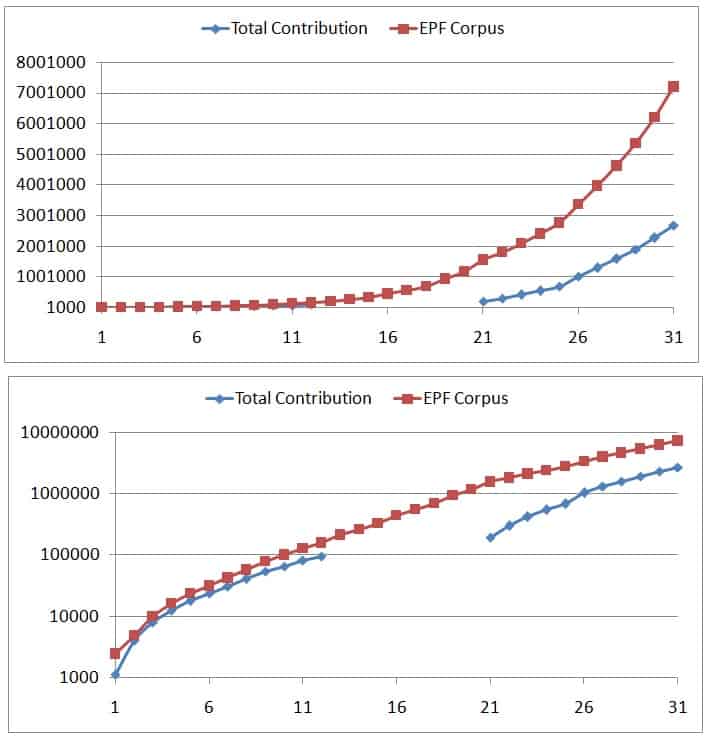
The hallmark of compounding is an explosion in growth in later years. So much that it pushes the initial year growth to the horizontal axis. The log scale is necessary to pull this up and show that the growth is always present. In fact, the interest rate in the 90s was double-digit and higher than in recent years.
What can we learn from this? As mentioned above, this has nothing to do with equity investing or mutual funds. This EPF corpus growth illustrates the importance of efficient money management more than the simple power of compounding.
In a fixed-income investment, Rs. 1 would grow at the same pace as Rs. 10. The key is to leave the corpus untouched as much as possible. This is the key to staggering growth. Naturally, additional contributions, promotions etc would have played a role but the key is to avoid withdrawals.
While a good dose of good fortune is necessary to avoid withdrawals or loans from PF, investors need to help the cause with efficient fortifications such as a robust emergency fund, large health insurance, accident insurance and life insurance.
Young earners who wish to orient their money management in the direction in 2020 can consult this free resource: Re-assemble: Step by step money management basics for beginners
Please join me in thanking the reader for sharing his PF numbers with us.