In the previous article, we discussed the basics and important considerations while planning for a five-year girl’s future. In this article, we will do the calculations with some inputs and assumptions. We shall also include the retirement planning calculation for the parents in brief.
We shall use the robo advisory tool for this illustration. We must point out that several inputs for the calculation are not available. For instance, the present investments for retirement and the child. So the calculation below should only be used as a broad guideline on how to do the calculation. None of the results should be directly used.
Inputs and assumptions
We shall show the example of a unified portfolio, That is all investments are made with a set asset allocation (equity + fixed income) in a single portfolio. Withdrawals are made as and when required. The final amount left will be the target retirement corpus. See these articles for more details.
- Financial Goal Planning with a Unified Portfolio
- How I manage my money using the unified portfolio approach
- Not this approach should only be used for combining long-term goals. Do not combine a short-term goal and a long-term goal.
- Age of husband: 35
- Age of wife: 30. The retirement planning will be done until the younger spouse turns 90.
- Age of child: 5. As mentioned in the previous article, we shall plan for a UG and PG education and her marriage.
- Current monthly expenses that will persist until retirement for the couple (this excludes expenses for the child, in-laws, EMIs etc): Rs. 50,000
- Expected age of retirement: 60
- Inflation before retirement: 7%
- Inflation after retirement: 6%
- The rate at which investments will increase each year in the unified portfolio: 10%
- Post-tax return expected from equity: 9%
- Post-tax return expected from fixed income: 5%. Remember we are looking at a two-decade and more investment journey! Do not expect returns to be as high as they are today!
- Naturally, the above return assumptions may not be acceptable for many. This is why users can vary all assumptions at will (at their risk).
- No income flooring option is used in the retirement planning (this can be turned on in the robo tool if necessary). See: How to beat inflation after retirement along with guaranteed pension.
- Corpus required for retirement: Rs. 10.7 Crores. This is assumed to be managed by bucket strategy as explained here: Retirement plan review: Am I on track to retire by 50? Details of the buckets can be found in the robo tool. A DIY bucket strategy sheet and an annuity laddering sheets are also available as stand-alone modules.
- Undergraduation:
- Goal deadline: 12 years from now
- Current cost: Rs. 20 lakhs
- inflation 10%
- Goal target: Rs. 62.7 lakhs
- This amount will be withdrawn in five equal instalments from years 8 to 12
- Postgraduation:
- Goal deadline: 16 years from now
- Current cost: Rs. 50 lakhs
- inflation 10%
- Goal target: Rs. 2.3 Crores
- This amount will be withdrawn in five equal instalments from years 12 to 16
- Marriage:
- Goal deadline: 19 years from now
- Current cost: Rs. 25 lakhs
- inflation 10%
- Goal target: Rs. 1.5 Crores
- This amount will be withdrawn in five equal instalments from years 15 to 19
- There are 25 years to retirement. So the realignment from an investment portfolio to a bucket portfolio will happen over the last 5 years of investing.
Results
- Initial monthly investment required in the unified portfolio to fund all the above goals: Rs. 87,621 (including EPF or NPS mandatory contributions).
- The monthly investment is expected to increase by 10% each year
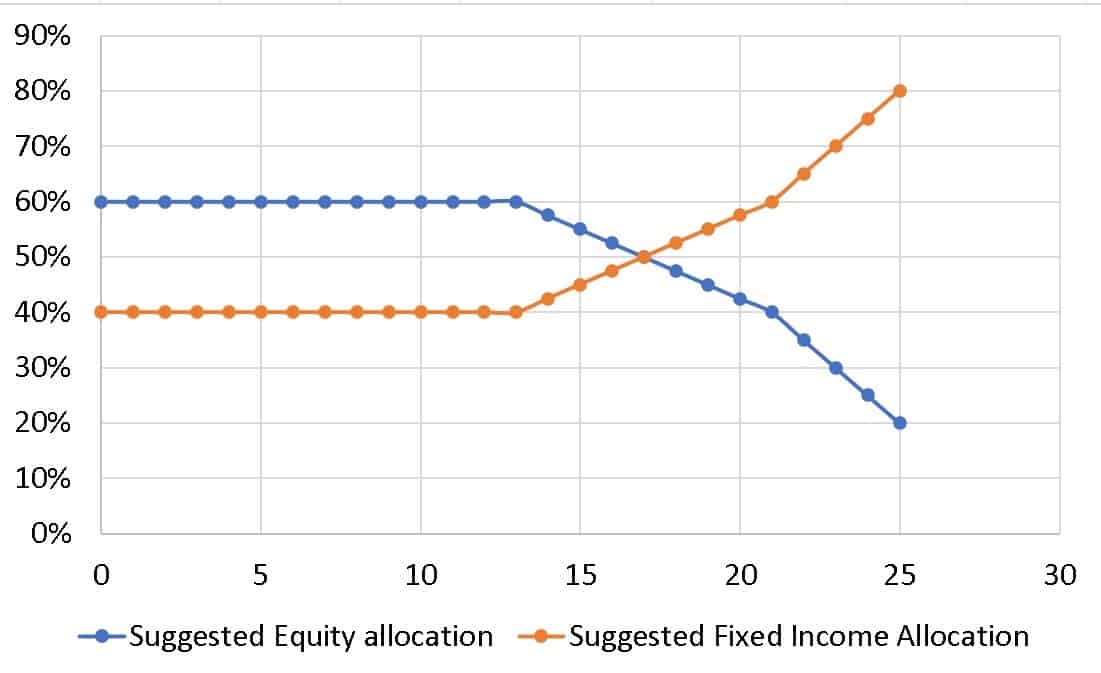
- The recommended asset allocation schedule and how the corpus grows are illustrated below.
- In addition to guidance on when and how to gradually withdraw funds for each goal, the tool also suggests how much to withdraw from equity and how to withdraw from fixed income.
The portfolio needs to be rebalanced each year to follow this auto-recommended schedule.
🔥Secure your future with our Robo-advisory tool trusted by over 3,500 investors and advisors. From effortless retirement planning to funding your children’s biggest dreams, turn your financial goals into reality. 🔥
Subscribe for money management solutions via email! (Link takes you to our email sign-up form) Join 32,000+ readers in our community.
👉 New Tool Alert! NaviPlan: A Privacy-Focused Multi-asset Tracker and Goal Planner 👈
Withdrawals will be made as per the schedule mentioned above. The net corpus decreases after each such withdrawal and grows in between.
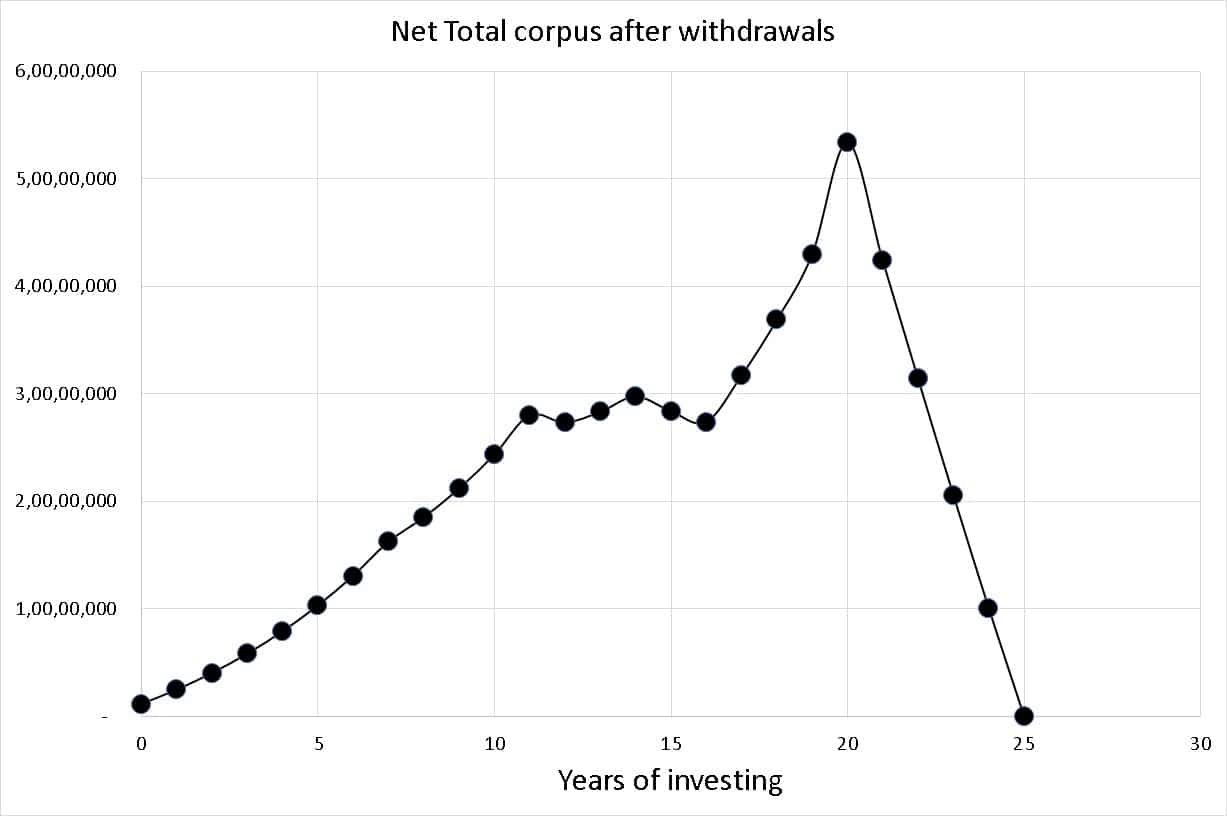
The final net corpus is zero because the last few withdrawals are for retirement. This is only a technicality (to compute the initial investment amount) and not an actual withdrawal because typically just before retirement that will be the only long term goal left. So a withdrawal is unnecessary.
The advantage of this unified portfolio method is a lower investment amount. Had the goals been treated separately the total investment will be about 28% higher (the robo tool offers both choices). In a unified portfolio method, we take into account the extra cash that will be available for investment once each of the earlier goals is reached. It is debatable whether this is a reasonable assumption or not.
Treating goals separately is, in our opinion, the better choice in terms of risk management. The unified approach can be used in cases where the user has a shortfall of funds to invest. The approach can be changed at any point in the journey.