A freefincal robo advisory user shared an interesting situation with us. Both the husband and wife were senior citizens with at least 27 years in retirement to plan for. The robo-advisory tool allows users to input three different sources of post-retirement income, each growing at a different pace.
This couple had an income source almost twice their annual expenses and could grow at 4%. Even though inflation during retirement was assumed to be 6%, this income source was more than enough to handle it. There was no need for any additional investments! Quite a rare scenario indeed.
In this case, aside from an emergency corpus recommendation does not tell the user how to invest the corpus. The quickest “fix” is to assume that the retirement income is zero (or lower than what it is). Typically, retirees with such a high post-retirement income will also have a sufficient nest egg.
Once the income is set to zero (in this case) or lower, the tool immediately provides a detailed post-retirement asset allocation and bucket strategy. For example (amount details redacted for privacy):
- Suggested Equity allocation (in all buckets combined): 17%
- Suggested Fixed income allocation (in all buckets combined): 83%
- low-risk bucket with 60 % fixed income (rest equity) expected to grow at 8%
Medium risk bucket with 50 % fixed income (rest equity) expected to grow at 9% - High-risk bucket with 0 % fixed income (rest equity) expected to grow at 10%
For most retirees, these buckets would get used up one after the other as they withdraw to combat inflation. In the present case, withdrawals will be minimal and as needed.
🔥Secure your future with our Robo-advisory tool trusted by over 3,500 investors and advisors. From effortless retirement planning to funding your children’s biggest dreams, turn your financial goals into reality. 🔥
Subscribe for money management solutions via email! (Link takes you to our email sign-up form) Join 32,000+ readers in our community.
👉 New Tool Alert! NaviPlan: A Privacy-Focused Multi-asset Tracker and Goal Planner 👈
Some might argue for a more aggressive asset allocation, but the 15% to 20% equity allocation would be right.
Thanks to the user’s experience, we have now updated the robo-advisory tool with a note on handling the above situation.
A standard retirement bucket strategy example
For typical retirement (where regular withdrawals would be necessary), here is an example of the output from the original article: How should I plan to retire in 20 years?
- Current monthly expenses that will persist in retirement Rs. 40,000
- Annual expenses that will persist in retirement Rs. 80,000
- Your age at the end of the current year: 30
- Age you wish to retire 50
- Years to retirement 20
- Total average monthly expenses (annual/12) Rs. 46,667
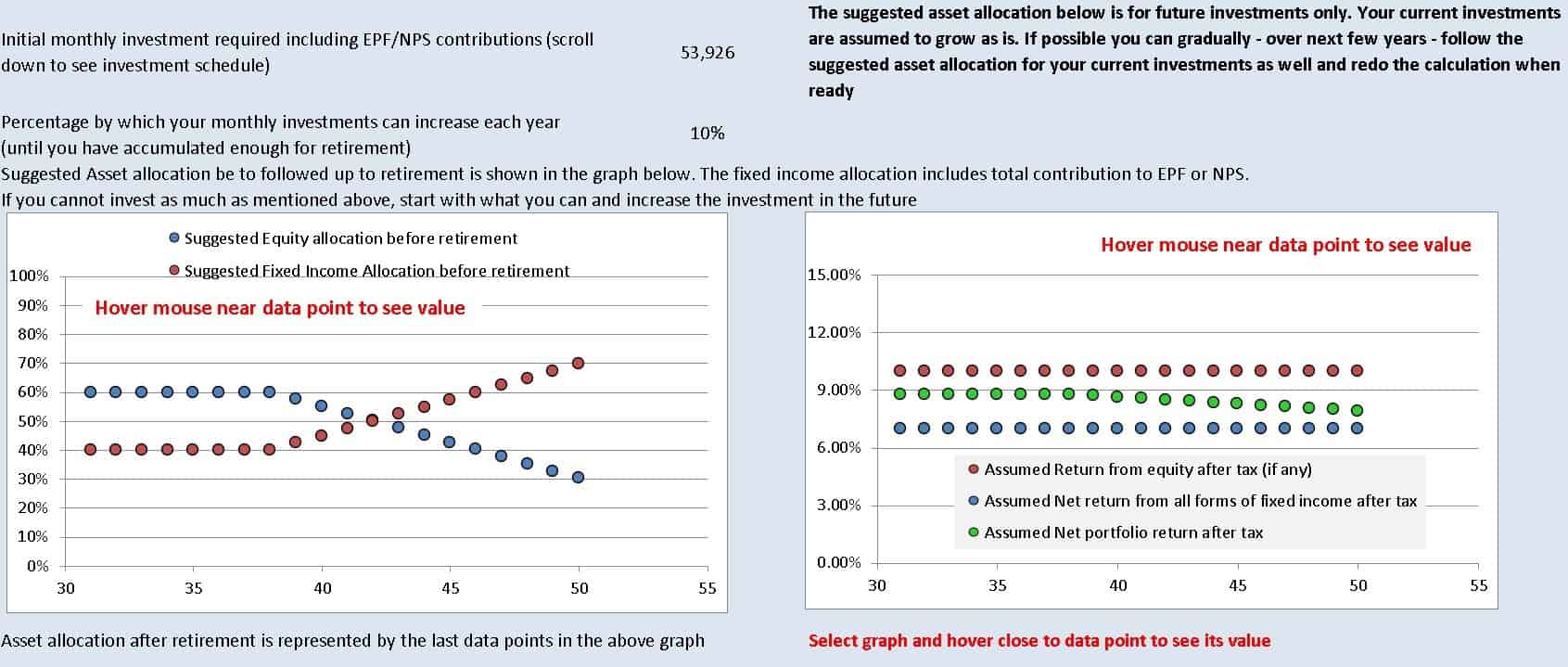
- Percentage by which your monthly investments can increase each year (until you have accumulated enough for retirement): 10%
- Post-tax return expected from equity investments % 10
- Rate of return expected from current tax-free fixed income % 7
- Value of current equity investments ( stocks and equity mutual funds) Rs. 2,00,000
- Total Value of current tax-free fixed-income investments (PPF + EPF etc.) Rs. 5,00,000
- Inflation before retirement (%) 8
- The assumed life expectancy of the younger spouse is 90
- Inflation during retirement (%) 6
- Years to retirement 20
- Monthly expenses in the first year of retirement: 2,17,511
- Years in retirement (until younger spouse reaches age 90) 42
- Retirement corpus required at retirement (assuming the money will be invested in different buckets. This is after accounting for the future value of current investments, post-retirement benefits, and any post-retirement income specified) Rs. 8,27,25,934
- Initial monthly investment required, including EPF/NPS contributions (scroll down to see investment schedule) Rs. 58,229
- The percentage by which your monthly investments can increase each year (until you have accumulated enough for retirement) is 10%.
The retirement corpus is assumed to be invested in five buckets.
- An emergency bucket to handle unexpected expenses.
- The income bucket provides guaranteed income for the first 15 years of retirement. During this time, investments are made in the following three buckets.
- Corpus from a low-risk bucket that provides retirement income from year 16 to year 26. To provide this income, the low-risk bucket will have an asset allocation of 30% equity and 70% debt during the investment period (years 1 to 15 of retirement).
- Corpus from a medium-risk bucket will provide retirement income from years 27 to 34. To provide this income, this bucket shall have an asset allocation of 50% equity and 50% debt during the investment period (year 1 to year 26)
- Corpus from a high-risk bucket will provide retirement income from years 35 to 42. To provide this income, this bucket shall have an asset allocation of 70% equity and 30% debt during the investment period (year 1 to year 34)
That is, the retirement corpus will be divided into five parts.
- 5% in an emergency bucket
- 47% in an income bucket will guarantee risk-free inflation-protected income for the first 15 years. The rest of the parts will be invested in three buckets: low-risk (26%), medium-risk (12%) and high-risk (9%) in the asset allocations indicated above. During this investment period, the buckets will be actively managed to reduce risk: rebalancing and shifting from one bucket to another. To understand how this works, try The Retirement Bucket Strategy Simulator.
- After 15 years, the low-risk bucket will be turned into 100% debt and provide income for about 11 years. After that, the other buckets will also be progressively used.