A reader says, “I have a query about investment for my child’s future. We have been blessed with a baby boy this month, and I would like to start investing for his future and marriage”.
“I plan to open a bank account (for the child) with my wife as the parent until my child becomes 18. I plan to have multiple small FDs to care for his primary and secondary education. Also, to have a PPF account for lumpsum investment”.
“For equity, I am confused about whether to go with an index fund or a flexi cap fund. My investment horizon would be around 16-18 years. I would appreciate it if you could please share your thoughts and suggestions”.
“When it comes to child education from a parent’s point of view, is it better to put the child in state board school, CBSE, or some other board?”.
Starting early and starting right is the most important step in securing a future for our child. Some would say, “take it easy and enjoy the newborn”. That is fine, but the following planning will take no more than an hour to conceive and another hour or so to execute. There is no need to postpone it any more than necessary.
🔥Secure your future with our Robo-advisory tool trusted by over 3,500 investors and advisors. From effortless retirement planning to funding your children’s biggest dreams, turn your financial goals into reality. 🔥
Subscribe for money management solutions via email! (Link takes you to our email sign-up form) Join 32,000+ readers in our community.
👉 New Tool Alert! NaviPlan: A Privacy-Focused Multi-asset Tracker and Goal Planner 👈
Before we get to the specific steps of the plan, allow us to make the following observations:
- A bank account in the child’s name is unnecessary. It serves no purpose.
- You want to use multiple FDs for primary and secondary education. While, in principle, this is fine if you have a lump sum to spare (you will have to factor in other goals to decide if you can spare this amount now), just one or two FDs will get the job done.
- We recommend starting an RD to pay the annual school fees. After all, each year’s school fee should be manageable within our salary. Else you are in trouble!
- An index fund or a flexi-cap fund for equity is relevant only after most of the following goal-planning steps are in place, but the answer is simple: Buy a Nifty or Sensex Index fund and be at peace without having to worry about fund performance.
The goal-planning steps
- We need a target corpus after 16 years (or 17/18 years, depending on when he was born). That is after school graduation.
- When we refer to the child’s future here, it will only refer to the UG fee, PG fee, relocation expenses and marriage expenses if the parents see fit.
- Let us first set the target corpus = UG fee. The corpus can easily be enhanced to include other expenses. A UG fee of Rs. 1.5 lakh per semester x eight semesters + a joining fee of Rs. 5 lakhs + another Rs. 5 lakhs for relocation, travel etc., sounds right. You can make enquiries and set a target too.
- So that is about Rs. 22 lakhs. Make that Rs. 25 lakhs as the current cost. That is, if your child were to enter a four-year UG program today, that is what it would cost approximately.
- What is the likely cost for your child after 16/17/18 years, as the case would be when we start planning?
- We will use inflation of 10%-12%.
- At 10% inflation, the corpus will be about Rs. 1.25 crores after 17 years.
- Suppose the parents can invest Rs. X each month for this goal. About 50-60% of X should be invested in stocks or equity mutual funds, assuming a post-tax return of 10% from equity.
- The remaining amount can be invested in debt instruments with a return of about 6%. Remember, this is not the return you will get next year. This is the return you expect after 17 years.
- But which debt instruments? We recommend PPF and debt funds.
- The debt funds depending on your comfort level with the bond market. In terms of increasing NAV volatility, our recommendations are Money market funds < Edelweiss Short Duration Index Fund <= Corporate Bond Funds <=Parag Parikh Conservative Hybrid Fund <= Gilt Funds.
- The above-mentioned future target corpus is only for UG education. If you wish to include her PG education expenses, marriage expenses etc., please modify them as required.
- What is more important is asset allocation after we start investing. We cannot hold on to 50% or 60% for most of the journey. A string of poor returns will upset our plans. Entering the above details into our robo advisory tool, we get: 60% equity for 7-8 years and then a gradual tapering down to 0% for the rest of the journey. Many goal calculators input a single future return expectation to compute the monthly investment required. This is incorrect, as the asset allocation will vary.
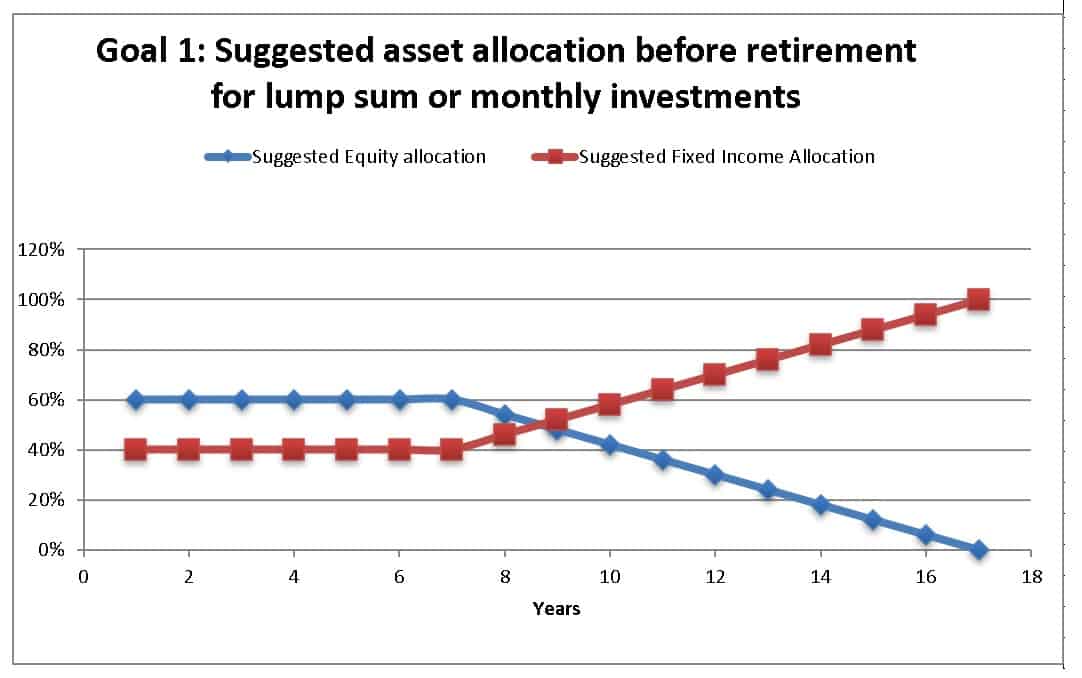
Suggested asset allocation by the freefincal robo advisory template for a child’s college education 17 years away. - With this variable asset allocation, the total monthly investment required in the first year of investing is Rs. 15,500. Each year after this, the investment should be increased by 10%.
- Do not rush to invest Rs. 1.5L a year in PPF just because it is tax-free with a guaranteed return. In the above plan, the total investment in debt will only be Rs. 74 K. Until the equity allocation starts decreasing, as mentioned above, the debt investment will not exceed Rs. 1.5 L a year. After this, a debt mutual fund may be added to accommodate the higher debt investment.
- The above calculation should be repeated each year with updated inputs and assumptions.
All the best!
For other illustrations, see:
- I am 30 and wish to retire by 50; how should I plan my investments?
- Retirement plan review: Am I on track to retire by 50?