Last Updated on August 22, 2022 at 11:18 pm
Many investors appear confused between investing in gold and buying gold. Here is a discussion on when to invest in gold and when to buy it.
Everything starts with the need. If we can clearly state our requirement, the solution often presents itself. Here is an example how to clearly define a goal: Financial Goal Planning: How to buy an Audi Car.
Let us consider common requirements and uses of gold.
I need to accumulate gold for my child’s marriage
The traditional way of accumulating gold is to actually accumulate it! Using gold saving schemes offered by jewellers, mothers often purchased gold from time to time. This is a fantastic way of doing things and I can see nothing wrong with it. The intended purpose is consumption and one starts ‘consuming’ periodically.
🔥Secure your future with our Robo-advisory tool trusted by over 3,500 investors and advisors. From effortless retirement planning to funding your children’s biggest dreams, turn your financial goals into reality. 🔥
Subscribe for money management solutions via email! (Link takes you to our email sign-up form) Join 32,000+ readers in our community.
👉 New Tool Alert! NaviPlan: A Privacy-Focused Multi-asset Tracker and Goal Planner 👈
The alternative is to accumulate money and buy the required gold at a later time in one shot. There are two ways to go about it.
1) Today we have ways to track the price of 24 carat gold. Via gold etfs, gold funds and sovereign gold bonds. Investing in these offers a way to hold an amount equivalent to weight of gold.
2) Depending on the duration, we can choose a mixture of equity and fixed income for generating the corpus.
Personally I see no benefit in choosing instruments that track gold price if the aim is to eventually buy gold jewellary.
If I have a 2 year old daugher and wanted to plan for her marriage, I would either adopt the traditional way mention above or invest in a portfolio of say 60% equity and 40% fixed income. Tracking the price of a commodity which has not not delievered real returns over ‘the long term” is not an enticing prospect for me. I would rather own it and enjoy it without worrying about returns since that is ultimate motive anyway.
Read more: Smart ways to accumulate gold for a marriage
I need a hedge against inflation
Gold is supposed to be a hedge against inflation. If the pertol price increases by Rs. 5 or if the exchange rate increases by Rs. 10, holding physical gold or gold (price) investments will not help much.
When the economy collapses and a loaf of bread costs Rs. 10,000, I would need physical gold -not bonds or etf.
Gold is a necessary hedge against hyperfinflation – as seen in Germany (after WW1), Zimbabwe (a few years ago) and Venezuela (right now). When the local currency becomes worthless, gold becomes the currency.
If and when such a thing happens, I would need oodles of gold for everyday life.
Is it prudent to drop all my other investment and focus on buying enough gold in fear of possible hyperinflation?
I am a pessimist, but not pessimistic enough to be paranoid.
There are many who claim that one should have 10-15% of gold exposure in a portfolio. If this amount is in etfs/bonds they may not aid if hyperfinflation strikes. And in such an event one would need a lot more than 10-15% of physical gold.
I need a hedge against volatility
Gold is considered to be a “safe haven” when there is fear. Fear of an impending crash or fear after a crash. So during these events, gold price surges. This can be efficiently used to reduce portfolio volatility.
Not by holding physical gold, but by holding a freely tradable instrument that tracks gold price and by rebalancing among equity, fixed income and gold periodically. As of now, ETFs is a simple way to accomplish this.
Take the case of funds like Axis Triple Advantage, Canda Indigo, Quantum Multi-Asset etc. They approximately hold 25-30% of gold ETFs at all times.
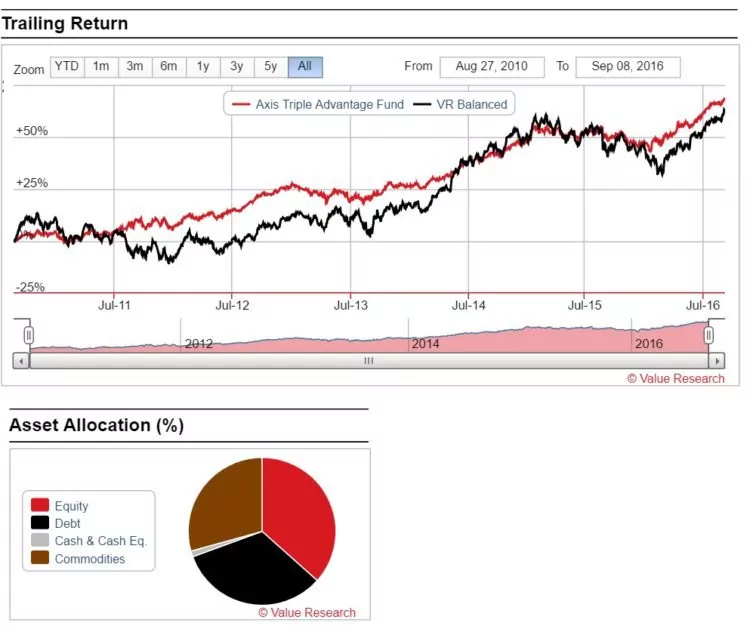
Notice how the Axis Triple Advantage fund is much less volatile than the VR balanced index. This is because of high gold exposure and periodic rebalancing.
Lower volatility almost always means lower returns: Over 5 years, the VR balanced index has given ~ 11% return while the axis fund ~ 9%.
So increasing gold exposure in the portfolio reduces volatility and also returns. If the exposure was only 10-15% as many experts recommend, it will neither impact volatility or returns as much.
Therefore, in my opinion, might as well not have any gold in an investment portfolio. Gold jewellery is naturally excluded.
Read more:
Gold Price Movement: USD vs INR
Should gold be part of your long-term investment portfolio?
Charts: Equity vs. Gold. Vs. Debt