Last Updated on December 18, 2021 at 10:38 pm
The expense ratio of direct mutual fund plans is a subject of debate among those who do not benefit from it. In this post, Balaji Swaminathan digs deep into the annual reports from three AMCs to understand how the expense ratios compare and whether the absence of commission is the only reason for the lower expense ratio in direct plans.
This is a significant improvement over the previously published Understanding the Total Expense Ratio of a Mutual Fund using the annual report of FT Smaller Companies fund. Before we look at that fund again, let us consider a simple case.
HDFC Top 200 Expense Ratio Analysis
First, Balaji compiled the quarterly AUM (qAUM) averages for direct and regular plans from AMFI. He then used the average of the quarterly data to compute the expense ratio as a percentage of this average AUM.
This had to be done as the exact average AUM used in the annual report for regular and direct plans are not known.
🔥Secure your future with our Robo-advisory tool trusted by over 3,500 investors and advisors. From effortless retirement planning to funding your children’s biggest dreams, turn your financial goals into reality. 🔥
Subscribe for money management solutions via email! (Link takes you to our email sign-up form) Join 32,000+ readers in our community.
👉 New Tool Alert! NaviPlan: A Privacy-Focused Multi-asset Tracker and Goal Planner 👈
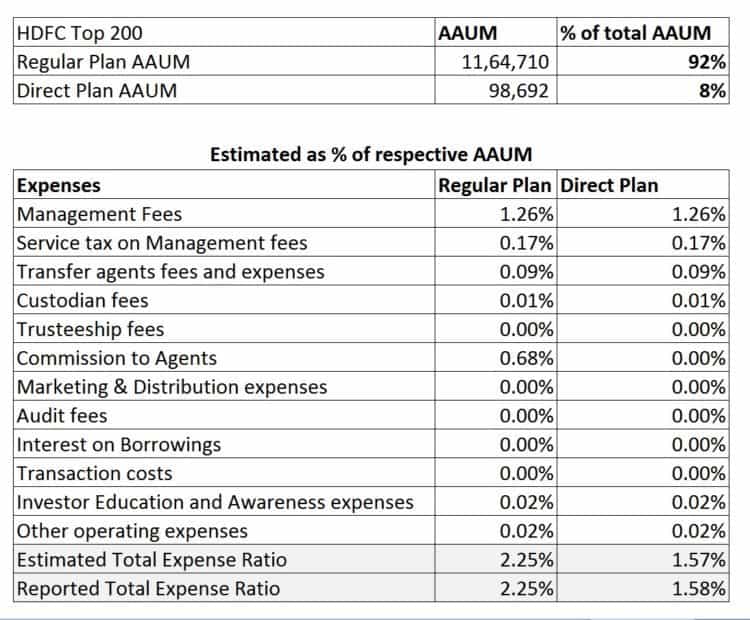
Notice that there is practically no discrepancy between the estimated and reported expense ratio. The amount of management fee charged is the same for direct and regular plans.
PPFAS Long Term Value Fund Expense Ratio Analysis
PPFAS is the second direct to investor mutual fund after quantum despite having a regular option! That could have been guessed from how eager they are to interact ‘directly’ with investors!
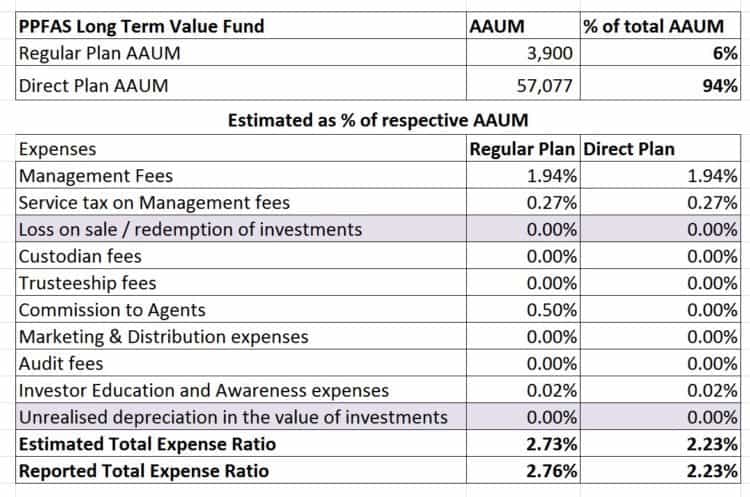
The trouble here is the presence of the two greyed entries. We have not seen that in any other annual report. Using that skews the expense ratio estimated significantly. So until there is more clarity on this, they have not been included in the total expense ratio.
If that is acceptable, there is no discrepancy between the estimate the value reported in the annual report. The management fees are also the same.
Franklin India Smaller Companies Fund Expense Ratio Analysis
This was considered in the above-mentioned post but not explored further. If we repeat the above calculation where the management fee is the same for regular and direct plans, there is a huge discrepancy in the direct plan expense ratio.
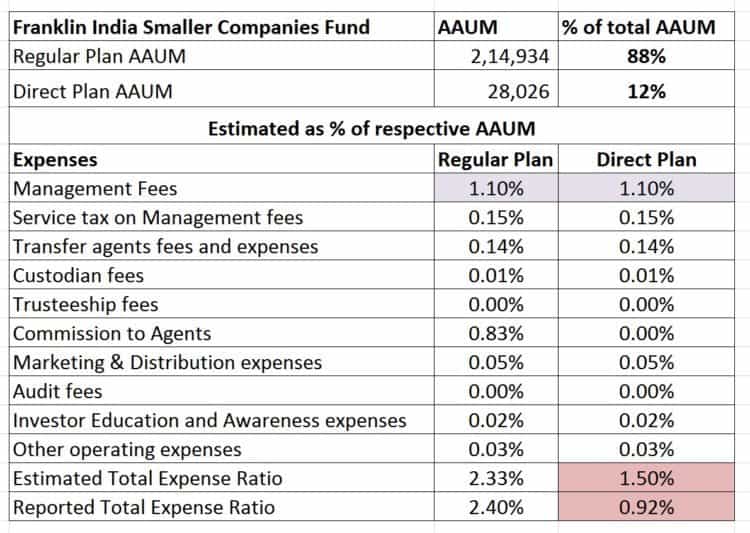
However, Franklin has clearly mentioned in the annual report that the management fee as a percentage of AAUm is
1.33% of Regular plan AAUM and
0.7% of Direct plan AAuM.
There is a huge difference between how regular fund investors and direct fund investors are charges. Yet another reason to get rid of regular plans. Well at least, for this (and such) fund(s)!!
If the calculation is repeated after taking into account this difference, the estimate is reasonable.
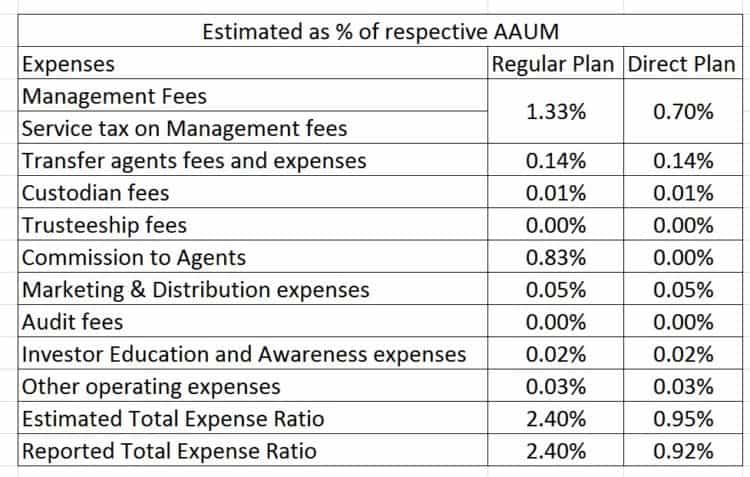
Why does Franklin provide such differential treatment? As a direct investor, I am happy to enjoy the huge difference between regular and direct plans returns in this fund, without bothering about why. I think regular plan investors should question Franklin about it.
I think regular plan investors should question Franklin about it.
There is a view among the distributor community that regular plans “subsidise” direct plans. Clearly not for all funds and not in all AMCs as the above analysis shows.
Is this difference a really a subsidy or is it used for any other means in regular plans? Would great if someone from Franklin Templeton can clarify.
Please join me in thanking Balaji Swaminathan for this fantastic analysis of direct plan vs regular plan expense ratios.